
What Is Local SEO? The 2026 Guide for Small Businesses
Local SEO is the work of getting your business to show up when someone nearby searches for what you sell, in the Google map results, in the Maps app, and in the AI answer that now sits at the top of many results pages. It is search engine optimization narrowed to a place: your city, your neighborhood, the few miles a customer will actually travel.
You've probably been told you need it. This guide explains what local SEO actually is, why it matters more for a small business in 2026 than it did a year ago, and which moves are worth making first. No jargon without a plain-language gloss, and no promise that a tool can buy you a ranking, because none can.
In this guide:
- What local SEO actually is
- Local SEO vs SEO: what actually changes
- Why local SEO matters in 2026
- How Google decides local rankings
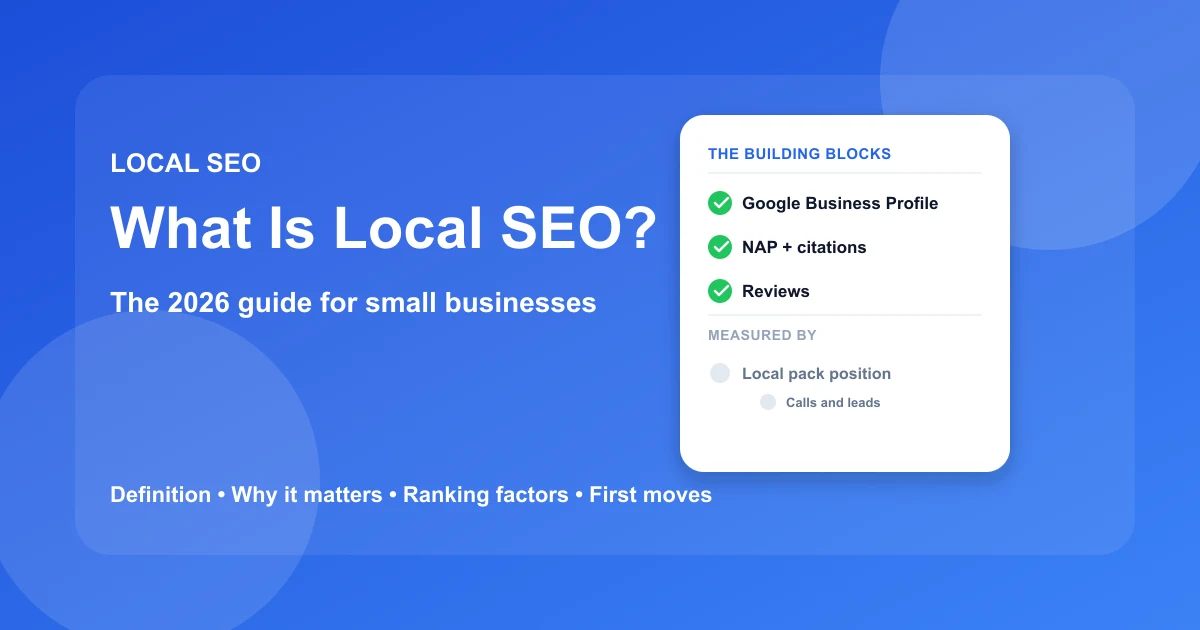
- The building blocks of local SEO
- How to start doing local SEO
- How to tell whether local SEO is working
This picture comes from patterns we see across hundreds of real audits from the GBP SEO Tools team. Before you dig in, take stock of where your own profile already stands, then come back to whichever section below matches your biggest gap.
What Local SEO Actually Is
At its core, local SEO is about matching your business to searches that have a place attached to them. Someone types "emergency plumber" or "coffee near me," and Google tries to return businesses that are relevant, close, and trusted enough to recommend.
The plain-language definition
Local SEO is the set of things you do so that a nearby person searching for your product or service finds your business instead of a competitor. Some people call it local search optimization, but it means the same thing: claiming and filling out your Google Business Profile, keeping your name, address, and phone number identical everywhere they appear online, earning reviews, and making sure your website tells Google clearly what you do and where you do it.
The goal isn't traffic from across the country. It's the handful of people in your service area who are ready to call, visit, or book today.
Where local results show up
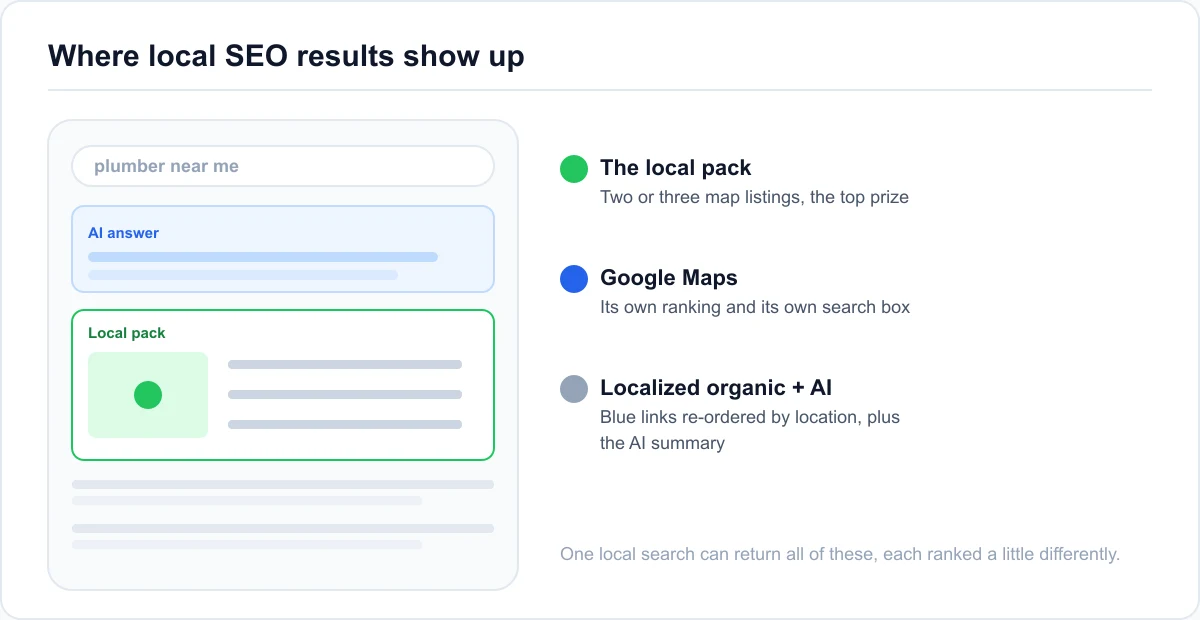
There are three surfaces you're trying to win, and they behave differently:
- The local pack. The block of two or three business listings with a small map, usually near the top of the page. This is the highest-value spot for most local businesses.
- Google Maps. The Maps app and the maps.google.com site run their own ranking and their own search box. People deep in buying mode often skip the main results page entirely.
- Localized organic results and AI answers. The regular blue links get re-ordered by location too, and the AI summary at the top of the page now pulls business details, hours, and review sentiment straight from Google Business Profiles.
Local SEO vs SEO: What Actually Changes
Local SEO and regular SEO share a foundation, then split on two points that change how you work day to day.
What stays the same
Both are about matching a page or a listing to what someone searched, and both reward clear content, a fast site, and links from places Google trusts. If you already understand page titles, site speed, and helpful content, that knowledge carries straight over. A national blog wants to rank for "best running shoes" whether the reader is in Denver or Miami, and the on-page craft behind that is the same craft local search uses.
What local SEO adds
Two differences set local SEO apart. First, distance is a ranking factor in local search and it isn't in national search, so where the searcher stands changes the result. Second, local SEO leans on assets that national SEO barely touches: your Google Business Profile, your map listing, your reviews, and citations on directories. Your website still matters, but it shares the stage.
Why Local SEO Matters in 2026
Local search is where a large share of buying decisions now start, and the businesses that show up in the right spot take work away from the ones that don't.
How much search is actually local
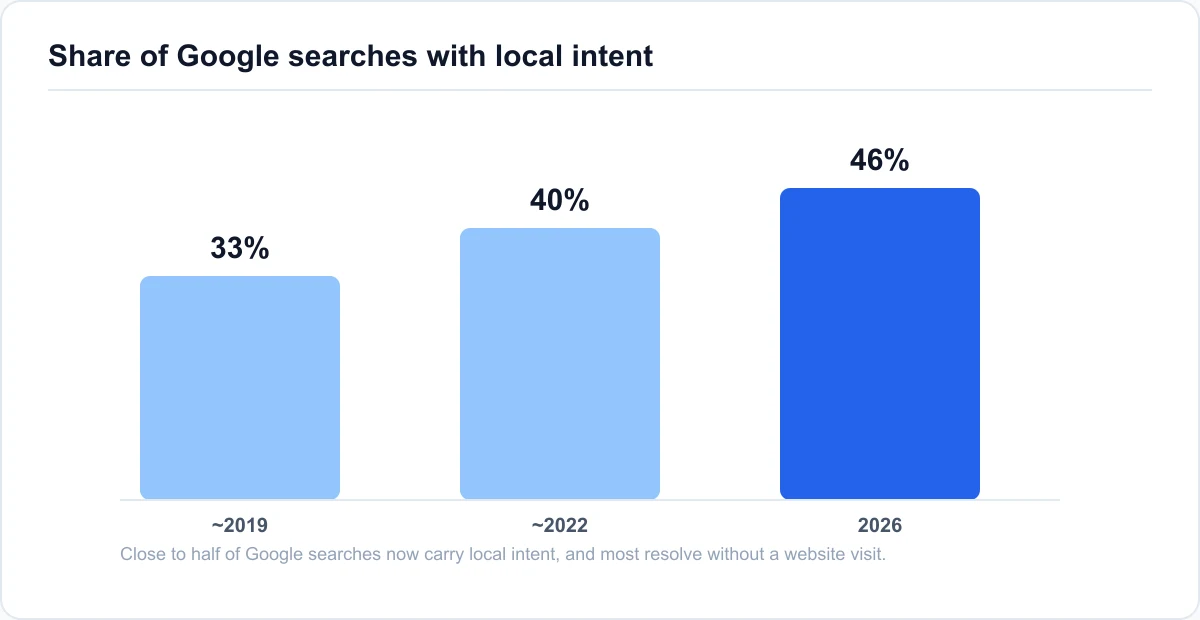
Close to half of all Google searches have local intent, a figure that has climbed from roughly a third a few years ago as phones became the default way people look things up. Searches that include "near me" run into the hundreds of millions a month in the United States alone, and about three quarters of the people who run one on a phone visit a related business within a day.
If you sell to people in a specific area, that's your demand. It's already there, several times a week per customer, and it goes somewhere whether or not it goes to you.
The local pack takes the clicks
Ranking in the local pack matters out of proportion to its size. Businesses in the top three map results pull well over double the traffic of businesses ranked just below them. The drop from position three to position four is steep.
At the same time, more than half of local searches now end with no click to any website at all. The searcher gets the phone number, the hours, or the directions right on the results page and acts on it. That's not lost business. It's business that goes to whoever occupies the listing, which is another reason the profile itself, not just the website, is the thing to optimize.
Low cost, and it compounds
Local SEO is one of the cheaper marketing channels a small business can run, because the core asset is free. Claiming your profile, choosing the right category, adding photos, and replying to reviews costs time, not ad spend. Stop paying for ads and the leads stop the same day. A profile that has earned steady reviews and consistent citations keeps working while you run the business.
Consider a two-location dental practice that spent a quarter fixing its primary categories, cleaning up address inconsistencies across a dozen directories, and asking every satisfied patient for a review. By the third month, both listings were showing in the local pack for "dentist" plus their neighborhood names, and new-patient calls from search had roughly doubled with no increase in ad budget. The work didn't vanish when they stopped actively touching it, though it did need light monthly upkeep to hold.
How Google Decides Local Rankings
You can't optimize for a system you don't understand, so it helps to know the shape of what Google is measuring.
Relevance, distance, and prominence
Google's own local ranking guidance comes down to three factors. Relevance is how well your profile matches what someone searched. Distance is how close your business is to the searcher or the area they searched. Prominence is how well known and trusted your business appears to be, based on reviews, links, and your wider presence on the web.
You can't move your building, so distance is mostly fixed. Relevance and prominence are where the work lives, and nearly every tactic in this guide maps back to one of the two.
The 2026 signal weights
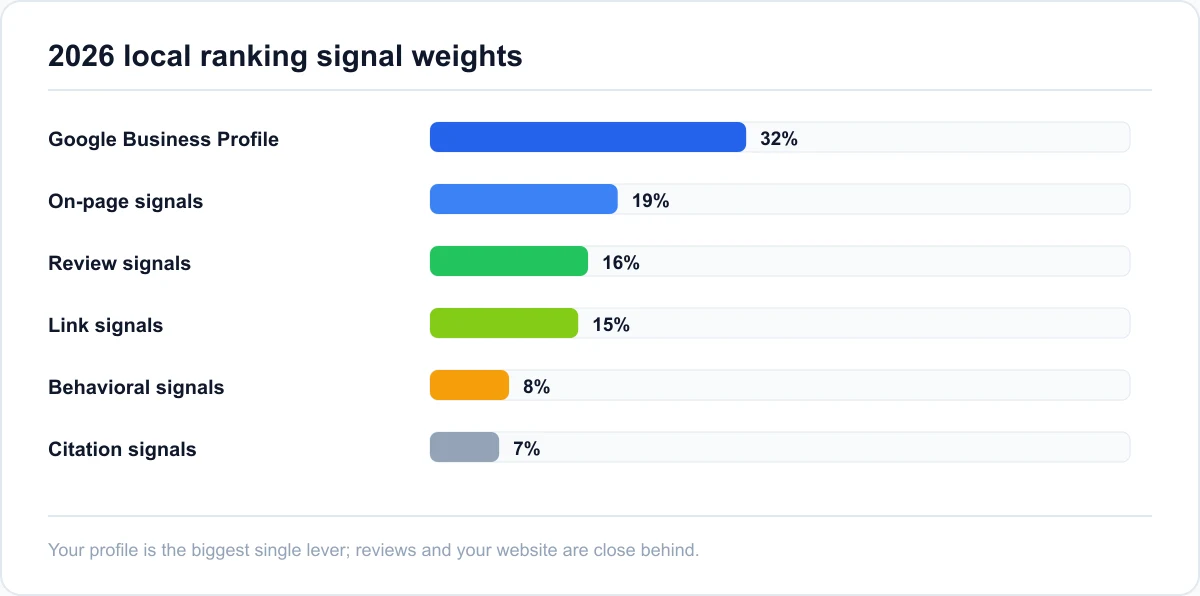
Industry analyses of local ranking in 2026 put rough weights on the signal groups: Google Business Profile signals around 32%, review signals around 20%, on-page signals around 15%, behavioral signals around 9%, link signals around 8%, citation signals around 7%, and personalization and social signals around 5% and 4%.
The practical read is that your profile is the single biggest lever, reviews and your website are close behind, and citations, while still worth getting right, are no longer the centerpiece they were treated as a decade ago. For the full picture, including how each group breaks down, see our guide to local ranking factors.
What changed in 2026
Three shifts changed what to prioritize this year:
- Freshness is now a direct ranking signal. Recent posts, new photos, and prompt review replies feed local pack position directly. A profile that was completed perfectly two years ago and left alone since is no longer treated as optimized.
- AI answers pull from your profile. The summary at the top of many local results is built from Business Profile data and review text, so accurate hours, categories, and services now shape whether you're quoted there.
- Visual search became a ranking input. Photo quality and coverage moved from a nice-to-have to something Google weighs.
None of this changes the fundamentals. It changes the order you work in, and it raises the cost of letting a listing sit untouched all year.
The Building Blocks of Local SEO
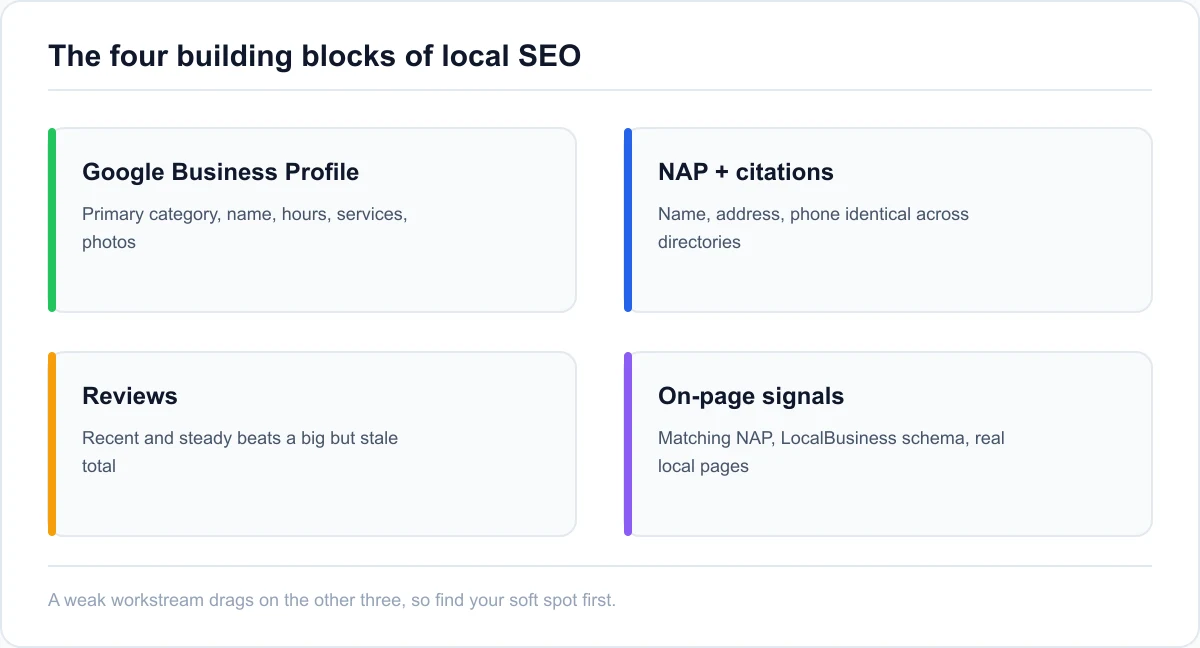
Local SEO is really four workstreams. You don't have to finish them in order, but a weak one holds back the rest.
Your Google Business Profile
This is the listing that powers the local pack and Maps. The fields that move ranking most are the primary category, the business name exactly as it appears on your signage, the service area or address, hours, services, and photos. Completeness matters, but precision matters more. A category that's one level too broad is a common reason a fully filled-out profile still doesn't rank.
If you're not sure where yours stands, run a structured check of the name, categories, contact details, reviews, and photos before you start changing things.
NAP consistency and citations
NAP stands for name, address, and phone number. A citation is any place online that lists those details: directories like Yelp and Bing Places, chamber of commerce pages, industry listings. Google cross-checks these against your profile, and mismatches, an old suite number here, a former phone number there, chip away at trust.
The job isn't to be listed in hundreds of places. It's to be listed identically in the ten or twenty that matter for your industry and city.
Reviews and reputation
Reviews feed the prominence factor, and in 2026 recency and steady flow matter more than the raw total. Ten reviews over the last three months often does more than fifty reviews that all landed two years ago. Replying to reviews, both the good and the difficult ones, feeds the freshness signal and shows Google the profile is actively managed.
One policy note: as of 2026 you can't solicit reviews that name a specific staff member, and review kiosks and gating stations are against the rules. Ask broadly, make it easy, and don't filter by expected rating.
On-page signals and local landing pages
Your website still carries about a fifth of the weight. The pieces that matter locally are your name, address, and phone number in the site footer matching your profile exactly, LocalBusiness schema markup, page titles that name what you do and where, and a genuine page for each location or service area rather than one thin page listing twenty towns.
How to Start Doing Local SEO
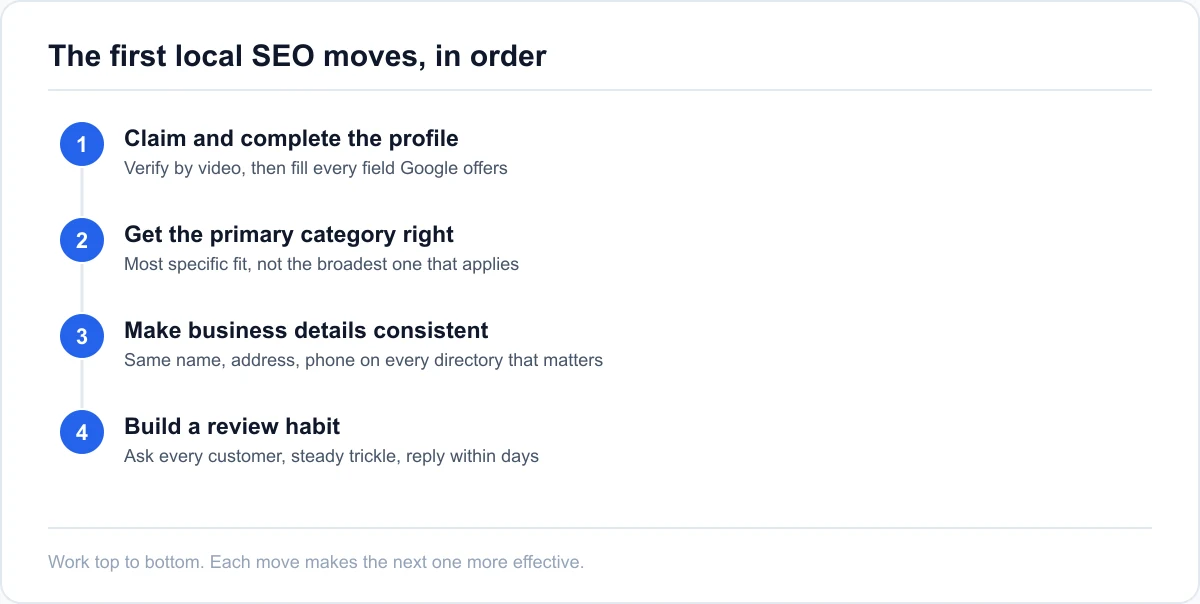
If you're starting from close to zero, these four moves deliver the most for the least effort, roughly in order. When you're ready to put them on a calendar, our local SEO plan for small businesses turns them into one setup day and two hours a week.
Claim and complete the profile
Search your business name on Google and claim the listing if it exists, or create it if it doesn't. New listings in most regions now go through video verification: one continuous recording that shows your signage, your interior, and you performing a real management action. Once verified, fill every field that applies. Leave nothing blank that Google offers.
Get the primary category right
Pick the most specific category that describes your core business, not the broadest one that technically fits. A shop that repairs phones should be "Mobile phone repair shop," not "Electronics store." Add secondary categories for genuine secondary services only. This one field carries more relevance weight than any other, so it's worth getting a second opinion on.
Make your business details consistent everywhere
Write your name, address, and phone number down in the exact format you want them, then work through the directories that matter for your industry and fix every listing to match. Old addresses and disconnected phone numbers are the usual culprits. It's tedious, and it's also one of the highest-return hours you'll spend.
Build a review habit
Set up a simple, repeatable way to ask every customer for a review at the moment they're happiest, by text or email with a direct link. A slow, steady trickle beats a one-time push. Reply to each one within a few days.
How to Tell Whether Local SEO Is Working
Local metrics are noisy, and a single number hides more than it shows. Watch a few things over weeks, not days.
Local pack position, checked from more than one point
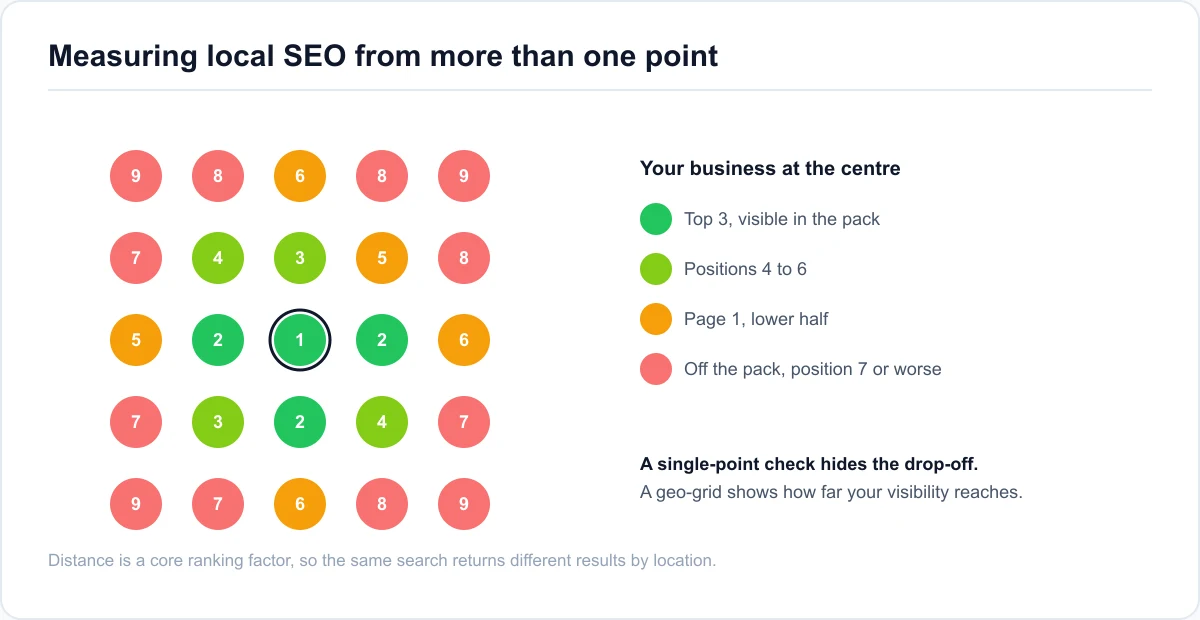
Your ranking isn't one figure. Because distance is a core factor, the same search returns different results depending on where it runs from. A listing can sit in the local pack at its own address and fall out of it a mile away.
Check your main keywords from several points around your service area, or use a geo-grid rank tracker that scans a grid of points at once, so you can see where your visibility holds and where it fades. Checking only from your office overstates how well you're doing.
Profile actions, calls, and direction requests
The performance view in your Business Profile dashboard shows how people found you and what they did next: calls, direction requests, website clicks, and which searches brought them in. These move sooner than ranking does and they tell you whether a relevance change is landing. Track them monthly.
Leads and revenue, not just rankings
Rankings and profile views are means, not ends. Tie the effort back to booked jobs, new patients, or covers served. A modest ranking gain that brings ten qualified calls a month beats a big gain for a phrase nobody in your area actually searches.
Picture a mid-size-city plumbing company that watched a rank-tracking dashboard for months while call volume stayed flat. When they finally checked the phrases they were winning, they were terms like "plumbing history" and "how a water heater works," informational searches with no buyer behind them. Shifting the focus to "water heater repair" plus their city names turned a quieter dashboard into a busier phone.
Conclusion
Local SEO is search optimization narrowed to a place: getting your business in front of the nearby people who are ready to act. In 2026 that means a precise, actively maintained Google Business Profile first, then reviews and a clear local website, with citations kept tidy underneath.
If you take four things from this guide, make them these. Your profile is the biggest single lever. Freshness now counts as a ranking signal, so the work is a habit, not a one-time setup. The primary category is the field most worth getting right. And measure from more than one point, against leads rather than vanity rankings, so you know whether any of it worked.
The fastest way to know where to begin is to see how your listing looks against these checks right now. Run the audit for a prioritized list of what's holding your profile back, with the specific fixes to make first.
What Is Local SEO? Common Questions
What is local SEO in simple terms?
It's the work of getting your business to show up when a nearby person searches for what you offer. That means claiming and completing your Google Business Profile, keeping your business details consistent across the web, earning reviews, and making your website state clearly what you do and where. The payoff is visibility in the map results and Maps for people in your service area.
What is the difference between local SEO and SEO?
Regular SEO competes for a keyword everywhere at once. Local SEO competes for it in one area, and results shift based on where the searcher is. Local SEO also depends on assets that general SEO barely uses: your Google Business Profile, your map listing, reviews, and directory citations. Distance is a ranking factor locally and isn't one nationally.
How long does local SEO take to work?
Profile edits like a category fix are picked up within a few hours to a couple of days. Ranking movement usually takes two to six weeks, because it depends on reviews accumulating and Google recrawling and re-scoring the listing. Fixing citation inconsistencies across many directories can take a month or more to fully register.
Do I need local SEO if I don't have a storefront?
Yes. A service-area business hides its street address and sets the areas it serves instead. Everything else still applies: primary category, reviews, posts, photos, a local website. Keep the service area realistic, since an oversized one weakens the distance signal rather than extending your reach.
How much does local SEO cost?
The core work is free. Every change to your Google Business Profile is made in your own dashboard at no charge, and consistent citations and review requests cost time rather than money. Paid tools speed up diagnosis, for example checking your category against real search behavior or tracking rank from several points, but Google never charges for a better position and no tool can buy one.
Can I do local SEO myself?
For a single location, yes. Claiming the profile, setting the right category, fixing your business details across directories, and building a review habit are all owner-level tasks. Businesses usually bring in help when they run many locations, compete in a crowded city, or are recovering from a suspension, where the work gets repetitive or technical.
Is local SEO still worth it now that AI answers the question?
More so, not less. The AI summary at the top of local results is built from Google Business Profile data and review text, so an accurate, active profile is how you get represented there. The searcher still has to choose a business to call or visit, and that choice is still driven by proximity, reviews, and how complete your listing looks.