
Ask Maps: Why Google's AI Skips the Top 3 (and How to Get Picked)
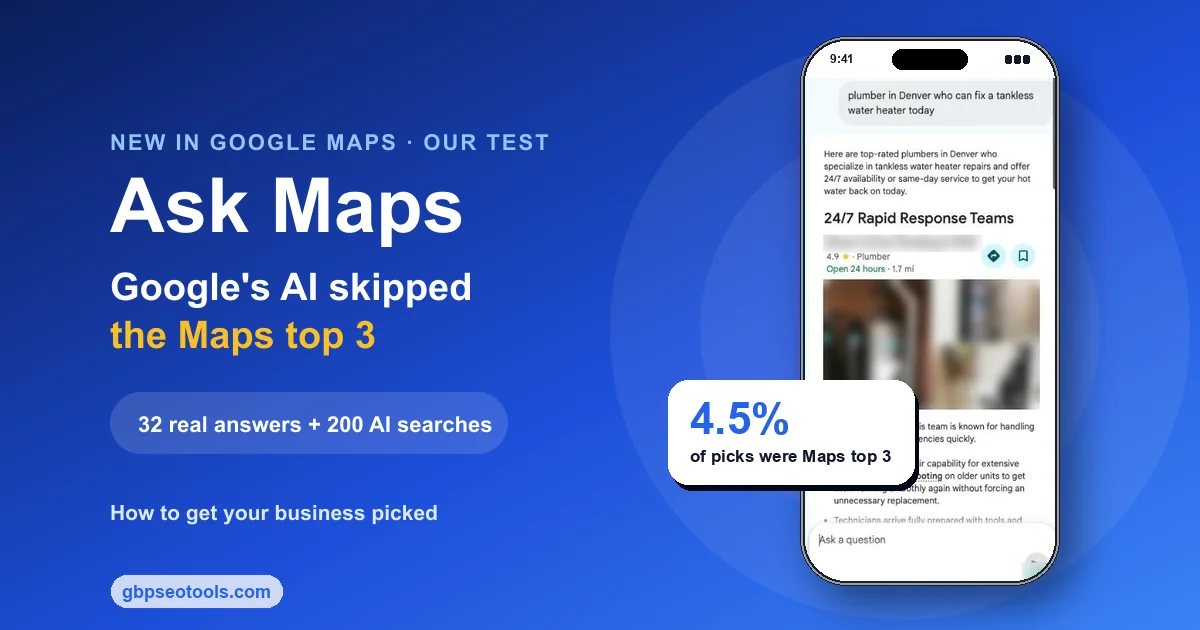
Ask Maps, the Gemini assistant inside Google Maps, rarely recommends the businesses that rank in the Maps top three: in 20 real questions we asked it in Denver and Austin, only 5 of the 110 businesses it named were in the top three for the main keyword. It picks from a wider pool, and it builds each answer from what your reviews and profile say.
That matters because people now ask Maps full questions instead of typing "plumber near me." Someone with a broken tankless water heater types exactly that, and Gemini writes back a short list with reasons.
So we tested it. We asked Ask Maps 32 questions on desktop Google Maps, compared every answer with the regular Maps results, and ran 200 more searches through Google's AI Mode to see whether the pattern held at scale. Below is what came back, why the same question gets different answers, and what makes a business the one Gemini names.
It works the same whether you run one location or manage profiles for clients.
In this guide:
- The short version
- The top 3 rarely make the answer
- The answer changes every time
- What Gemini reads
- How to get picked
- Common questions
- Run the 10-minute test
The short version: rank and recommendation have split
Ask Maps puts Google Maps Gemini in front of every searcher, answering inside the map itself. For years, being in the local pack (the three businesses Google shows on the map at the top of a search) was the whole game. Ask Maps adds a second shortlist, written by AI, and it overlaps with the first far less than you'd expect.
What we tested
Ask Maps launched on March 12, 2026, on Android and iOS in the US and India, and Google's Ask Maps announcement said desktop was coming soon. On October 19, 2026, it was live on desktop Google Maps, behind an "Ask Maps" button next to the category chips. That's where we ran our tests.
We picked 10 services (plumber, dentist, HVAC company, roofer, auto repair, hair salon, electrician, vet, personal injury lawyer, pest control) and asked each one as a real customer would, with a specific need: "plumber in Denver who can fix a tankless water heater today," "vet in Austin open on Sunday." That's 20 questions across two cities, plus three of them repeated five times each.
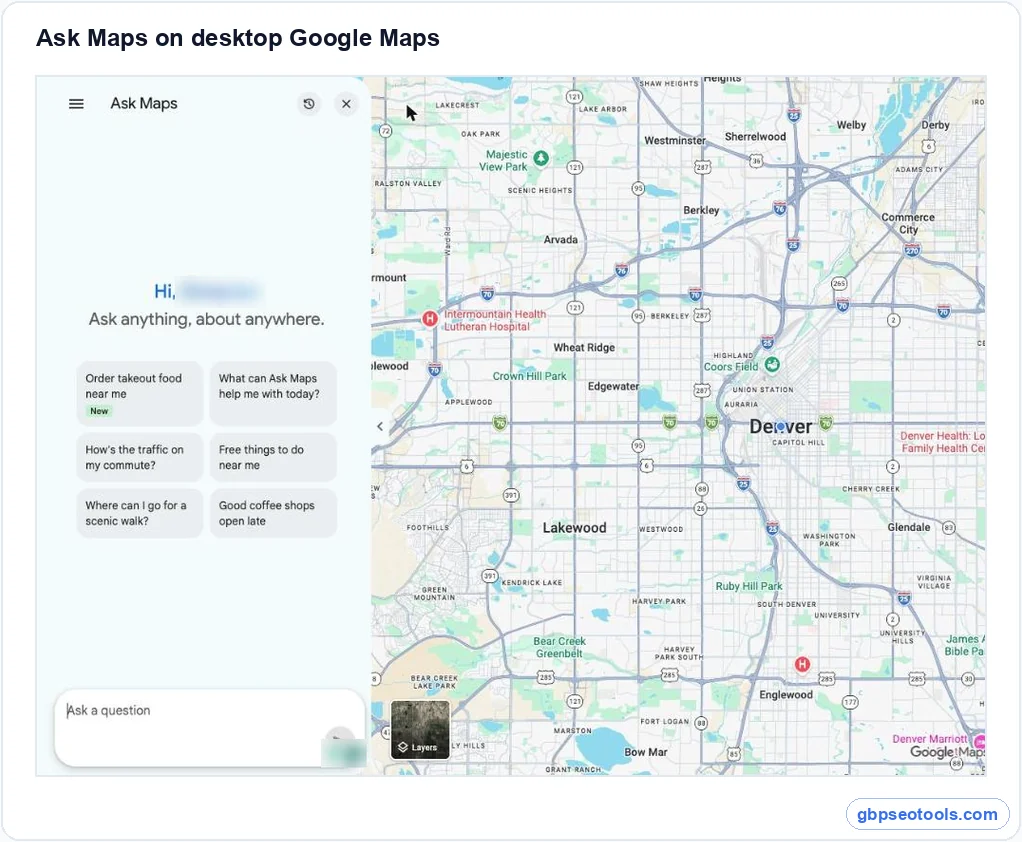
For each question we pulled the Google Maps results for the same search and for the plain keyword a business usually tracks ("plumber in Denver"), with sponsored listings removed. Then we ran the same 10 services in 10 US cities through Google's AI Mode, twice each (plain and specific), for 200 more answers.
Five numbers that sum it up
| What we measured | Result |
|---|---|
| Businesses Ask Maps named (20 questions) | 110, about 5 per answer |
| Of those, in the Maps top 3 for the main keyword | 5 (4.5%) |
| Not in the top 20 for either search | 39% |
| Write-ups that quote reviews or customers | 68% |
| Picks rated 4.5 stars or higher | 94% |
| Same question asked 5 times, different businesses named | 9 to 13 per question |
| AI Mode answers (200 searches), picks outside the Maps top 20 | 49% |
One caveat sits over all of it. Google says Ask Maps personalizes answers using places you've searched for or saved, and our tests ran from one signed-in account. Your customers may see different names. That's part of the story, not a flaw in it.
Finding 1: the map top 3 rarely make the answer
If you rank first on Google Maps for your main keyword, it's natural to assume the AI will name you too. In our tests, that happened in 4 of 20 questions.
Real answers in Denver and Austin
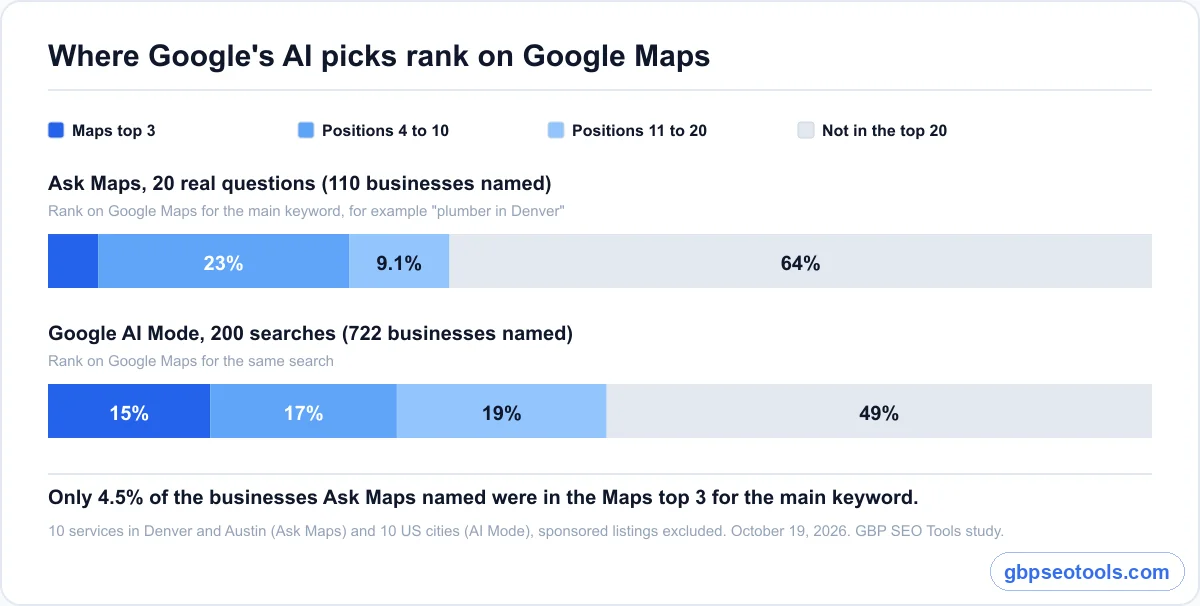
Across the 20 questions, Ask Maps named 110 businesses. Only 36% of them were in the Maps top 20 for the main keyword at all, and 39% weren't in the top 20 for either the main keyword or the full question typed into regular Maps.
In 15 of the 20 answers, not one of the three businesses at the top of the map was named.
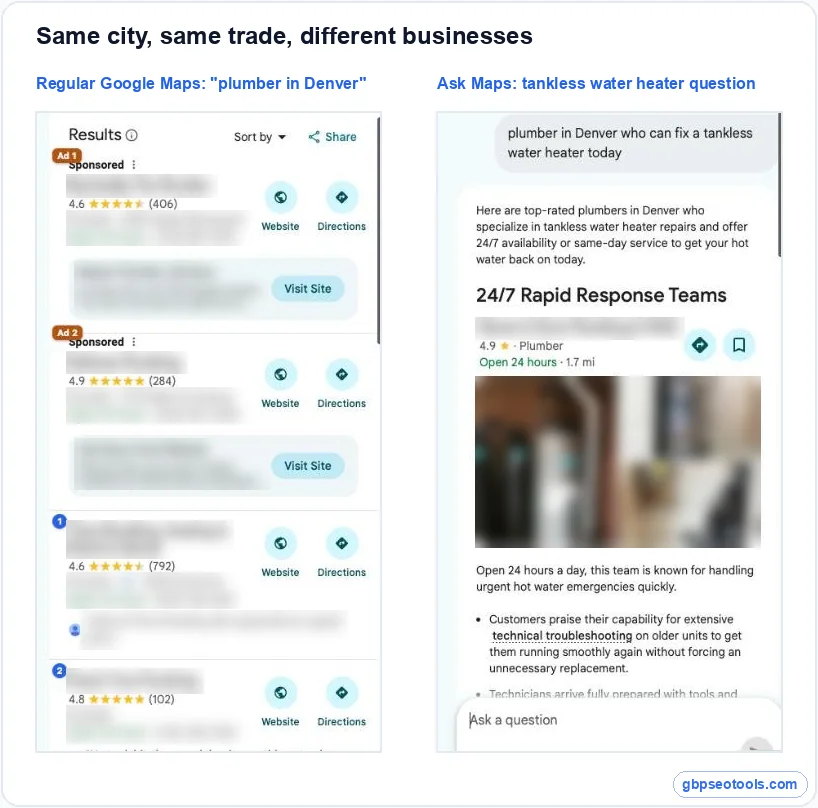
The side-by-side makes it concrete. For "plumber in Denver," the regular Maps list opened with two sponsored listings and then the organic top three. None of those five appeared in any of our five Ask Maps answers to the tankless question. We saw no ads in any of the 32 Ask Maps answers.
200 more searches pointed the same way
Ask Maps has no data feed, so we checked the pattern at scale with Google's AI Mode, the Gemini answer in Search that also lists businesses with their Maps rating. It isn't the same system (it named only 20% of the businesses Ask Maps did for the same questions), but it pointed the same way.
Across 200 searches in 10 cities, AI Mode named 722 businesses. 15% were in the Maps top three for that exact search and 49% were outside the top 20. The Maps number one was named in 27% of answers. When the question carried a specific need, 60% of the picks came from outside the top 20.
The businesses AI Mode picked had more reviews than the map's top three: a median of 497 against 228. It favors places with a deep review history, even when they rank lower on the map.
Finding 2: the answer changes every time you ask
Most people assume an AI answer is fixed, like a ranking. We asked the same three questions five times each, in fresh chats, within 40 minutes. The lineups moved every time.
Five asks, thirteen plumbers
"Plumber in Denver who can fix a tankless water heater today" produced 13 different plumbers across five answers. One appeared every time. Ten appeared once or twice.
The dentist question ("takes new patients on Saturdays") named 9 businesses, and two of them appeared in all five answers. The curly-hair salon question named 11, with two in every answer.
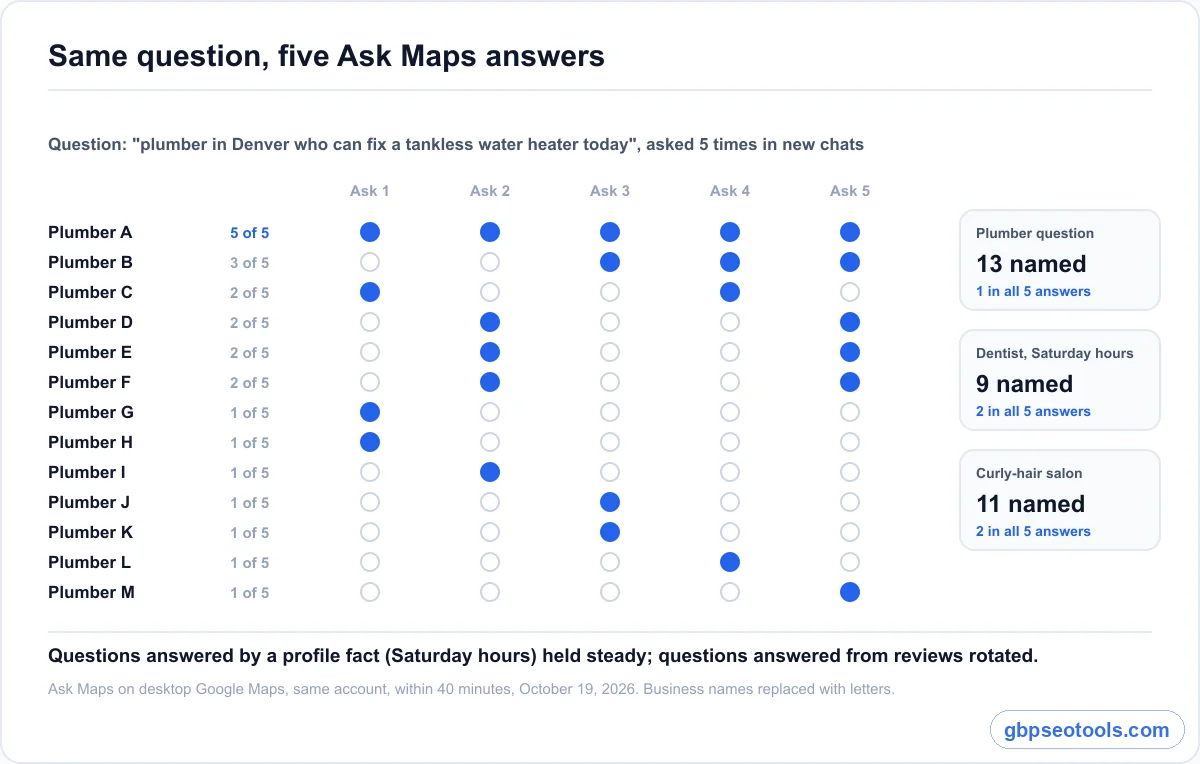
Across all 15 repeat answers, 33 different businesses were named. None of them was in the Maps top three for the main keyword.
Why facts hold the line better than praise
The pattern behind the difference is useful. The dentist question could be answered from a hard fact on each profile: the Saturday opening hours. Ask Maps listed those hours for every pick, and the lineup barely moved.
The plumber question depended on claims only reviews can back up ("they can fix it today"). Many plumbers have a few reviews like that, so the answer rotated through them. If your profile states a fact that answers the question, you hold your spot. If you depend on praise alone, you're one of several candidates sharing it.
What Gemini in Google Maps reads before it names a business
Google's description is short: Ask Maps draws on information about more than 300 million places, including reviews from over 500 million contributors, and personalizes results using places you've searched for or saved. Our answers show which parts of a profile it actually quotes.
Your reviews, quoted back
68% of the write-ups we collected quoted reviews or customers directly: "Customers praise their capability for extensive technical troubleshooting," "Reviewers highlight their capability to swiftly track down solutions where other plumbers could not."
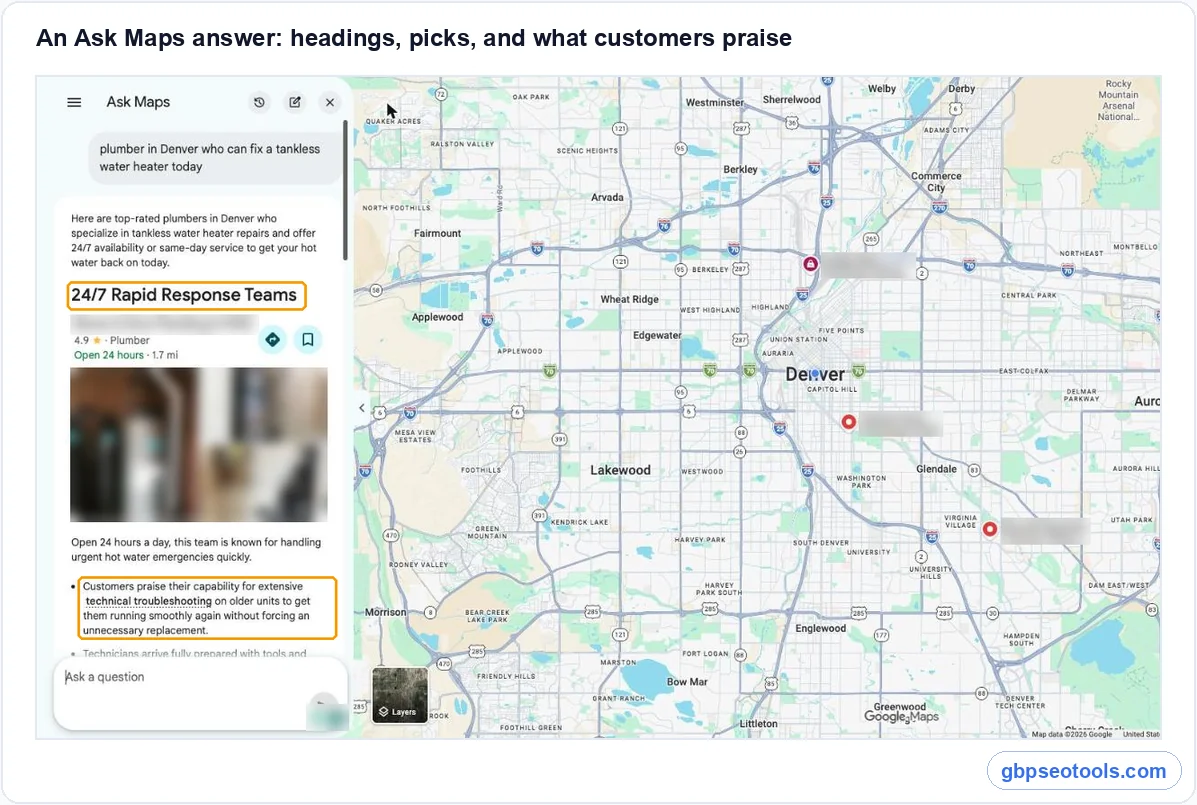
The underlined phrases inside an answer are clickable. Click "water heater problem" and Ask Maps opens the actual reviews it drew on, each one describing that job: a leaking water heater, a unit that stopped working, a plumber who came the same day.
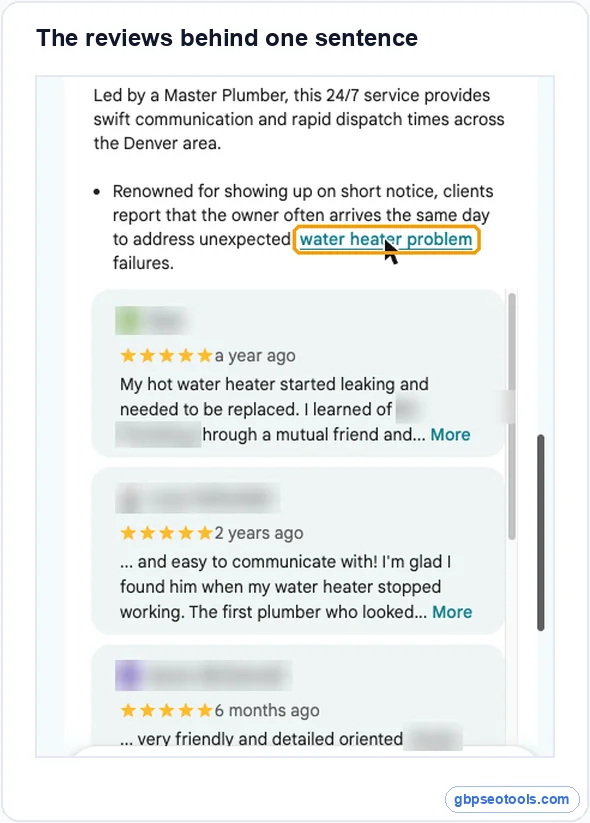
That's the clearest signal in the whole test. A review that says "great service" gives Gemini nothing to quote. A review that says "replaced our tankless unit the same afternoon" answers a question someone will ask.
Hours, services, and attributes
The dentist answers listed "Saturday Hours: 7:30 AM to 1:30 PM" under each pick, straight from the profile. The vet answers leaned on Sunday and emergency hours. Answers about heat pumps, EV chargers, and hail inspections matched the services those businesses list.
In AI Mode, 89% of the write-ups for specific questions mentioned the exact need (Saturday, tankless, hybrid, Spanish-speaking). The AI looks for proof that you do the specific thing, and your hours, services list, and attributes are the cheapest proof to add.
Your name and category
28% of the businesses Ask Maps named had the need in their name: a tankless specialist, a hybrid repair shop, a curly hair studio. Specialists get picked for specialist questions, even with fewer reviews than the generalists ranking above them on the map.
That's not a reason to add keywords to your business name, which breaks Google's guidelines and can get a profile suspended. It's a reason to pick the most specific category that's true and to describe your specialty plainly in your services and description.
How to get your business picked
There's no setting for Ask Maps and no way to pay into it today. What you can control is whether your profile and reviews contain the answers to the questions your customers ask.
Make your profile answer the question
Write down the five questions customers ask before they book: "Do you work Saturdays?", "Do you service heat pumps?", "Can you come today?" Then check that your profile answers each one somewhere Google reads.
- Hours: real hours, including weekend and special hours. They decided every dentist and vet answer in our test.
- Services: list each specific job ("tankless water heater repair," not only "water heaters"), with a short description.
- Attributes: language spoken, appointment options, accessibility, anything your category offers.
- Description: one plain paragraph naming your specialties and the areas you serve.
If an AI answer states something false about you (old hours, a wrong phone number), fix it at the source on your profile first. AI answers pick up the correction from your profile, so fix it there before anything else.
Earn reviews that describe the job
You can't write reviews for customers, and Google's rules don't let you tell them what to say. What you can do is ask at the right moment, right after a specific job, when the details are fresh. A customer asked the day you replaced their water heater will mention the water heater.
Ask every customer, not only the happy ones. Over a few months that builds a body of reviews that describe the job, which is the text Ask Maps quotes when someone asks about it.
Check your map rank and your AI answers separately
They are two different results now, so track them as two. Your map position still decides who sees you in the local pack and in regular Maps searches, and it changes block by block across your service area. A Google Maps position tracker shows that on a grid, from dozens of points instead of one.
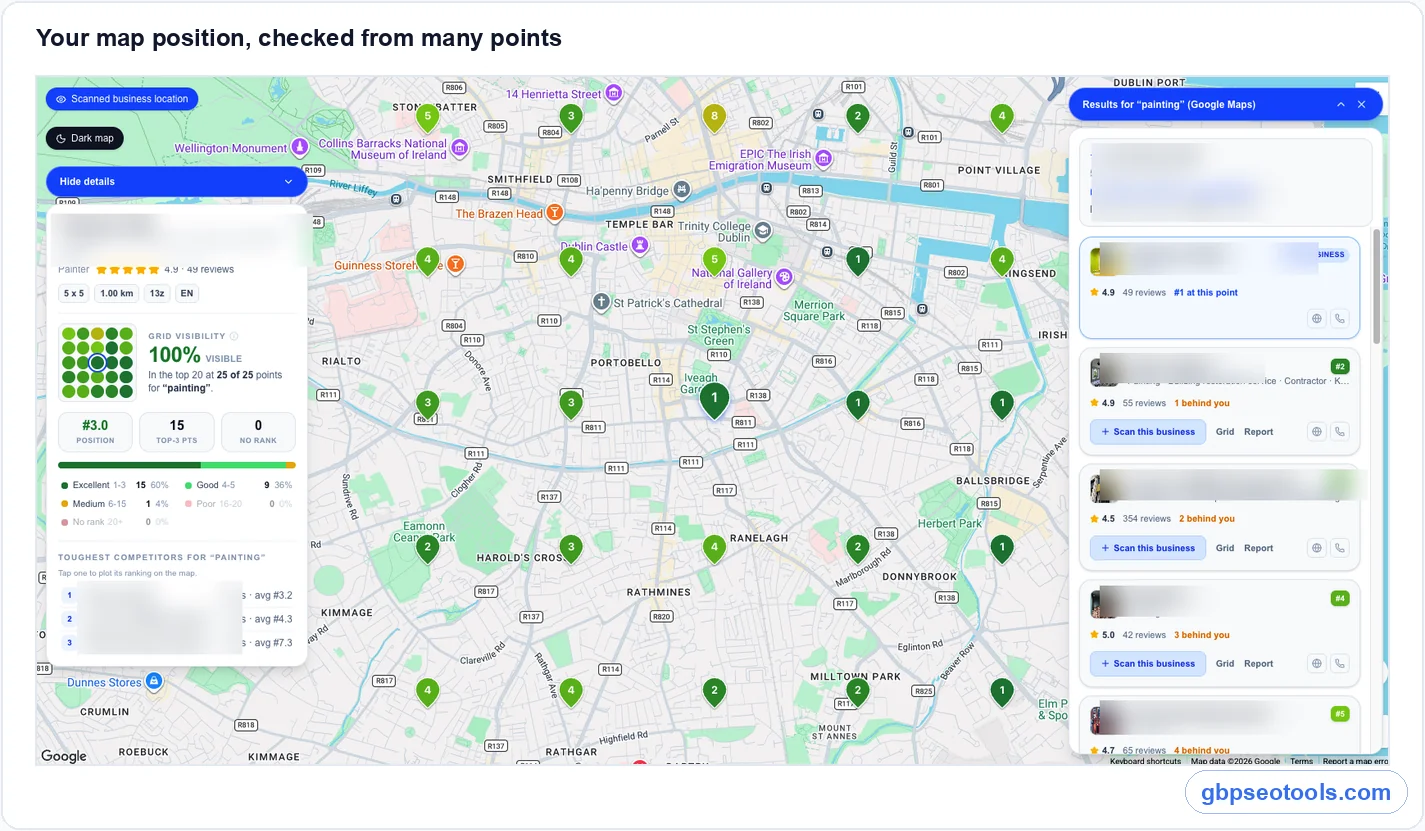
Ask Maps answers, on the other hand, can't be tracked by any rank tool today, ours included. The check is manual, and it takes 10 minutes.
Track the AI answers you can measure
Google's other AI answers can be measured. AI Mode, the Gemini answer in Search we used for our 200-search test, lists local businesses the same way, and so do AI Overviews, ChatGPT, Perplexity, Claude, and Gemini. Glocavo's AI visibility tracker for local businesses asks those six engines the questions your customers ask, on a schedule, and records whether you're named, who's named instead, and which sources each engine read.
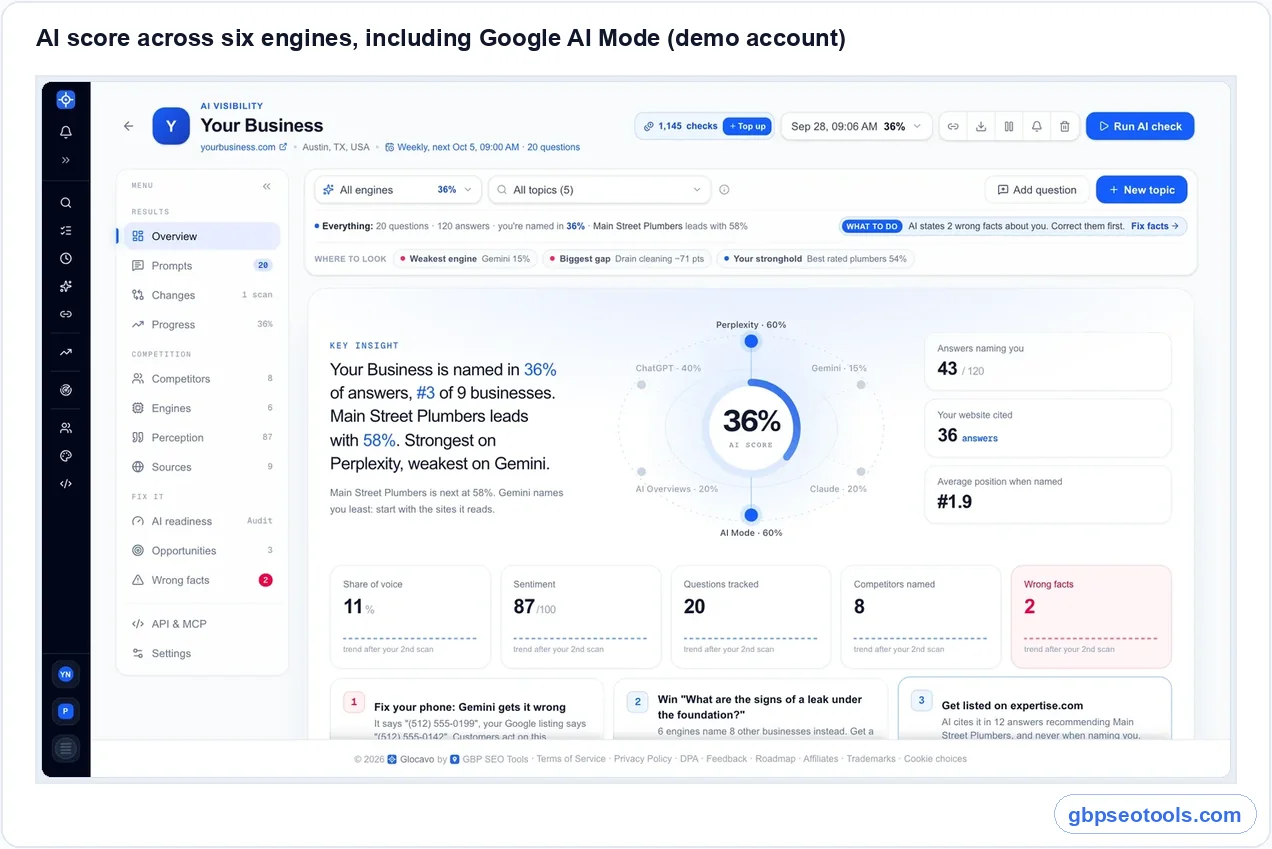
Treat it as a separate check, not a stand-in for Ask Maps. In our test, AI Mode and Ask Maps named only 20% of the same businesses for the same questions. The profile and review work above feeds both, so run the manual Ask Maps test alongside the tracked engines.
Questions owners ask about Google Maps AI
What is Ask Maps?
Ask Maps is a Gemini-powered assistant inside Google Maps. You ask a full question, such as "dentist open Saturday that takes new patients," and it answers with a short list of places, a reason for each, and a map. It launched in March 2026 on phones in the US and India.
Does it work on desktop Google Maps?
Yes. Google launched it on Android and iOS and said desktop was coming soon. We found it live on desktop Google Maps on October 19, 2026, as an "Ask Maps" button next to the category chips at the top of the map.
Does ranking first on Google Maps get you named?
Not reliably. In our 20 questions, the Maps number one for the main keyword was named in 4 answers. Ask Maps chose from a much wider pool, including many businesses outside the top 20, based on how well their reviews and profile answered the question.
Can you pay to appear in the AI answers?
We found no way to. None of the 32 answers we collected included an ad, while the regular Maps results for the same trade opened with two sponsored listings. Getting named depends on your profile and reviews, not your ad budget, at least for now.
Does Gemini read my Google reviews?
Yes, heavily. 68% of the write-ups we collected quoted reviews or customers, and clicking an underlined phrase opens the actual reviews behind it. Reviews that describe a specific job give Gemini something to quote when someone asks about that job.
Why does the same question name different businesses?
Answers are generated fresh for each question and personalized to the person asking. In our tests, the same question asked five times named between 9 and 13 different businesses. The businesses that appeared every time had a hard fact on their profile that answered the question.
Run the 10-minute test on your own business
You don't need a tool for this, only Google Maps and a list of questions. Do it once now and again after you change your profile.
Pick five questions your customers actually ask
Use the questions your front desk or your inbox hears every week, phrased the way a customer would say them, with your city in each one. Mix fact questions ("open Sunday," "takes walk-ins") with job questions ("fixes cracked tile," "good with anxious patients").
Open Ask Maps, start a new chat for each question, and write down every business it names and the reason it gives.
Ask each one three times, then compare
Ask each question three times in fresh chats, since one answer is a single draw. If you show up in all three, your profile answers that question. If you appear once or never, look at the businesses that appear every time and check what their profiles and reviews say that yours doesn't.
Of every Google Maps update in 2026, this is the one that changes how customers pick a local business. The job now is one list of the questions customers ask, and a profile and review history that answers each of them. The map rank still matters. Ask Maps is the second shortlist, and it goes to whoever answers the question best.