
Local SEO Ranking Factors 2026: What Actually Moves the Local Pack
A business with a perfectly filled-out Google Business Profile can still lose the local pack to a competitor with a messier-looking listing. That's not a glitch, it's the local SEO ranking factors working exactly as designed, just not the ones most local SEO advice focuses on.
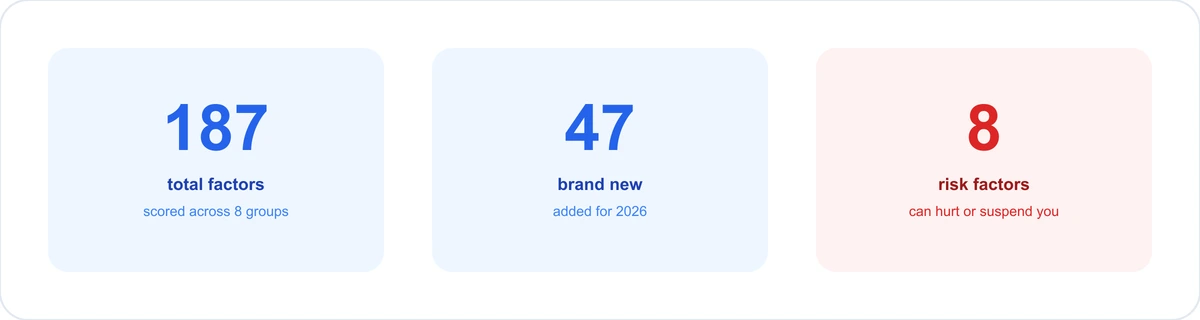
A 2026 survey of local search experts scored 187 individual ranking factors, 47 of them brand new this year. Most posts covering this kind of data just repeat the list. This one shows you what the numbers actually mean for a business like yours, and how to check where you stand on each factor using real data instead of guesswork.
The 2026 Ranking Factor Data Changed What We Prioritize
47 Experts, 187 Factors: How the Survey Works
A panel of working local SEO practitioners scores each factor from 0-5 across four dimensions: impact on Local Pack/Maps ranking, Local Organic ranking, AI Search visibility, and conversion. The scores get aggregated into a ranked list per category, and this has run as an annual industry benchmark since 2008.
What's different in 2026 is the AI Search visibility dimension. It's been scored before, but this is the first edition where it gets its own full ranking factor breakdown, treated as seriously as local pack and organic. If your business shows up when someone asks ChatGPT or Perplexity "best plumber near me," a different set of factors is doing the work than the ones getting you into the map pack.
Why This Matters More Than Generic "Optimize Your Listing" Advice
Take Priya, who runs a two-location bakery in Austin. She'd spent a weekend filling in every field Google offers: hours, attributes, a 750-character description, twelve categories. Her local pack ranking didn't move. What she'd missed wasn't a missing field, it was that her business hours weren't accurate for a Tuesday holiday closure, and Google's real-time "open now" signal was actively working against her every time someone searched during that window.
That's the gap this data closes. It's not a checklist of fields to fill in, it's a ranked list of what the fields are actually worth, and a few things (like hours accuracy) that matter far more than their five minutes of setup time would suggest. The primary keyword for this whole piece, local SEO ranking factors, only means something once you check where your own listing stands against them.
Google's Three Core Pillars: Relevance, Distance, and Prominence
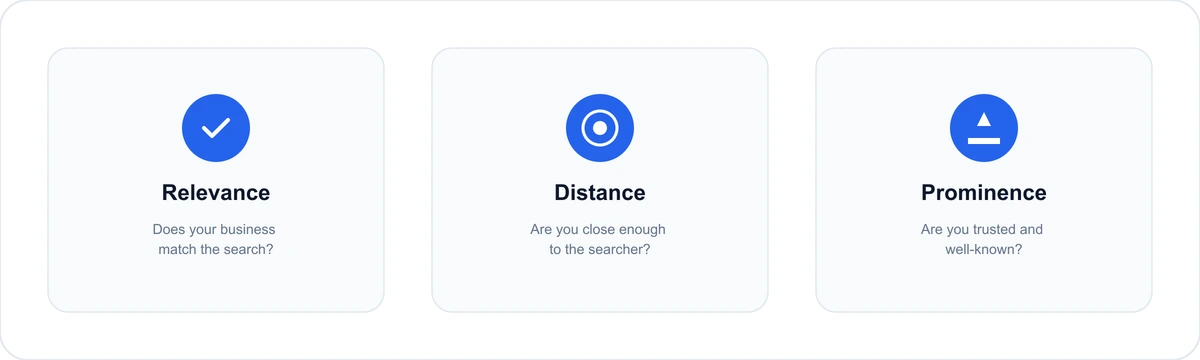
Before the 2026 detail, the fundamentals haven't changed. Google has confirmed for years that local ranking comes down to three inputs, and every factor below sorts into one of them.
Relevance: Does Your Business Match the Search?
Relevance is how well your listing matches what someone typed. A plumber searching "emergency water heater repair" needs a business categorized and described in those terms, not a general "plumber" category hoping the algorithm connects the dots. This is why primary category selection is consistently one of the highest-scoring individual factors in the data, it's the single clearest relevance signal Google has.
Distance: Are You Close Enough to the Searcher?
Distance is the most literal of the three: how far is your business from wherever the search happened (or from the area someone specified, like "plumber in Austin"). You can't optimize distance directly, but you can make sure Google has an accurate read on it, correct address, correct service area, correct map pin placement. Proximity to the search point is the #2 individual ranking factor in the 2026 local pack data.
Prominence: Is Your Business Trusted and Well-Known?
Prominence covers everything that signals your business is established and trustworthy: review volume and rating, citation presence across the web, backlinks, even how often people search for your business by name. It's the broadest of the three pillars, and it's where most of the movement happens year over year, because it's the pillar most within a business owner's control.
Local Pack Ranking Factors by Weight, 2026 Data
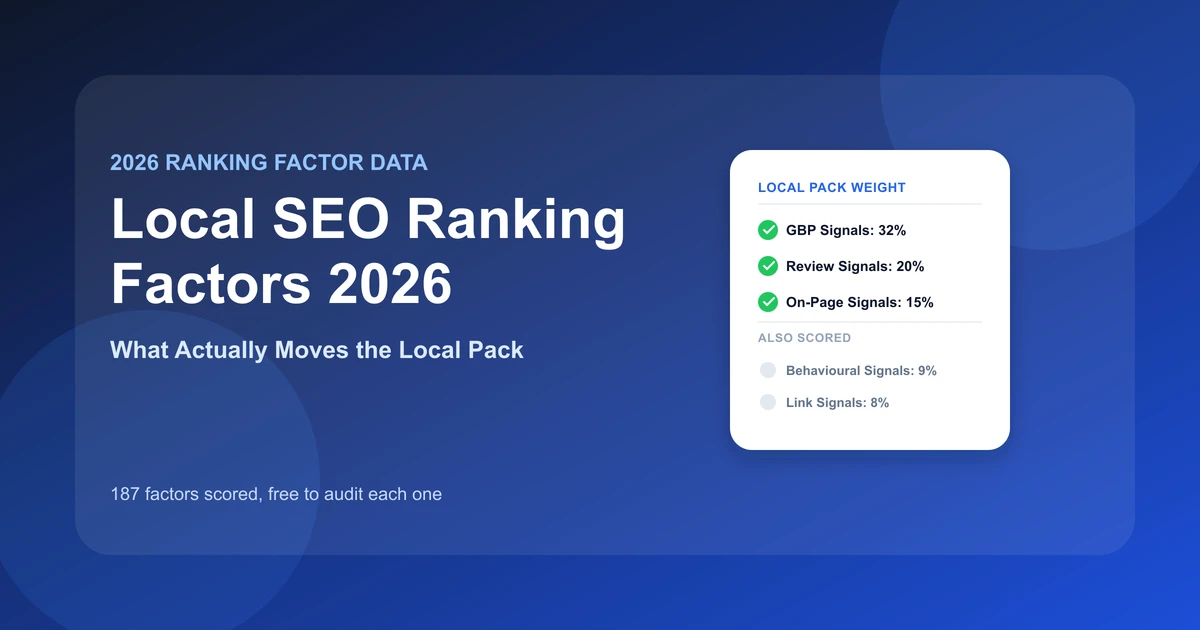
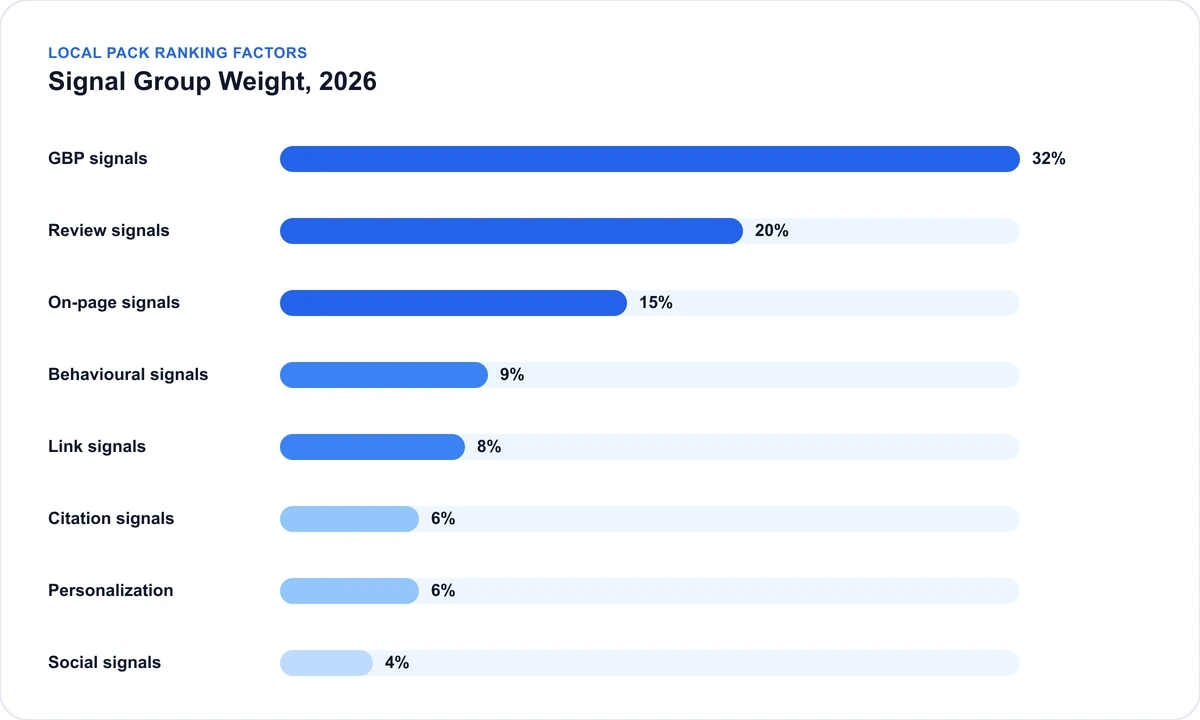
Here's where the 2026 data gets specific. Every individual factor rolls up into one of eight groups, and the group weighting tells you where to spend your time first. This breakdown is for Local Pack/Maps rankings specifically, the map results with the pin drop, not organic blue links.
| Signal group | 2026 weight | Trend |
|---|---|---|
| Google Business Profile signals | 32% | Declining slowly since 2020, still #1 by a wide margin |
| Review signals | 20% | Rising |
| On-page signals | 15% | Roughly flat |
| Behavioural signals | 9% | Rising |
| Link signals | 8% | Roughly flat |
| Citation signals | 7% | Declining, continuing a multi-year trend |
| Personalization | 5% | Roughly flat |
| Social signals | 4% | Roughly flat |
Google Business Profile Signals, 32%
This is proximity, category accuracy, and keywords in your business name and services, everything that lives directly inside your GBP dashboard. The top individually-scored local pack factors are almost all in this group: primary GBP category, proximity to the search point, and keywords in your GBP business title take the top three spots, with your listed address matching your actual search city close behind.
Review Signals, 20%
First and third-party reviews, review quantity, and review velocity (how steadily new reviews come in, not just the total). "High numerical Google ratings" is a top-10 individual factor on its own, separate from raw review count, meaning your average star rating and your total review volume are scored as two different things.
On-Page Signals, 15%
NAP presence on your site, keywords in your title tag, and your domain's overall authority. This is the one category that requires an actual website, not just a GBP listing, and it's worth more than double for organic rankings (33%) than it is for the local pack.
Behavioural Signals, 9%
Click-through rate from the local pack, mobile clicks-to-call, and dwell time. These are the hardest signals to influence directly since they're a byproduct of everything else working, but they're rising in importance, up from smaller shares in earlier years.
Link Signals, 8%
Inbound anchor text, linking domain authority, and the sheer quantity of linking domains. This one matters roughly twice as much for organic rankings (24%) as it does for the local pack (8%), so if your local pack position is already solid, links are where organic growth comes from next.
Citation Signals, 7%
Location data, NAP consistency across directories, and citation volume. This is the category with the clearest downward trend in recent years, sliding a little further each survey cycle. It's not irrelevant, but it's no longer a top-3 priority the way it was in 2018. If you're starting from scratch here, our guide to building local citations covers which sources are worth the time and which to skip.
Personalization, 5%
Search history, search location, and device type. Almost entirely outside your control as a business owner, this reflects how much Google tailors results to the individual searcher rather than anything on your listing.
Social Signals, 4%
Follower count, engagement, and post quality on platforms like Facebook and Instagram. Consistently the smallest group in the data, worth knowing so you don't over-invest time here at the expense of GBP and review work.
New Ranking Factors You Can't Ignore This Year
AI Search Visibility Gets Its Own Ranking Factor Group
For the first time, the 2026 data scores AI Search visibility (how you show up in tools like ChatGPT, Perplexity, and Google's AI Overviews) as its own full category, not a footnote. The weighting looks different from local pack: on-page signals lead at 24%, followed by review signals (16%) and, notably, citation signals (13%), tied with link signals for third. Citations are back in a real way, because AI tools lean on unstructured mentions across the web to confirm a business is real in a way Google Maps doesn't need to.
The top individual AI visibility factors reinforce this: presence on expert-curated lists ranks #1, ahead of dedicated service pages and prominence on industry-specific domains. None of these are things your GBP listing alone can deliver. Because AI answers shift from week to week, it pays to learn how to check your business's AI visibility across several engines before deciding which of these factors to work on first.
Being Open Right Now Jumped Into the Top 5
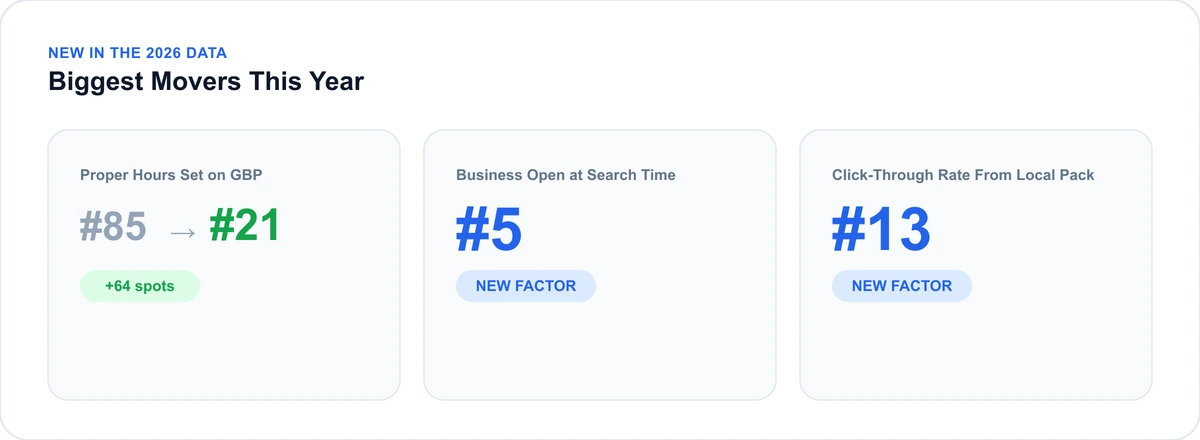
"Business Open at Search Time" is a new factor in the 2026 data, and it debuted at #5 among all local pack factors. Paired with it, "Proper Hours Set on GBP" climbed 64 positions since the last edition, from #85 up to #21, the single biggest mover in the whole data set. Real-time signals like Popular Times data appear to have a measurable ranking impact when a location shows busier-than-usual activity. Accurate hours aren't a formality anymore, they're an active ranking input.
Review and Behavioural Signals Are Gaining Ground
The clearest trend in the 2026 data: review signals and behavioural signals are the two categories seeing the biggest increases in importance this year, while on-page and link signals ticked down slightly. If your local SEO checklist still treats reviews as a reputation task separate from ranking, this is the year to stop.
47 New Factors Went Into This Edition
Out of 187 total factors scored in 2026, 47 are entirely new. Most cluster around GBP completeness details (like predefined services, which debuted at #22) and behavioral signals like click-through rate from the local pack, which landed at #13 on its first appearance, a strong debut for a factor most local SEO checklists don't even mention.
8 of the New Factors Can Actively Hurt You
Not every new factor is something to add, some are things to stop doing. The 2026 data introduced 8 negative and suspension-risk factors for the first time, each scored on both ranking impact and suspension risk. That's a big enough shift that it gets its own section next.
Local SEO Mistakes That Actively Hurt Your Rankings in 2026
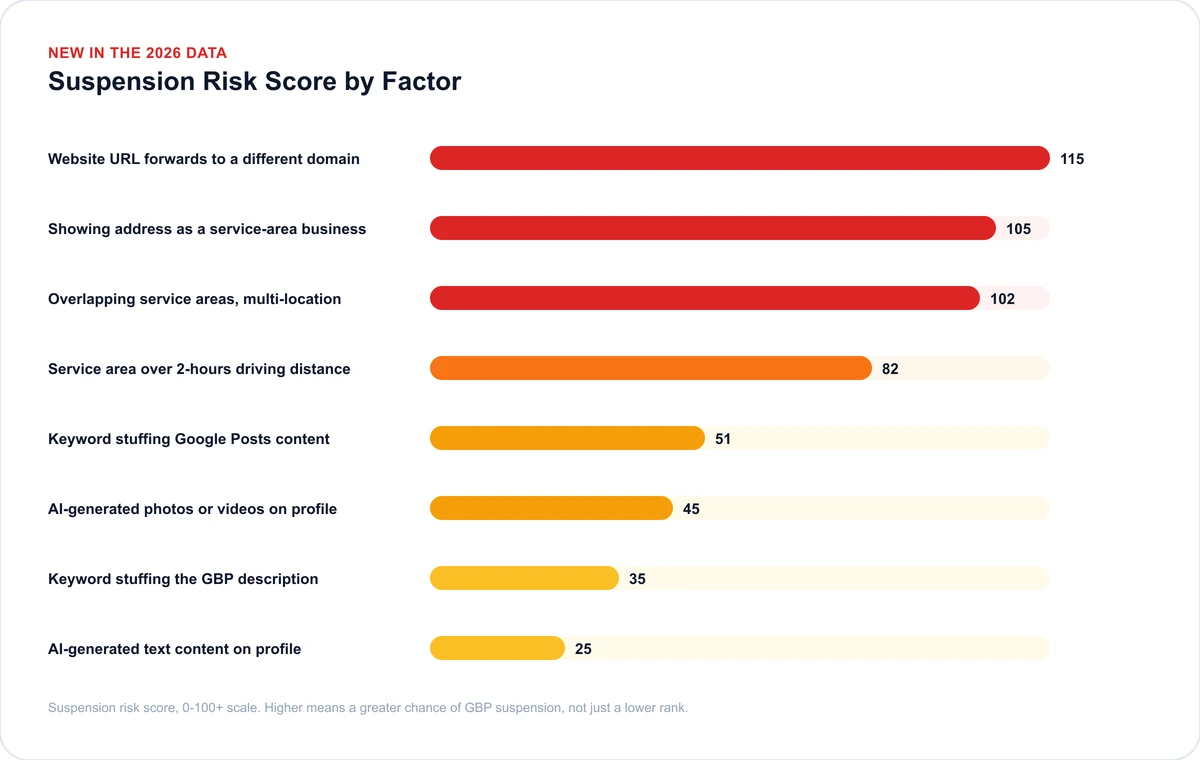
Every one of these is new to the 2026 data, scored on a 0-100+ scale for both negative ranking impact and suspension risk. Google's own guidelines back several of these directly, worth a read if you've never checked what actually triggers a suspension.
Keyword Stuffing Your GBP Business Name or Description
Stuffing keywords into your business name (like "Joe's Plumbing - Best Emergency Plumber Austin TX") is an old, well-documented violation. What's new in 2026 is that keyword stuffing your GBP description specifically now carries its own suspension risk score (35), separate from the business-name violation. Padding your description with search terms instead of writing it for a human reader is no longer a low-risk shortcut.
Using AI-Generated Text or Photos on Your Profile
Both AI-generated text content and AI-generated photos or videos are now individually scored negative factors, with the photo/video version carrying a higher negative-impact score (55 versus 31 for text). If you're using an AI tool to write your GBP description or generate profile imagery, both moves now carry a measurable ranking cost.
Showing Your Address When You're a Service-Area Business
If you're registered as a service-area business (no walk-in storefront) but your address still displays on your GBP, that's now flagged with a suspension risk score of 105, one of the highest of the eight new factors. This is a Google policy violation directly, not just a soft ranking penalty, see Google's Business Profile guidelines for how service-area businesses should be set up.
Setting Service Areas Larger Than 2-Hours Driving Distance
Service areas defined beyond a 2-hour driving radius from your business now carry a suspension risk score of 82. Google has always discouraged unrealistically large service areas, but 2026 is the first year with a concrete number on the risk. If your service area map looks more like a state than a metro, it's worth trimming back.
Website URL Forwarding to a Different Domain
This is the highest-scored negative factor in the entire new-factors list, negative impact 115 and suspension risk 115, both the highest of any factor added this year. If your GBP's website field points to a URL that forwards or redirects to a completely different domain than the one it displays, that mismatch is now one of the riskiest things on your profile. Marcus, who runs a landscaping company outside Denver, had his website field pointed at a short link he'd bought years earlier for a print ad, which forwarded to his real site. It worked fine for customers, and he had no idea it was the single riskiest thing on his profile until he checked. Fixing it took four minutes: pointing the field directly at his actual domain.
How to Check Your Local SEO Ranking Factors With Our Toolkit
Knowing the weights is only useful if you know where your own listing stands on each one. Here's how to check the factors above without hiring anyone.
Audit Your GBP Signals: Profile, Categories, Photos, Reviews
Your Google Business Profile carries 32% of local pack weight on its own, more than any other category, so it's the first place to check. A GBP audit reads your primary and secondary categories, your business name for keyword stuffing, your hours accuracy, your review volume and recency, and checks your listing against the new suspension-risk factors above, including the service-area address issue and description stuffing.
Audit Your On-Page Signals: NAP, Schema, Speed, Local Content
On-page signals are worth 15% for the local pack and a full 33% for organic rankings, the single largest organic category. A website audit checks your NAP consistency, LocalBusiness schema, title tags, and local content quality, the ranking work that happens separately from anything on your GBP.
Audit Your Keyword Relevance: What Customers Actually Search
Relevance only works if you know the exact terms your customers use, not the ones you assume they use. A local keyword tool shows you the service, location, and problem-based terms worth targeting in your GBP description, services list, and website content.
Track Your Behavioural Signals: Calls, Directions, Clicks
This is the one category worth naming honestly instead of pretending a free tool covers it: click-through rate, mobile clicks-to-call, and dwell time aren't exposed through Google's public API, so no third-party audit tool, including ours, can pull them. That data lives in your GBP dashboard's own Insights tab. Check Google's Business Profile help center directly for calls, direction requests, and website clicks, it's the only accurate source for this category.
Local SEO Ranking Factors Checklist: 30-Day Priority Order
This order follows the data directly: highest-weighted categories first, so the time you spend in week one moves the most.
Week 1: Fix GBP Completeness and NAP Consistency
Confirm your primary category is the closest possible match to what you do, correct your hours (including holiday hours), and check your business name and description for keyword stuffing. GBP signals carry 32% of local pack weight, more than any other category, start here.
Week 2: Improve Review Velocity and Response Rate
Set up a simple, consistent way to ask happy customers for a review (a QR code, a follow-up text, a receipt line), and reply to every review you have, positive and negative. Review signals are 20% of local pack weight and rising faster than any other category this year.
Week 3: Add LocalBusiness Schema and Location Pages
If you don't have LocalBusiness structured data on your homepage, add it. If you serve multiple areas, build a dedicated page per location or per core service, not one generic "service areas" paragraph.
Week 4: Build Local Backlinks and Check Citation Consistency
Reach out for a handful of genuinely relevant local backlinks (a chamber of commerce listing, a local news mention, a supplier partnership page), and spot-check your NAP on the 5-10 directories that matter most in your industry.
Same plan, at a glance
Frequently Asked Questions About Local SEO Ranking Factors
What is the most important local SEO ranking factor in 2026?
Google Business Profile signals remain the single largest category for local pack rankings at 32%. Within that group, primary GBP category, proximity to the searcher, and keywords in your business title score highest among individual factors.
How many reviews do I need to rank in the local pack?
There's no fixed number. Review signals make up 20% of local pack ranking weight, and quantity of native Google reviews is a top-10 individual factor, but recent data shows review recency and response activity carry real weight too, not just raw count. A business with 40 recent, replied-to reviews often outranks one with 200 stale ones.
Does NAP consistency still matter for local SEO?
Yes, but its relative weight has declined slightly for local pack and organic rankings, continuing a multi-year downward trend. It's resurging for AI search visibility instead: citation-related factors make up three of the top five AI Search Visibility factors, since AI tools lean on citations to confirm a business is real.
Can I rank in the local pack without a website?
You can appear in the local pack with just a Google Business Profile, since GBP signals alone carry 32% of the weight. But on-page signals (15% of local pack weight, and the single largest category for organic rankings at 33%) require an actual website. Skipping one caps how far you can rank, especially outside the map pack.
How do I rank in AI search results like ChatGPT and Perplexity?
AI Search Visibility is scored separately from local pack ranking, and the top factors differ: presence on expert-curated lists, dedicated service pages, and prominence on industry domains lead the group. On-page signals matter most here too (24%), but citations play a bigger role than they do for local pack or organic rankings.
Run a Local SEO Audit Against the Factors That Matter
The Data Tells You the Priority, Your Audit Tells You the Gap
The 2026 ranking factor data is useful, but it's still a general ranked list, it can't tell you whether your specific listing has a keyword-stuffed description, an unset primary category, or a website URL quietly forwarding to the wrong domain. Only your own data can answer that, and a structured local SEO audit collects it in the same weight order as the list above.
Check Your Own Listing Now
Check your GBP audit against the factors that carry the most weight (GBP signals, reviews, on-page basics), no signup, $4.99 one-time, then work down the priority order above.