
How to Do a Local SEO Audit: Six Steps in the Right Order
A local SEO audit checks every signal behind a business's local pack and Google Maps visibility (the Google Business Profile, reviews, website, citations, and links), then ranks the fixes by how much each one can move rankings.
Most people running one, owners and agencies alike, already know roughly what to check. The trouble is the order. A 60-item checklist makes every item look equally urgent, and the first month goes to directory cleanup while the wrong primary category keeps the listing out of the local pack, the three map results Google shows above the organic listings.
This guide gives you an order to work in. You confirm access, map where the business ranks today, read what that map says about the cause, and audit the signals in the order Google weighs them. Then you finish with a short fix list, ready to work through yourself or to hand to a client for approval. The detailed profile and website checks live in their own checklists, linked below, so this post stays on process.
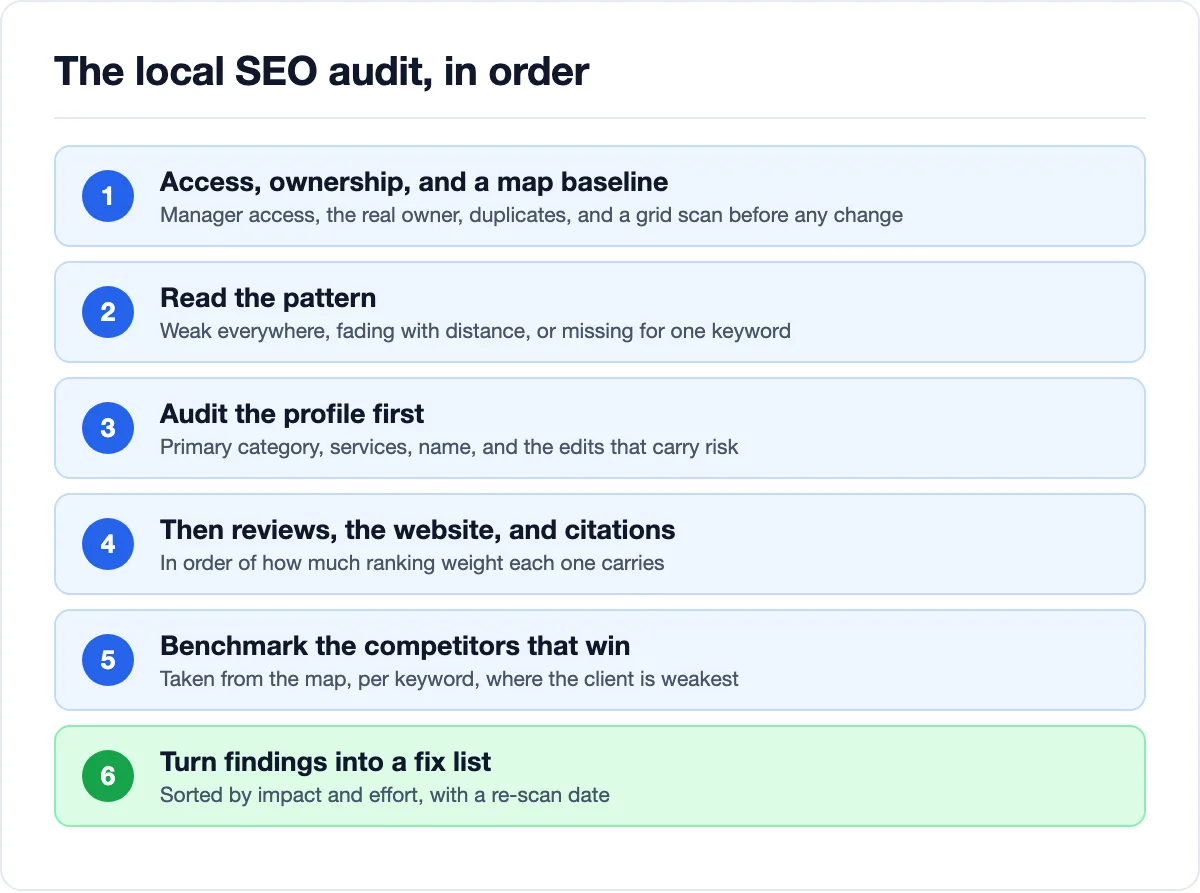
The audit in six steps:
- Confirm access, then baseline the map
- Read the pattern before looking for fixes
- Audit the Google Business Profile first
- Then reviews, the website, and citations
- Benchmark the competitors that outrank you
- Turn the findings into a fix list
Before any check, lock down access and baseline the map
Two things come before any check. You need to be able to change what you find, and you need a record of where the business stands before you change anything. Skip the first and the audit stalls. Skip the second and you can't prove anything later.
Confirm who controls the profile and the site
If you're auditing a client, ask for manager access to the Google Business Profile. If it's your own business, check that you're the primary owner, not just a manager. Profiles owned by a former employee, an old agency, or the web designer are common, and ownership requests take time. Send that request on day one.
While you're in there, search for duplicate listings: an old address, an old phone number, or a separate listing for one practitioner. Duplicates split reviews and blur which listing Google should rank. Then confirm access to the website's CMS, the domain's DNS, Google Search Console, and Analytics.
Take an HVAC company whose profile is still owned by the agency it fired two years ago. Every fix in the audit waits on that ownership request, so it goes out on day one, not after the audit is finished.
Run a grid scan before you change anything
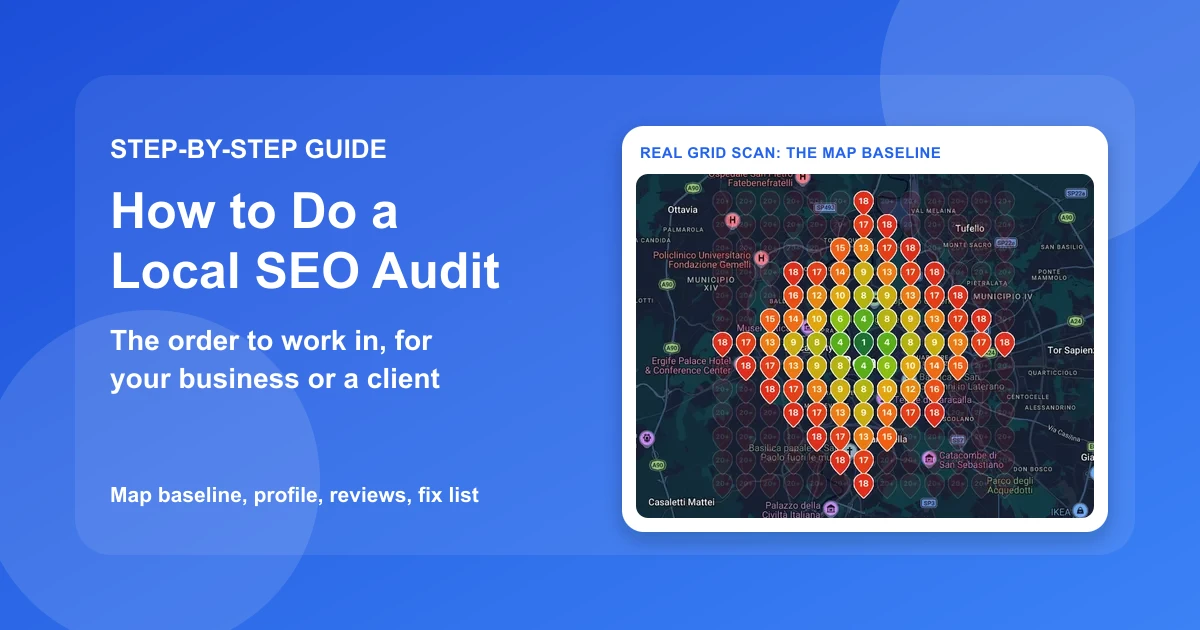
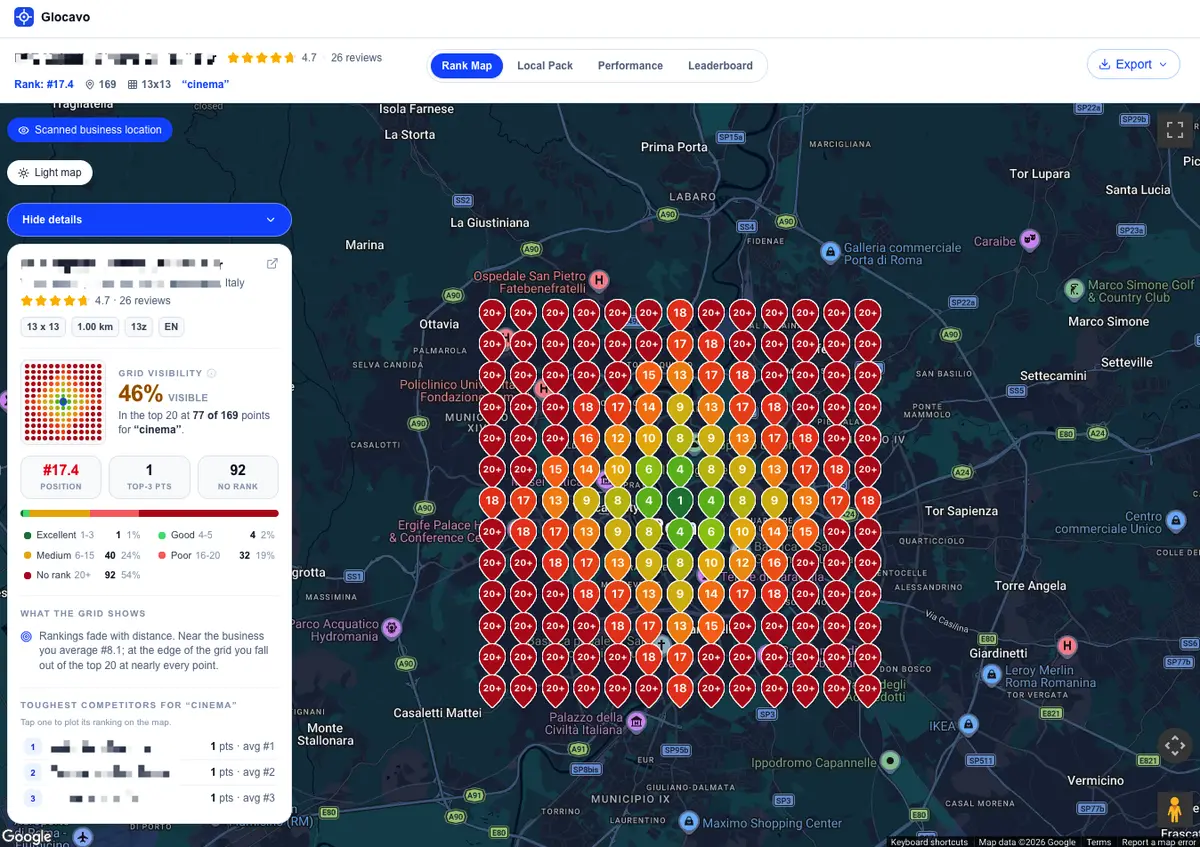
A single rank check from your desk tells you where the business ranks at your desk. Local results depend on where the searcher is, so the baseline has to cover the service area. A grid scan checks the same keyword from a grid of points around the business (a 7×7 grid is 49 searches). It returns a heatmap, the business's average position, the share of points where it ranks in the top 20 (the report calls it grid visibility), and how many points put it in the top three, the local pack itself.
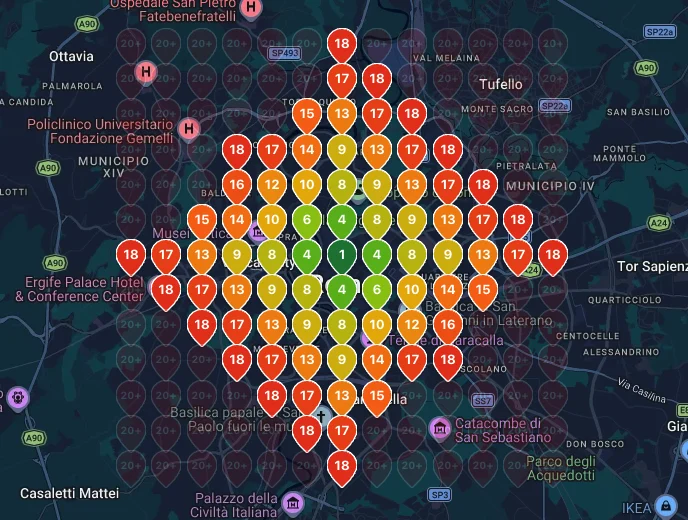
We run these baselines with our Google local rank tracker, which also records the top three businesses at every point. That list becomes your competitor set in step five. Save the settings (keyword, grid size, spacing, and center point), because the re-scan has to match them.
One scan is a snapshot, not a trend. Treat it as the "before" photo. If the listing isn't on Google Maps yet, there's nothing to scan, and the audit starts with verification instead.
Agree on the three to five keywords the audit is judged by
Pick the category head term (for example, "plumber"), the two or three services that bring in the most revenue, and one urgent variant if the business takes emergency jobs. Leave out a favorite vanity phrase unless people actually search for it.
Fixing this list up front stops the goalposts from moving later. With a client, it prevents the "but I searched for X and we weren't there" conversation in month two. Put it in writing, with the reason each keyword made the cut.
Local SEO analysis: read the pattern before you look for fixes
Local SEO analysis is where the baseline pays off. Google ranks local results on three things, relevance, distance, and prominence, per Google's own explanation of how local results work. The shape of the heatmap usually points at one of them, and that tells you where to spend the rest of the audit.
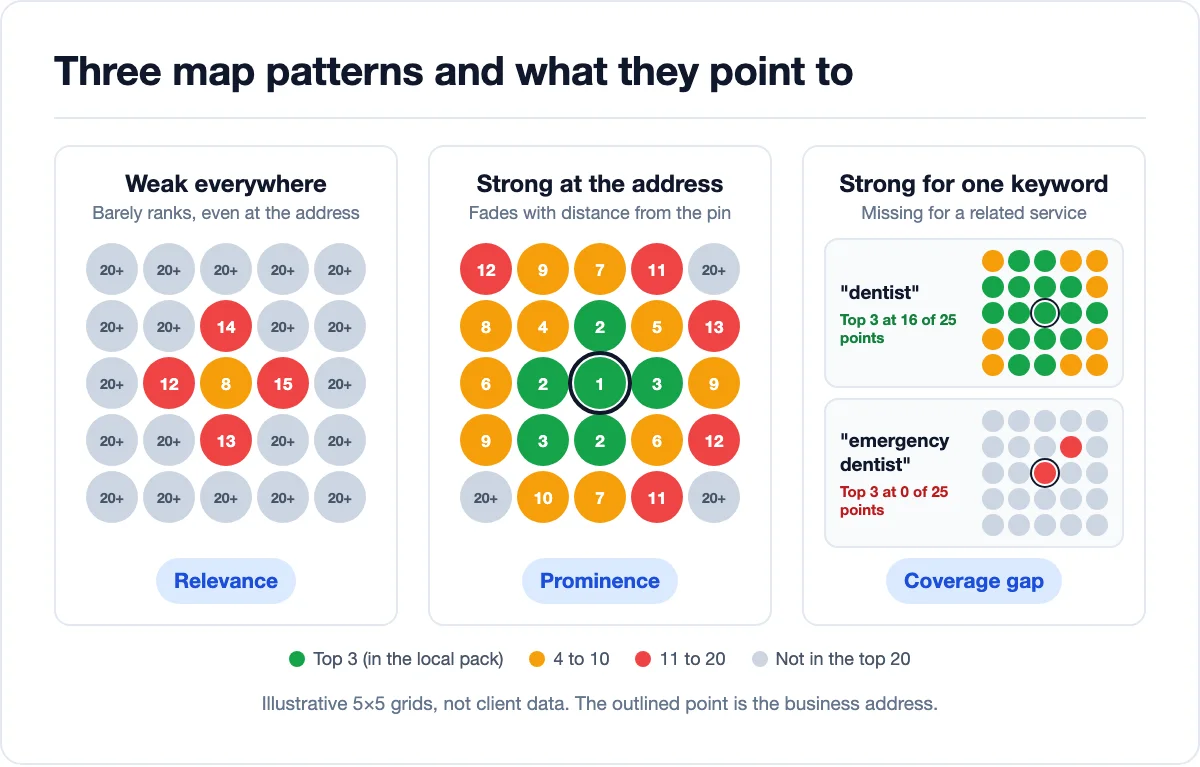
Weak across the whole grid points to relevance
If the business barely shows up anywhere, including right next to the address, Google doesn't see the listing as a strong match for the keyword. Distance can't be the problem at the front door.
Look at the primary category first, then the services on the profile, then whether the page the profile links to is about the keyword at all. A plumber whose profile links to a generic homepage with no mention of drain cleaning shouldn't expect to rank for it.
Strong at the address, fading with distance, points to prominence
Say a plumbing company ranks in the top three within about a mile of the shop and drops out of the local pack across the suburbs it actually serves. Relevance is fine. Google shows it where it's closest. Past that radius, competitors with more reviews, more links, and stronger sites win.
That's a prominence gap. The fixes are reviews, links, and service-area pages, not category changes. Part of the drop is plain distance, though, and distance can't be fixed. Say so in the audit, so nobody, owner or client, expects to rank 15 miles from the shop.
Strong for one keyword, missing for another points to a coverage gap
A dental group's second location ranks well for "dentist" and barely appears for "emergency dentist," even though it takes emergency patients. Its primary category is Dentist, no emergency service is listed on the profile, and no page on the site mentions it.
Nothing is broken. The profile and site just never told Google about that service. The fix is a secondary category where one fits, the service on the profile, and a page on the site that covers it.
Audit the profile first, because it carries the most weight
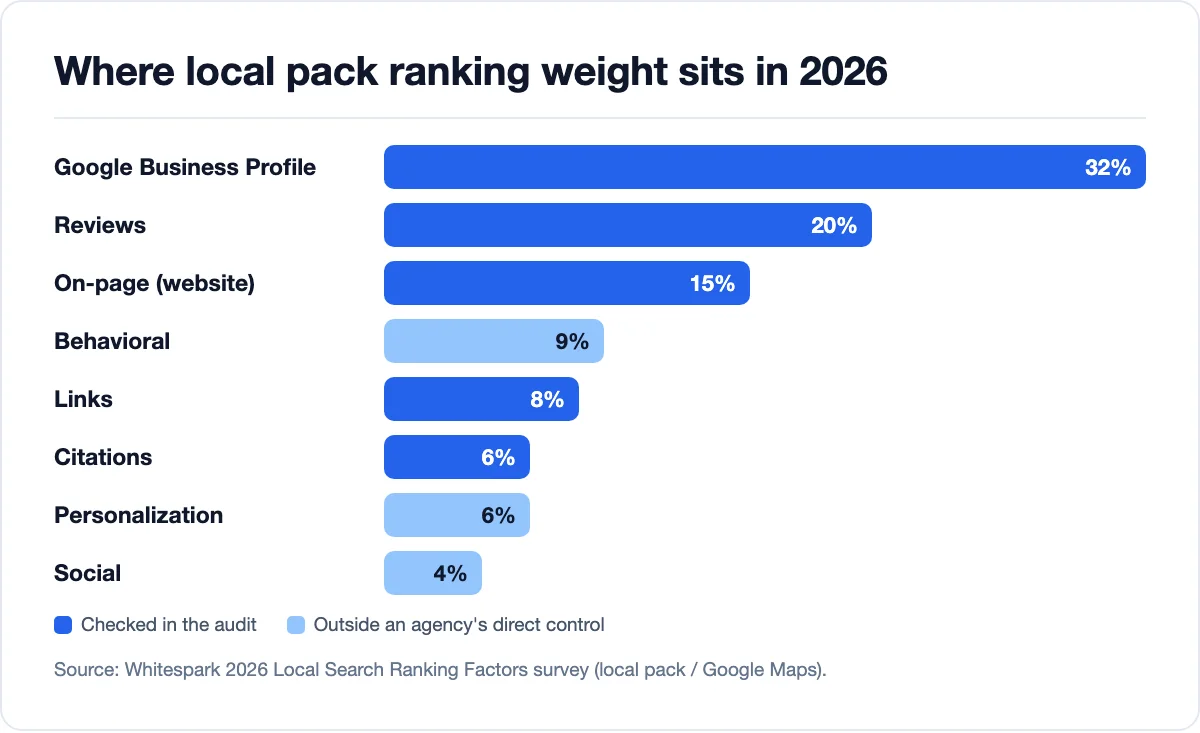
In Whitespark's 2026 Local Search Ranking Factors survey, Google Business Profile signals carry 32% of local pack ranking weight, more than any other group. Reviews follow at 20%, on-page signals at 15%, behavioral signals at 9%, links at 8%, and citations at 6%. It's an expert survey, not Google data, but it's the best available guide to where local SEO audit hours pay off.
The item-by-item profile checks are in our full profile audit checklist. In the audit itself, three areas decide most of the outcome.
Primary category, services, and the business name
Most local SEOs treat the primary category as the strongest relevance signal a profile has. Check it against the keyword list from step one and against what the top competitors use. Then check the secondary categories and services for gaps.
Check the business name too. "Smith Plumbing - Emergency Plumber Denver" is not a real business name, and keyword-stuffed names are a common trigger for suspensions. Flag it, but see the next section before you fix it.
Changes that can trigger re-verification or a suspension
Some fixes carry risk. Editing the name, the address, or the categories can send a profile back through verification, which is often a video now, and a flagged edit can end in suspension. That's the worst outcome an audit can cause, and it happens because someone touched the profile.
Schedule the risky changes after the safe ones, make them one at a time, and space them out. If it's a client's profile, tell them before each one, so a verification request doesn't come as a surprise.
Photos, posts, and signs the profile is maintained
Check when the last photo and the last post went up, whether the hours are current (holiday hours included), and whether anyone answers reviews. A neglected profile rarely costs the top spot on its own.
It's still the cheapest fix in the audit, and customers notice it. A fresh set of photos in week one shows visible progress while the slower work gets started.
Why reviews come before the website, and citations come last
Once the profile is covered, the remaining signals follow the same logic: the more weight a signal carries, the earlier it goes in the audit and the more time it gets.
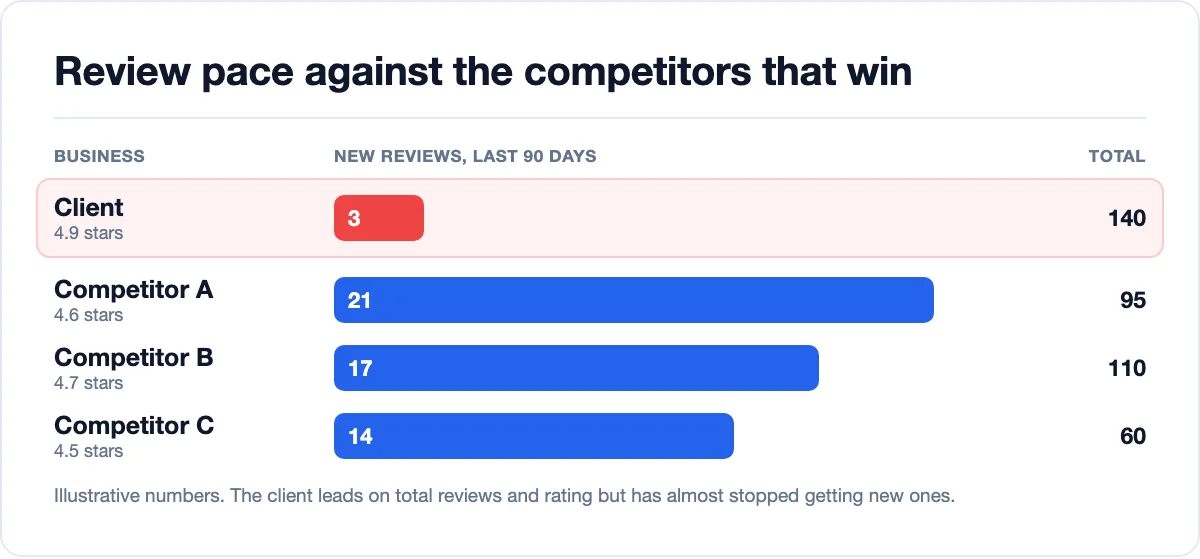
Reviews: recent pace against the competitors that win
Compare the business's reviews with the three businesses winning its weakest area of the map. Look at total count, how many arrived in the last 90 days, the average rating, and whether the owner replies. A 4.9 rating from 40 reviews, most of them two years old, often loses ground to a 4.6 that gets new reviews every week.
Check how review requests go out against Google's April 2026 policy updates too. Staff can't be given review quotas, customers can't be told what to write (including naming an employee), and in-store kiosks, shared devices, and review gating are all out. An old process that breaks these rules is a risk, not just a missed opportunity.
The website: the pages the profile and the map depend on
Start with the page the profile links to. It should match the primary category and name the city. Then check that each main service has its own page, and that a service-area business has pages for the areas it wants to rank in.
After that come the basics: name, address, and phone matching the profile, LocalBusiness schema that's present and correct, and a site that works on a phone. The ten on-site areas are covered in the local website audit checklist, so this step only needs to confirm which of them are holding this business back.
Citations and links: check them, but don't live there
Links (8%) and citations (6%) matter, but together they carry less weight than reviews. Check the major data sources and the directories that rank for the business's own keywords, and fix any wrong name, address, or phone.
Note the local link opportunities, such as suppliers, trade associations, sponsorships, and local press. Then move on. Building 80 new directory listings in month one while the primary category is wrong is the most common way an audit wastes a budget.
Local SEO competitor analysis: benchmark the businesses that outrank you
Owners usually name the competitor they resent, often the one across the street, and clients do the same. The businesses actually winning are often different, and they change across the service area. A local SEO competitor analysis should compare you with the businesses that actually win, in the places where you lose.
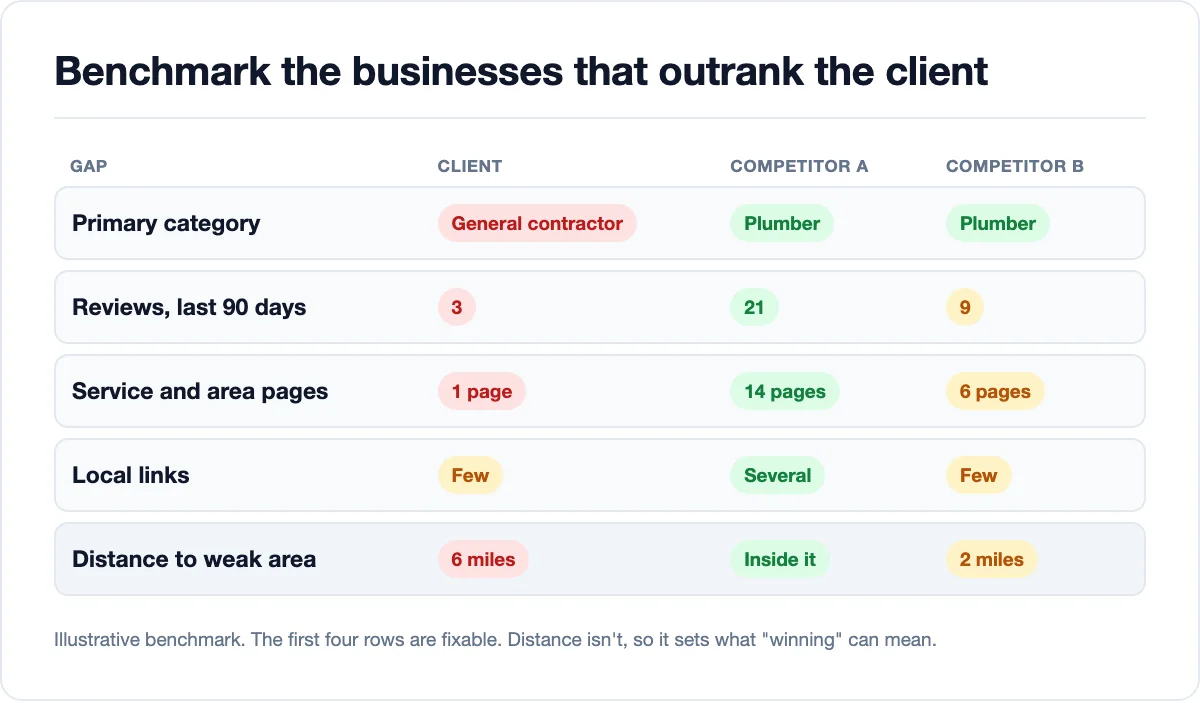
Take the competitors from the map, not from memory
Open the baseline scan and list the businesses in the top three at the points where the business is weakest. Two or three names usually repeat across those points. That's the competitor set for the audit.
Do this per keyword. The business that owns "emergency plumber" in the north of town may not even appear for "water heater installation." Benchmarking against the wrong competitor produces a to-do list for the wrong fight.
The gaps worth measuring, and the one you can't close
| Gap | What to compare | Can you close it? |
|---|---|---|
| Primary category | You vs each competitor | Yes, in days |
| Reviews | Count, last-90-day pace, rating, replies | Yes, over months |
| Service and area pages | A dedicated page for each target keyword | Yes, in weeks |
| Links and local mentions | Associations, suppliers, local press | Slowly |
| Distance | Where each competitor sits vs the weak area | No |
The last row matters most for expectations. If the winning competitor sits in the middle of your weak area, you may never own that area outright. The realistic goal is a spot in the local pack next to them. Saying that in the audit sets expectations, yours or a client's, before month three shows progress but not a clean sweep.
Turn the local SEO audit checklist into a prioritized fix list
A local SEO audit checklist helps you find problems. The deliverable is something else: a short list of fixes, in order, with a reason attached to each one.
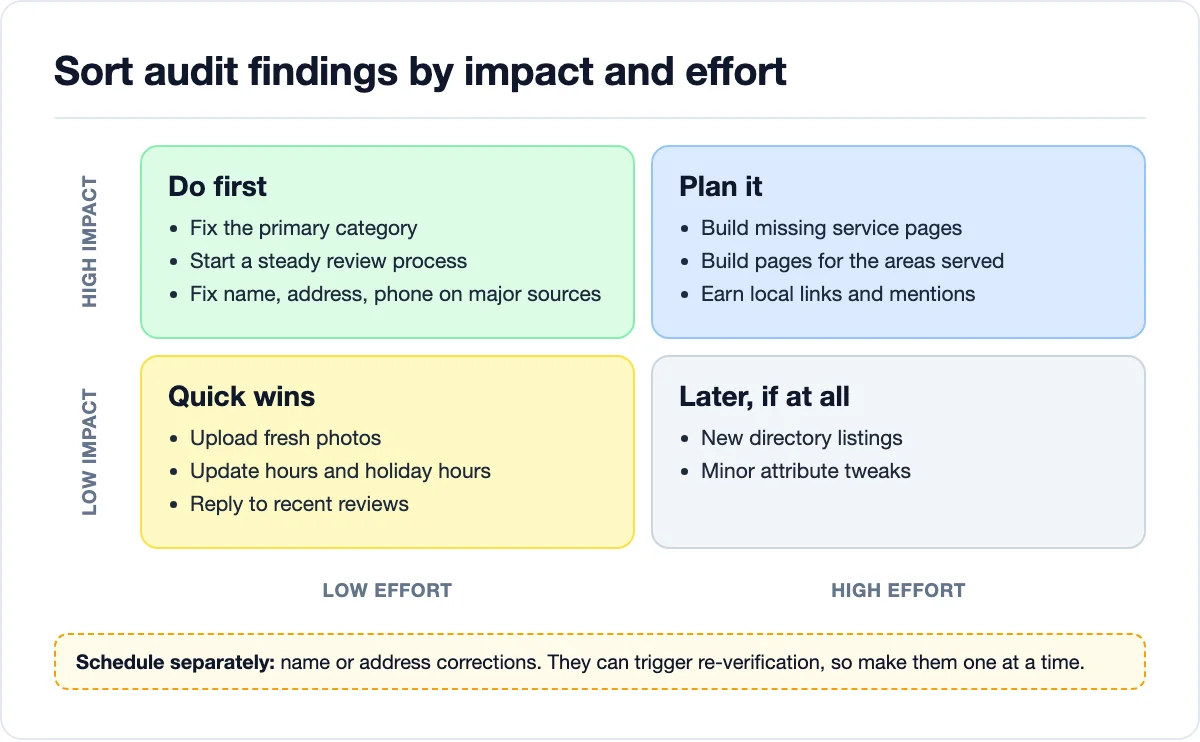
Score every finding by impact and effort
Give every finding two marks: how much weight the signal carries, and how much work the fix takes. Sort by both and the order mostly writes itself.
| Finding | Impact | Effort | When |
|---|---|---|---|
| Wrong or weak primary category | High | Low | Week 1 |
| Review pace behind the winning competitors | High | Ongoing | Start in week 1 |
| Missing service or area pages | High | Medium | Weeks 2 to 6 |
| Name, address, or phone mismatch on major sources | Medium | Low | Week 2 |
| Stale photos, no recent posts | Low | Low | Week 1 |
| Keyword-stuffed name or address correction | Medium | Risky | Scheduled, one change at a time |
| New directory listings | Low | Medium | After month 2 |
What the audit report should contain
Keep the local SEO audit report short enough to read in one sitting. It needs five parts:
- A one-page summary of what's holding the business back and why
- The baseline heatmap with grid visibility, top-3 points, and average position
- The top five fixes, each with the reason it made the list
- What you're deliberately not doing yet, and why
- The date of the re-scan
The fourth part matters as much as the fixes. It answers "what about citations?" before anyone asks, and it shows the order is a decision, not a gap in your work. Monthly reporting after that is a separate document with a separate job.
Re-scan at the same points in four to six weeks
Run the second scan with the same keywords, grid size, spacing, and center point. Two scans are the start of a trend. One is still a snapshot.
If visibility improved where you worked, show the before and after side by side. If a weak area didn't move, the next step is usually prominence work, which takes longer. If you report to a client, they should hear that from you before they see the map.
The value of a local SEO audit is in the order, not the length of the checklist. Start with access and a baseline map, and let the map's pattern tell you what kind of problem you're dealing with. Fix the heaviest signals first, and be honest, with yourself or a client, about what distance won't let you win. Run the baseline scan before you change anything, and the audit has something to measure against from day one.
Five questions to settle before you start an audit
What is a local SEO audit?
A local SEO audit is a review of everything that affects how a business shows up in Google's local pack and on Google Maps: its Business Profile, reviews, website, citations, links, and competitors. A good one ends with a prioritized list of fixes, not just a list of problems.
How is a local SEO audit different from a Google Business Profile audit?
A Google Business Profile audit covers the listing: categories, name, address, and phone, photos, reviews, and attributes. The full audit includes that and adds the website, citations, links, the map baseline, and competitors. The profile audit is one step inside the full audit, usually the most important one.
How long does a local SEO audit take?
For one location and three to five keywords, the checks themselves fit in a day or two of focused work. The calendar time is usually longer, because access and ownership requests can take days or weeks. Multi-location audits scale with the number of locations, though many findings repeat across them.
Can ChatGPT do a local SEO audit?
An AI assistant can organize findings, draft the report, and suggest an order, if you give it real data. It can't see the live local pack from your service area, check who owns the profile, or verify a listing. Use it to write up the audit, not to run it.
What happens after the audit is delivered?
You (or the client) approve the fix list, you work through it in order, and you re-scan at the same points after four to six weeks. From there, the audit turns into ongoing work: monthly reporting, recurring scans, and a fresh look at competitors each quarter.