
Local Citations: What They Are and How to Build Them in 2026
Local citations are the online mentions of your business name, address, and phone number that sit on directories, review sites, maps apps, and other companies' pages across the web. For years the advice was to get as many as possible. In 2026 that advice is mostly wrong, and chasing volume can waste a month of effort for almost no return.
What still matters is narrower: a handful of sources Google actually trusts, listed with details that match everywhere, and no stray duplicates pulling in a different direction. This guide covers what a citation is, whether they still move rankings, which sources are worth your time, how to build them in the right order, and how to keep them consistent as your business changes. It draws on patterns we see across hundreds of real audits run with our Google Business Profile SEO tools, where a messy citation footprint is one of the most common findings and one of the least urgent to fix.
In this guide:
- What a local citation is in SEO
- Do local citations still affect rankings in 2026?
- The local citation sources that actually matter
- How to build local citations step by step
- Keeping your local citations consistent
- How to check your local citation coverage
What a Local Citation Is in SEO
A citation in SEO is any place online that names your business and shows at least one piece of contact information. It doesn't have to link to your website, and it doesn't have to be a review. A profile on Yelp counts. So does a line in a "best plumbers in Denver" article that prints your phone number.
Structured and unstructured citations
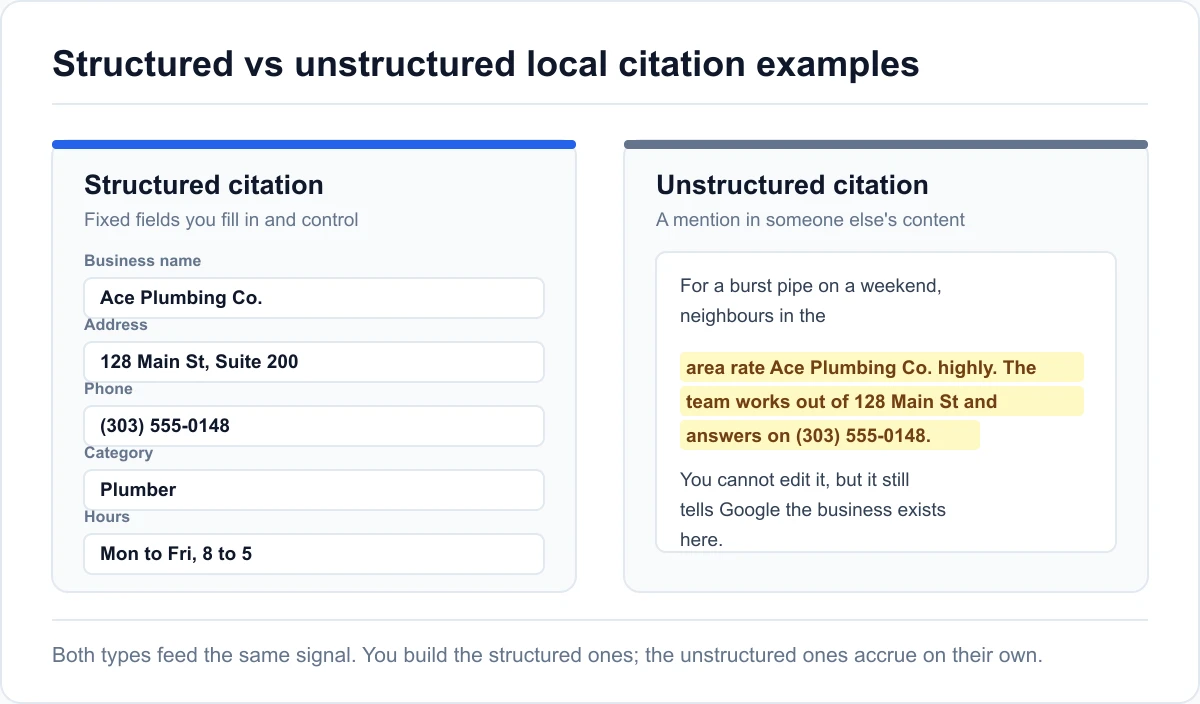
A structured citation is a listing in a fixed format: a directory or app with dedicated fields for business name, address, phone, hours, and category. Google Business Profile, Bing Places, Apple Business Connect, and Yelp all produce structured citations. These are the ones you create and control directly.
An unstructured citation is a mention in free-form content. Think of a news story, a blog roundup, a sponsor list on a community group's site, or a forum thread. You can't edit these, but they still tell search engines your business exists and operates where you say it does. Both types feed the same underlying signal.
What counts as NAP
NAP stands for name, address, and phone number. Those three details have to be identical across every citation. Some listings also carry a website URL, which is why you sometimes see the term written as NAP+W. When people ask what NAP is in SEO, that's the whole of it: the core identity block Google cross-checks from one source to the next.
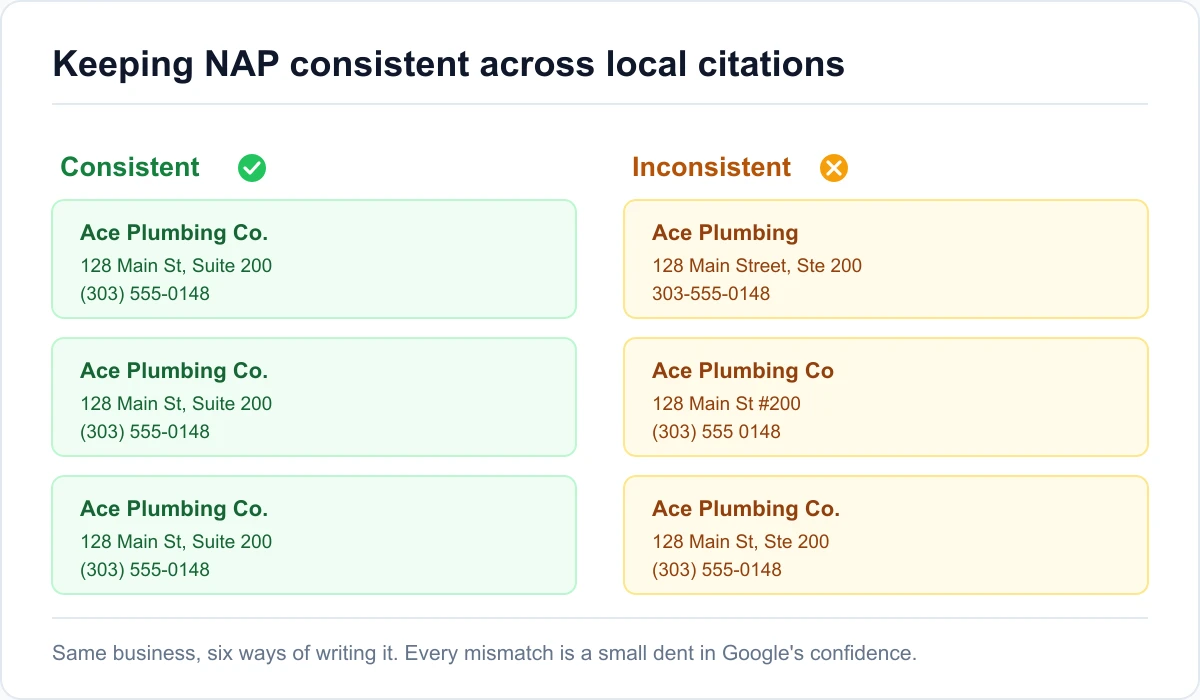
The address is where most businesses slip. "Suite 200" on one listing, "Ste 200" on another, and "#200" on a third are three versions of one address, and every mismatch is a small dent in confidence. Service-area businesses that hide their address have their own rules, covered later.
Citations, backlinks, and directory listings aren't the same thing
These three get used interchangeably, and they shouldn't be:
- A backlink is a clickable link to your site that passes ranking value through the link itself.
- A citation is a mention of your business details, with or without a link.
- A directory listing is one common container that happens to produce a structured citation, and sometimes a backlink too.
The practical difference is what you're building for. You build backlinks for domain authority and general SEO. You build citations for local entity trust. A directory listing can serve both, but treating a citation push as a link-building campaign points you at the wrong sources.
Do Local Citations Still Affect Rankings in 2026?
Yes, but less directly than they used to, and not in the way most guides still describe. The honest answer: citations have shifted from a lever you crank to a foundation you get right once.
What the ranking studies show
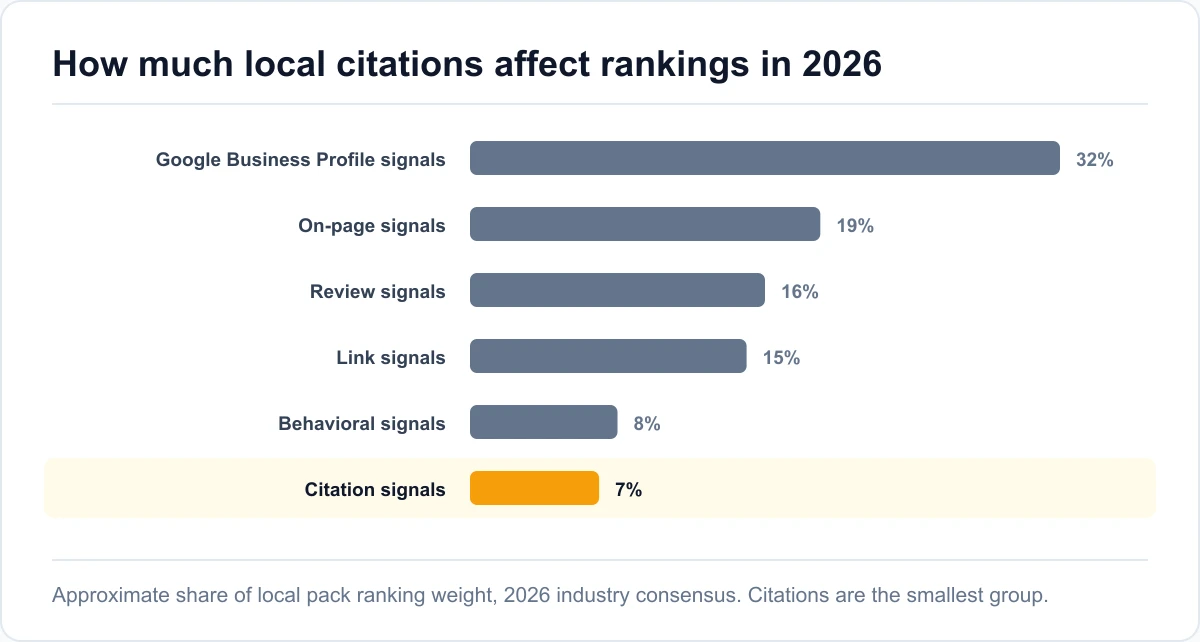
Across the 2026 local search ranking factor surveys, citation signals land at roughly 7 percent of what decides local pack position. That puts them last among the six main groups, behind Google Business Profile signals, on-page signals, review signals, link signals, and behavioral signals. Their share has trended down year over year as the other groups, reviews especially, have grown.
Seven percent isn't nothing. It's enough to matter for a close race in a competitive category. But it isn't where a struggling listing is won or lost, and it's a poor place to spend your first ten hours.
From ranking lever to trust signal
The reason to still care is entity trust. When your name, address, and phone number appear the same way across sources Google already trusts, Google grows more confident that your business is real, is one single entity, and operates where you claim. That confidence supports the prominence half of local ranking.
The inverse is the real risk. Conflicting addresses, an old phone number still live on three directories, or a duplicate listing with a slightly different name all introduce doubt. Doubt shows up as a ranking ceiling, not a sudden drop.
You don't get penalized for it. You just stop climbing.
How consistent citations feed Google's entity confidence
Google assembles its understanding of your business from its own crawl, the structured data on your website, your Business Profile, and corroborating mentions elsewhere. Google's guidelines for representing your business are explicit that your information has to be accurate and consistent for it to show the right details. That same entity record is what feeds AI Overviews and other AI answers when someone asks a local question. So a clean citation footprint quietly supports visibility in places that aren't a blue-link ranking at all.
The Local Citation Sources That Actually Matter
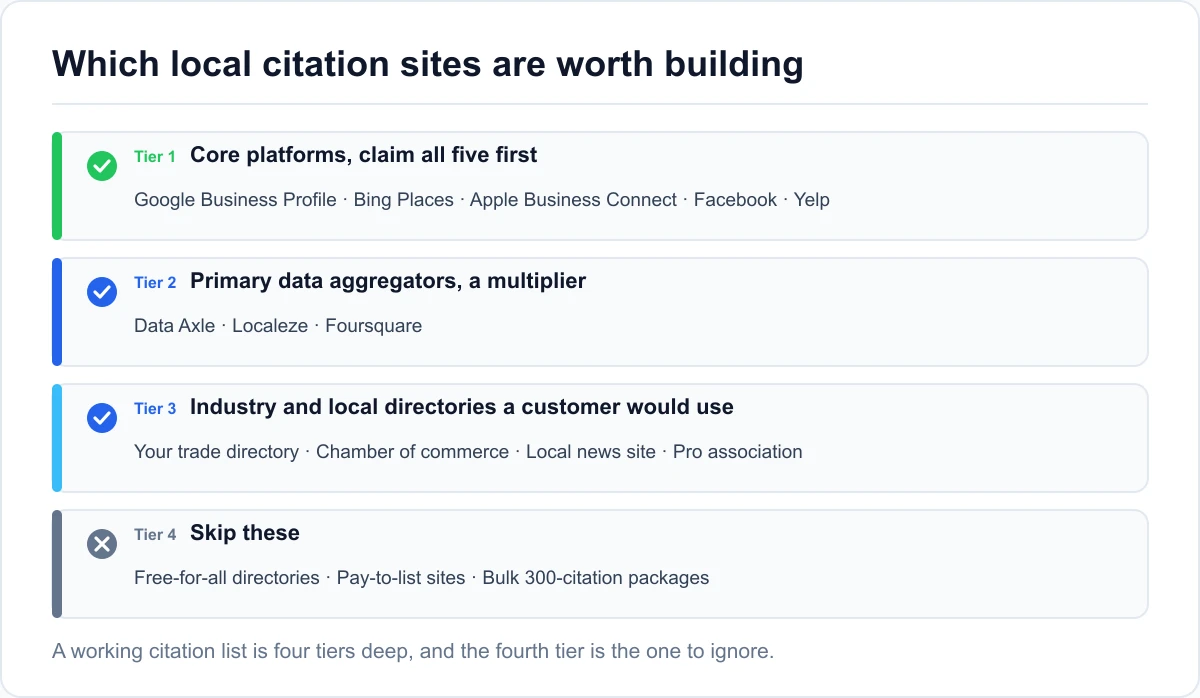
Most "top 150 citation sites" lists are padded with directories no one visits and Google barely weighs. A working list is short. Here's how to think about it, in four tiers.
The core platforms every business needs
These are non-negotiable and you control them directly:
- Google Business Profile, the single highest-impact listing and the one that feeds the map pack
- Bing Places
- Apple Business Connect, which powers Apple Maps
- Yelp
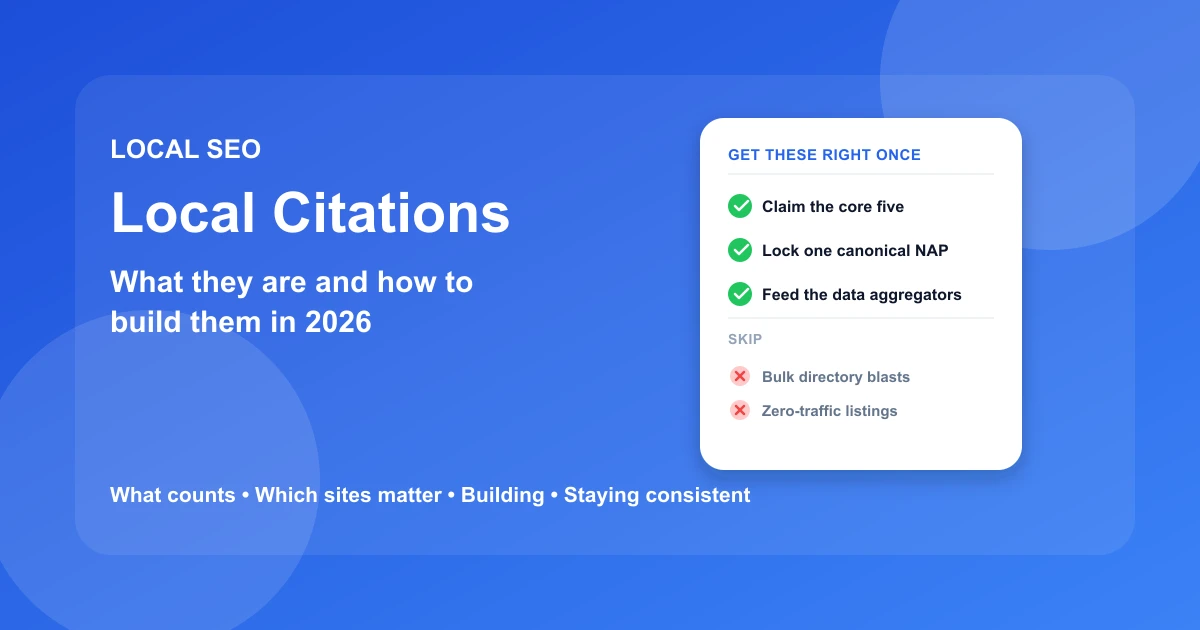
Claim and fully complete all five before touching anything else. For many small businesses, these plus a clean website are enough citation coverage to compete.
The primary data aggregators
A few companies collect business data and syndicate it to hundreds of downstream directories, apps, GPS systems, and voice assistants. In the United States, the names to know are Data Axle, Localeze (now run by TransUnion), and Foursquare. Getting your details right with these has a multiplier effect. A single correction can propagate outward, and a single stale record can keep reappearing on sites you never submitted to.
The aggregator landscape keeps changing hands, so confirm the current submission routes before you pay anyone. You can submit to some directly. Others are reached through a paid service.
Industry and local directories worth the time
After the core five and the aggregators, add citations that a real customer might actually use:
- Your primary industry directory, for example Avvo for a law firm, Healthgrades for a medical practice, HomeAdvisor or Angi for a trade
- Your city or regional chamber of commerce
- A well-known local news or community site with a business directory
- Any professional association you belong to that lists members publicly
These often send referral traffic on top of the citation value, which the junk directories never do.
The low-value directories to skip
Some sources aren't worth the time: free-for-all directories with no editorial standards, sites that exist only to sell you an upgrade, and anything that charges to list a basic citation. Bulk submission services that promise 300 citations in a week mostly place them here. A citation on a site with no traffic and no trust adds almost nothing, and if it introduces a NAP mismatch, it's a net negative.
How to Build Local Citations Step by Step
Build in this order. Auditing before submitting is what separates a clean footprint from a pile of near-duplicates.
Audit what already exists first
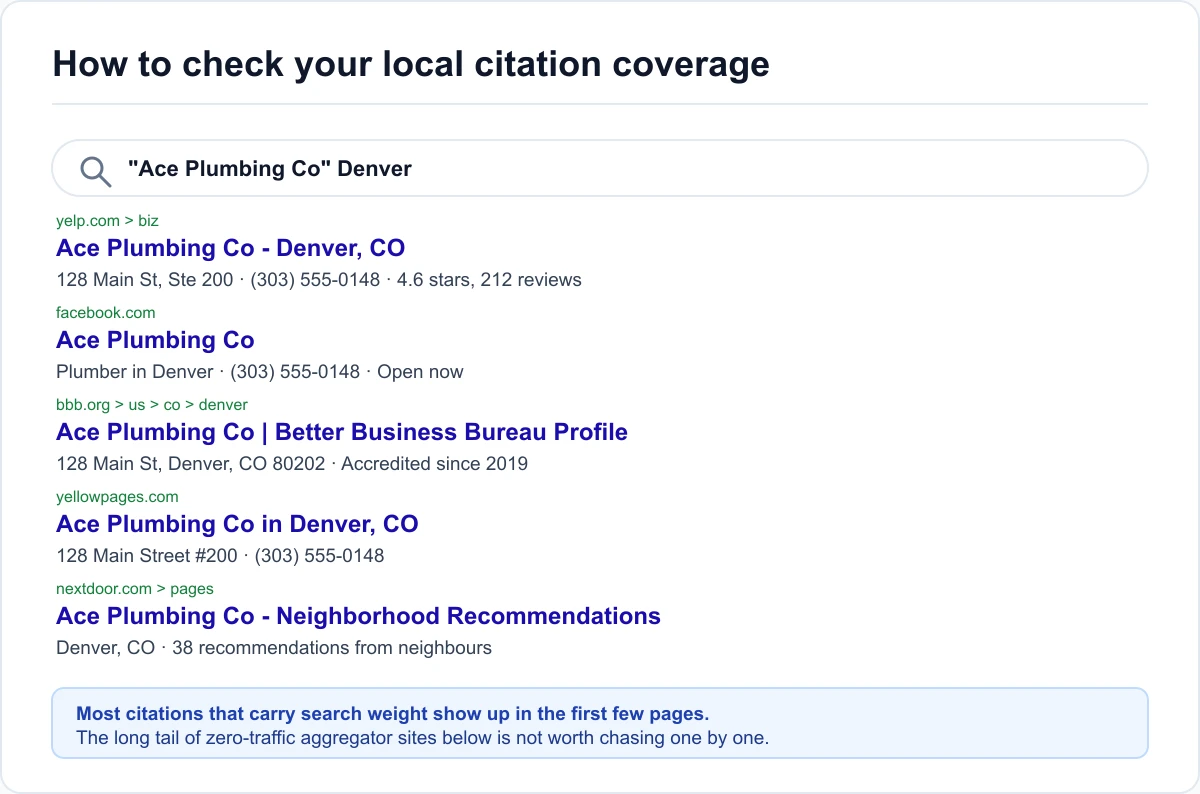
Search your exact business name plus your city on Google and work through the first few pages of results. Note every directory that already lists you, and record exactly how your name, address, and phone number appear on each. You'll usually find listings you never created, some with old or wrong details, sometimes a duplicate of your Google listing.
Fix or claim what's already out there before you add anything new. Stacking fresh citations on top of inconsistent old ones just spreads the inconsistency.
Lock your canonical NAP format
Write down the one correct version of your business name, address, and phone number, down to the abbreviation of "Street" or "Suite" and the formatting of the phone number. That's the version you'll use everywhere, with no variation. Keep it in the same document as your citation tracker.
If your legal name and your trading name differ, pick the name customers actually see on your storefront and signage, and match your Google Business Profile to that.
Claim and complete the core platforms
Work through Google Business Profile, Bing Places, Apple Business Connect, Facebook, and Yelp. For each one, claim the listing, then fill every field: categories, hours, description, service area, photos, and payment methods. A half-finished listing is a weak citation.
Use your canonical NAP exactly. Don't add a keyword to the business name field, since that's a Google guidelines violation that can get the listing suspended.
Submit to the aggregators and a short industry list
Once the core five are clean, get your data right with Data Axle, Localeze, and Foursquare. Then add your main industry directory, your chamber of commerce, and one or two local or professional listings. That's the whole build for most businesses. Ten to fifteen strong, accurate citations beat a hundred thin ones.
Log every citation in a tracker
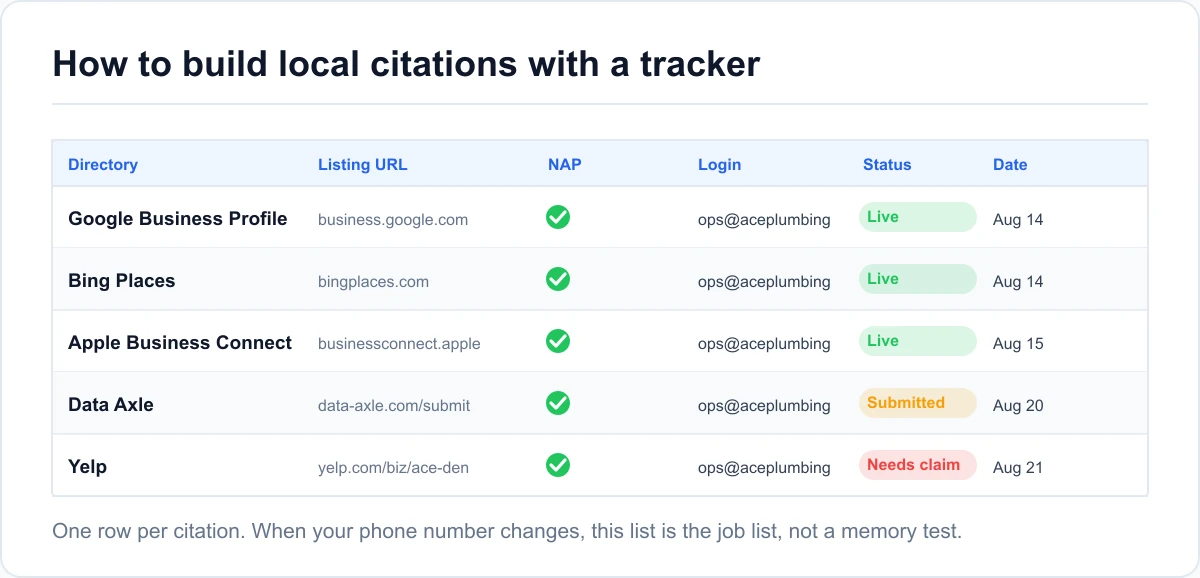
Keep a simple spreadsheet: one row per citation, with columns for the directory, the listing URL, the exact NAP you submitted, the login used, the status, and the date. This is what makes future updates fast. When your phone number changes, the tracker tells you the eleven places you need to edit instead of leaving you to rediscover them.
Keeping Your Local Citations Consistent
Consistency is where citations either help or quietly hurt. This is the short version. For the full walkthrough of checking and fixing your details across the web, see the guide on NAP consistency.
Why one wrong suite number sets a ranking ceiling
Every version of your address that exists online is a small vote for what your real address is. When those votes disagree, Google hedges, and hedging looks like a listing that ranks fine but never quite breaks into the top three for competitive searches.
One wrong suite number won't remove you from the map pack. It'll hold down your prominence in a way that's hard to diagnose, because nothing visibly broke.
Nail the canonical format once, and the problem mostly takes care of itself, as long as you use that exact format on every new listing.
Handling a move, a rebrand, or a new phone number
When your details change, your tracker becomes the job list. Update Google Business Profile first, then the other core platforms, then the aggregators, then the industry and local listings. Expect the change to take days to weeks to propagate, especially anything downstream of an aggregator.
A move is the hardest case, because the old address can persist on aggregator-fed sites for months. Submit the correction to the aggregators early and keep checking. A phone number change is easier, but it still needs every row in the tracker touched.
Finding and clearing duplicate listings
A duplicate is two listings for the same business on the same platform, usually with slightly different details. They split your reviews and your ranking signals, and Google can end up showing the weaker one. On Google, report a duplicate through the Business Profile tools and ask for it to be merged or removed. On other directories, contact support with both URLs and your canonical NAP.
Duplicates often trace back to a business being auto-listed by an aggregator years ago, then claimed separately later. Clearing them is tedious, and it's worth it.
How to Check Your Local Citation Coverage
You don't need paid software to get a clear picture, though it saves time. The goal is to know where you're listed, whether the details match, and whether anything is duplicated.
The manual name-and-city search method
Search your business name plus your city, then repeat with your phone number in quotes, then your old address if you've moved. Open every directory result and check the NAP against your canonical version. Most citations that carry any search weight will surface in the first three or four pages. The long tail of zero-traffic aggregator sites below that isn't worth chasing one by one.
Do the same search for your closest competitor. It's the fastest way to see which industry and local directories are standard in your market.
What an audit surfaces automatically
An automated check does the same sweep faster and flags the gaps. The GBP SEO Tools audit runs a citation and directory presence check as part of the wider scan, so you can see which directories already list your business without working through search results by hand. It sits alongside checks for your profile fundamentals, reviews, and local pack position, rather than in isolation.
Be clear about what that check does. It confirms whether a listing exists on a given directory, not whether every NAP field on that listing is verified correct. Presence is the starting point, and the manual NAP comparison above is still how you confirm accuracy.
Re-checking on a schedule
Citations drift. Aggregators refresh, directories get bought, and old records resurface. Once your footprint is clean, a check every three to six months is enough for most businesses, plus an immediate pass any time your name, address, or phone number changes. Put it on the calendar the same way you'd schedule a review of your hours before a holiday.
Conclusion
Local citations are still worth getting right, but the job is smaller and more precise than the old "get 200 listings" advice suggests. In 2026 the work is: claim and complete the five core platforms, get your details right with the main data aggregators, add a few industry and local directories a real customer would use, and make sure your name, address, and phone number are identical everywhere.
Skip the bulk submission services and the zero-traffic directories. A citation on a site nobody trusts adds nothing, and if it introduces a mismatch, it works against you. Ten to fifteen accurate citations beat a hundred sloppy ones, and once the footprint is clean, it mostly stays clean with a check every few months.
Start by finding out where you already stand. Run the audit for a read on which directories list your business today, then compare the details against your canonical NAP and fix the mismatches before you add anything new.
Local Citations: Common Questions
What is a local citation, in plain terms?
It's any place online that names your business and shows a piece of contact information, usually your address or phone number. That includes directory profiles like Yelp or Bing Places, and plain mentions in articles or community sites. It doesn't need to link to your website to count.
How many local citations does a business need?
There's no target number, and chasing one is the wrong approach now. Most small businesses are well covered with ten to fifteen accurate citations: the five core platforms, the main data aggregators, and a few industry or local directories. Accuracy and consistency matter far more than the total.
Do citations help if I don't have a website?
Yes. Citations reference your business details, not your site, so they still build local entity trust and can send referral traffic from the directory itself. A website makes everything work better, but a business with no site still benefits from a clean, consistent set of listings.
Are paid citation services worth it?
Sometimes, for the initial setup and for reaching aggregators that are awkward to submit to directly. They're not worth it for volume. A service that promises hundreds of citations is placing most of them on low-value sites, and any NAP mismatch it introduces creates work to undo. If you use one, check its output against your canonical NAP.
How long do citations take to affect ranking?
Individual citations are a slow, cumulative signal, not a switch. Expect weeks to a few months before a cleaned-up footprint shows any ranking effect, and longer for corrections that have to propagate through an aggregator. Fixing a damaging inconsistency tends to show results sooner than adding new listings does.
What's the difference between a citation and a backlink?
A backlink is a clickable link to your website that passes ranking value through the link. A citation is a mention of your business name and contact details, with or without a link. You build backlinks for general SEO authority and citations for local entity trust, and a single directory listing can produce both.
How do I find every directory my business is already listed on?
Search your business name plus your city, then your phone number in quotes, and work through the first few pages of results, recording how your details appear on each. An automated citation presence check does the same sweep faster. There's no single authoritative list, because citations accumulate over time from sources you never submitted to directly.