
NAP Consistency: What It Is and Why It Matters for Local SEO
NAP consistency means your business Name, Address, and Phone number appear exactly the same way across every site where they're listed, your Google Business Profile, your website, Yelp, Facebook, Bing Places, and every other directory a customer or search engine might check. Get that wrong, even by a suite number, and you're quietly asking Google to guess whether two listings actually belong to the same business.
Most business owners assume this is a solved problem the moment their Google Business Profile looks complete. It isn't. A profile can be fully filled out and still disagree with what's printed on the homepage footer, or with what an old Yelp listing has said for three years. This guide covers what counts as a real mismatch, how to check for one, and how to fix what you find, without pretending every citation tool can verify what it actually can't.
In this guide:
- What NAP and NAP citation actually mean
- Why consistency affects local pack ranking, and why less than it used to
- How to check your own NAP consistency
- How to improve it once you've found the gaps
- Where NAP mismatches hide on your own website
Want to see where your own listing stands first? The GBP SEO Tools platform runs a website audit that cross-checks your site's NAP details against your Google Business Profile directly, the exact comparison this guide walks through by hand (more on that at the end).
What Does NAP Stand For in SEO?
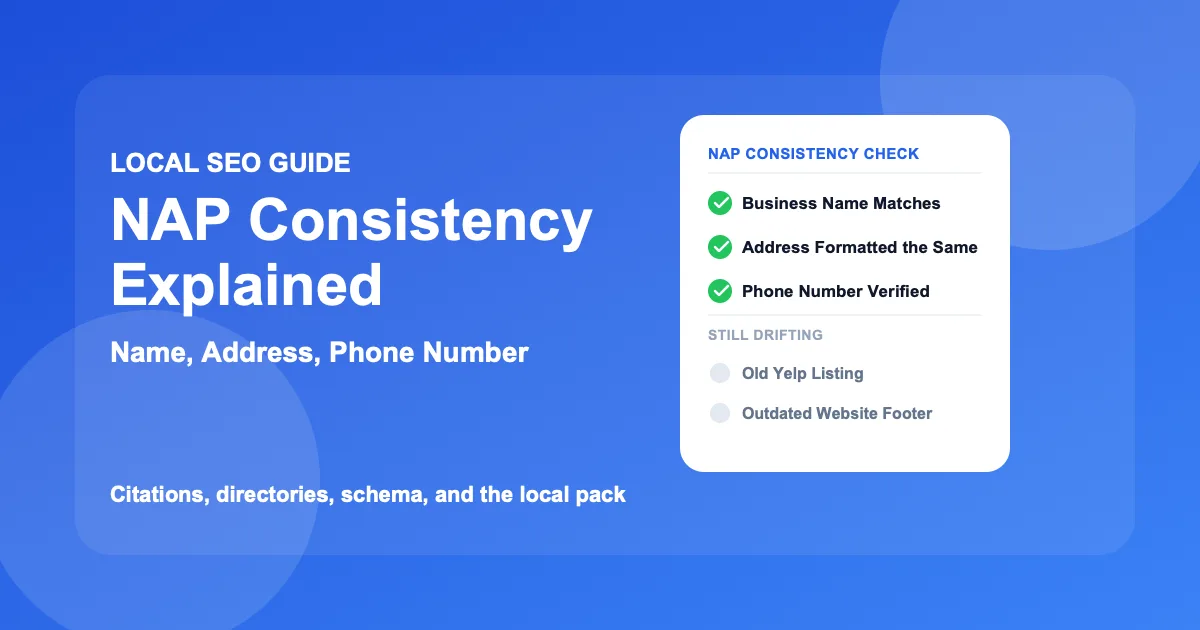
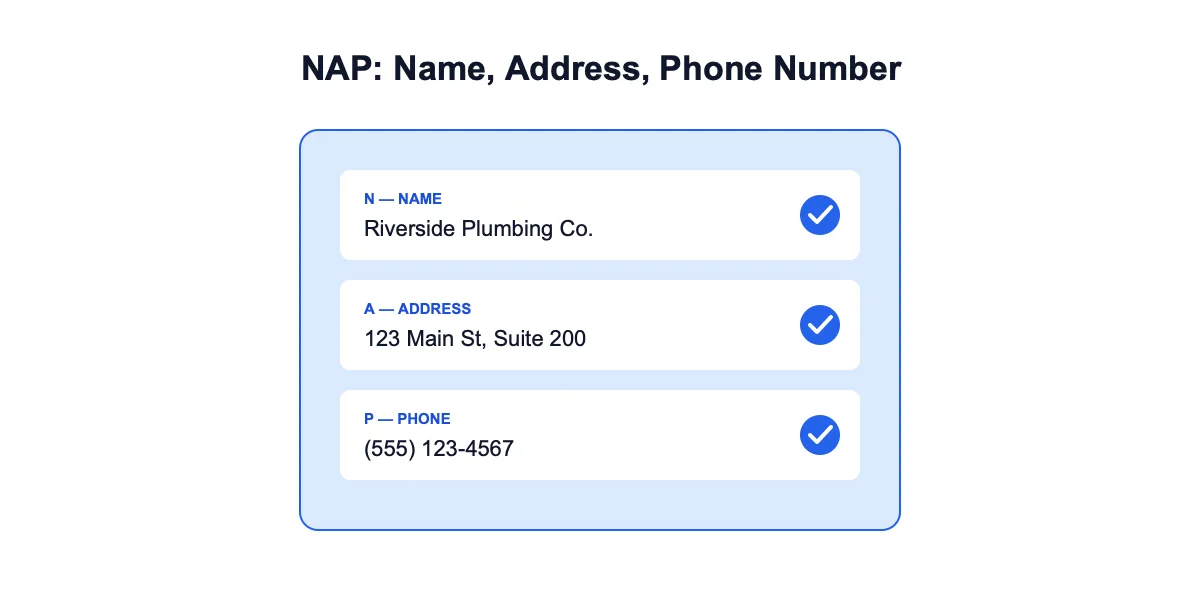
NAP stands for Name, Address, and Phone number, the three identifying details that let a search engine (and a customer) confirm that a listing on one site and a listing on another belong to the same physical business. It's not a ranking factor by itself. It's a matching problem: Google cross-references these three fields across every site it can find your business mentioned on, and inconsistency introduces doubt into that match.
What Is a Consistent NAP?
A consistent NAP means the name, address, and phone number are formatted identically, not just similarly, everywhere they appear. That's a narrower bar than most business owners expect.
Here's what inconsistent looks like in practice, three small mismatches that all count:
- Address: "123 Main St, Suite 200" on your website vs. "123 Main Street, Ste. 200" on Yelp
- Phone: "(555) 123-4567" on your Google Business Profile vs. "555.123.4567" on an old Facebook page
- Name: "Riverside Plumbing Co." on your site vs. "Riverside Plumbing" (no "Co.") on a directory that scraped an outdated listing
None of these are wrong information. They're formatting drift, and formatting drift is exactly what an automated matching system has to work around. A consistent NAP picks one format for each field and uses it everywhere, down to the abbreviation.
What Is a NAP Citation?
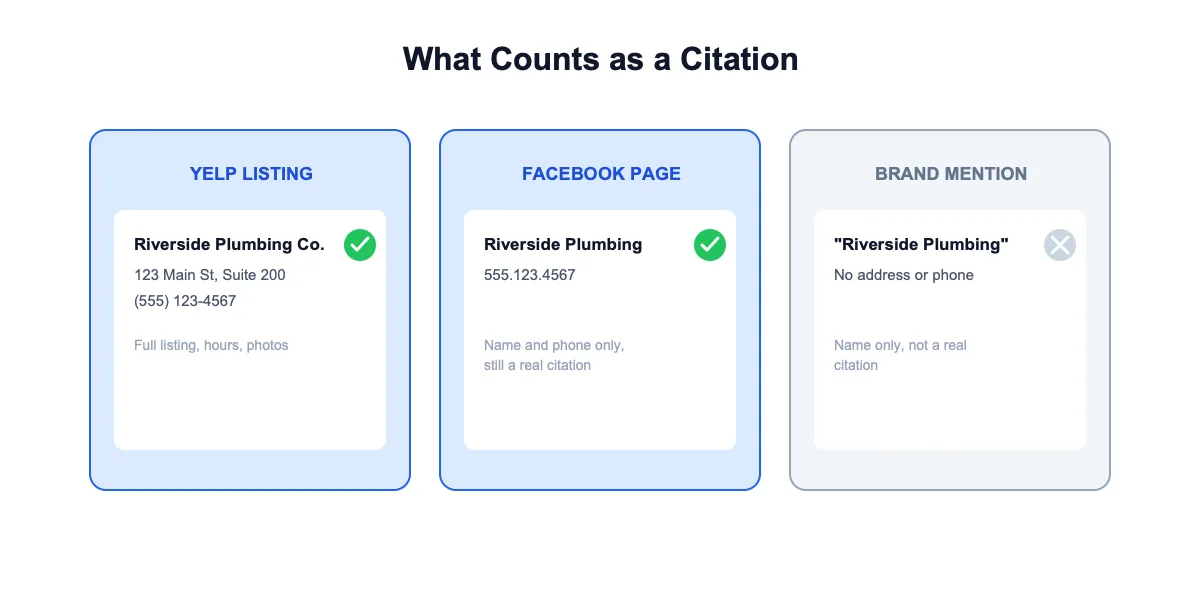
A NAP citation is any online mention of your business's name, address, and phone number, whether or not it links back to your website. A full listing on Yelp with your hours and photos is a citation. A one-line mention in a local news article with just your business name and phone number is also a citation. Directories, industry associations, chambers of commerce, and local news sites all generate citations, and each one is a place your NAP details can drift out of sync without anyone noticing.
Why NAP Consistency Matters for Local Pack Ranking
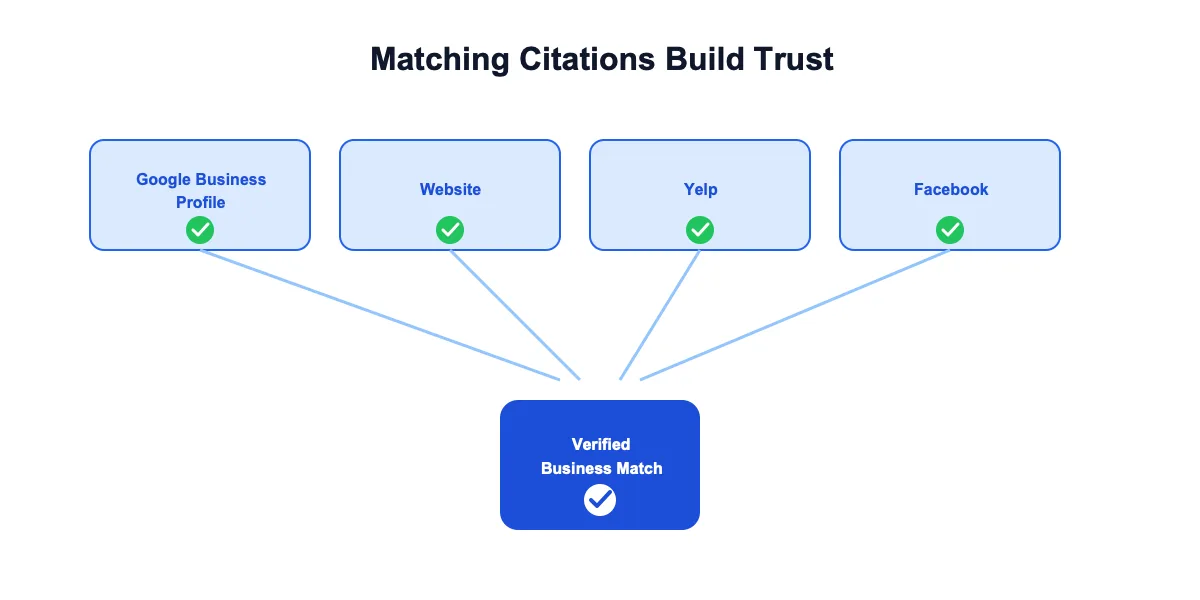
NAP consistency affects ranking indirectly. It's not a direct ranking boost so much as a trust signal, Google is more confident matching your business across the web when every citation agrees, and more cautious when they don't. A profile buried in conflicting address formats gives Google less to confirm, which shows up as a ranking ceiling rather than a hard penalty.
It's worth being precise about how much this still matters, because the answer has actually shifted. Citation-based signals, including NAP consistency, have trended downward for local pack and organic ranking for several years running, no longer the top-3 priority they were in 2018. They're resurging for a different reason: AI-driven search tools lean on citation agreement to confirm a business is real before surfacing it at all, which makes clean NAP data relevant again even as its classic ranking weight declines. Google's official business guidance still treats accuracy across your listing as foundational, even where it doesn't spell out every downstream ranking effect.
How a Single Mismatch Quietly Caps Visibility
A mismatch rarely tanks a ranking outright. What it does instead is cap how much Google trusts everything else on the profile, category accuracy, review volume, photo completeness, all of it sits on top of Google's confidence that this is one verified business, not several fragmented listings. One old directory with a wrong suite number won't sink a profile. Ten years of accumulated citations that never got updated after a move will.
How Do I Rank My Google Business Profile on Top?
NAP consistency is one input into local pack ranking, not the whole answer. The three factors Google names directly are relevance (how well your category and listing match the search), distance (how close you are to the searcher), and prominence (reviews, links, and overall visibility). NAP consistency mainly supports prominence, by removing doubt about which listing is authoritative. For the full breakdown of what actually moves a business toward the top of the local pack, see this local pack ranking guide.
How to Check NAP Consistency
Checking NAP consistency by hand means picking a small, fixed list of places to check, not trying to audit the entire internet. Most businesses only need to get five to ten directories right to cover the ones that actually carry weight.
Audit Your Core Directories First
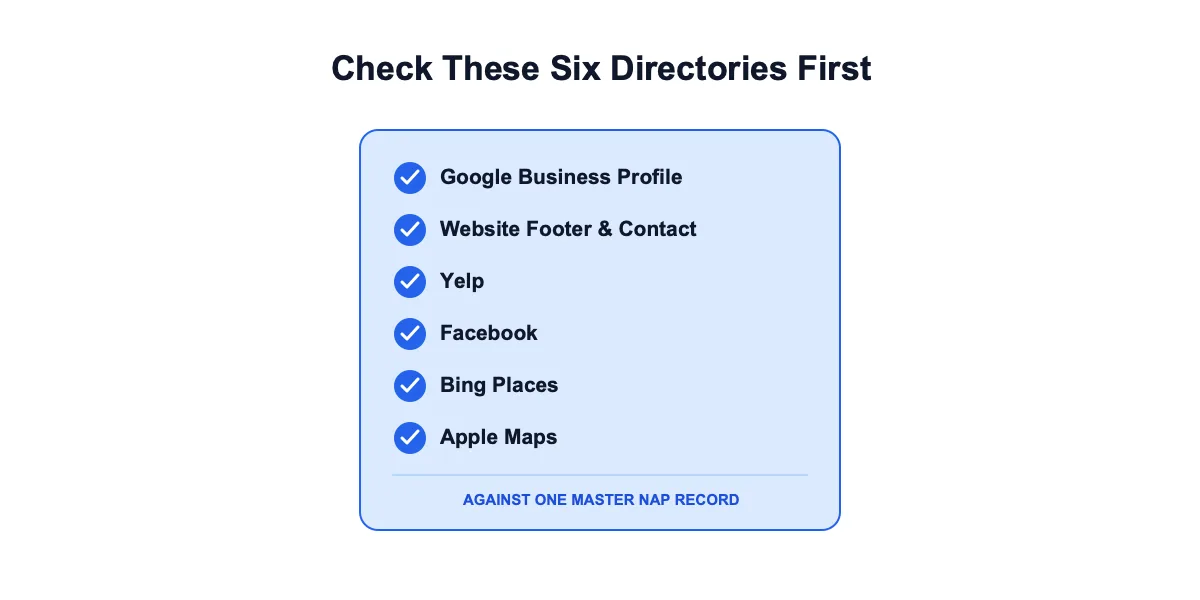
Start with a single master record, the exact name, address, and phone number formatting you want to use everywhere, written down in one place. Then check it against these, in priority order:
- Your Google Business Profile
- Your website's footer and contact page
- Yelp
- Bing Places
- Apple Maps
Write down every discrepancy you find rather than fixing them as you go, it's easier to batch the corrections once you know the full scope.
A website audit automates the first comparison, your site against your GBP, and flags exactly where the two disagree, which is usually the highest-value mismatch to catch since it's the pair customers cross-reference most.
How to Improve NAP Consistency Once You Find Gaps
Fix the master record first if the audit turned up a genuine error, not just a formatting difference, a wrong phone number is worth correcting everywhere immediately. For pure formatting drift, work through each directory's own edit flow one at a time: most platforms let you update a business listing directly once you've claimed it, and unclaimed listings usually have a "suggest an edit" or "report a problem" option instead. Prioritize the directories with real traffic first, Yelp and Facebook typically matter more than a citation site nobody browses, and treat the rest as cleanup once the high-traffic ones are fixed.
Citations and Directory Listings
Citations are where NAP inconsistency tends to accumulate the most, since a business can pick up dozens of them over the years without ever intentionally submitting to most of them. This section covers how citations relate to NAP matching; for what a citation is and how to build a clean set from scratch, see the full guide on how to build local citations.
What Actually Counts as a Citation
A citation counts if it shows your business name alongside at least one other identifying detail, address or phone number, published somewhere searchable. A passing mention of your business name with no contact detail attached is a brand mention, not a citation, and it doesn't carry the same NAP-matching weight.
Which Directories to Prioritize First
For NAP-matching purposes, fix the listings with real search visibility and real customer traffic first: Yelp, Facebook, Bing Places, Apple Maps, and whatever directory is standard for your industry. A mismatch on a low-traffic aggregator that only scrapes other directories is worth cleaning up eventually, not before the ones customers actually browse.
NAP Consistency on Your Website
Your own website is a NAP source too, and it's the one most audits skip, since it's easy to assume a site "obviously" matches the business that built it.
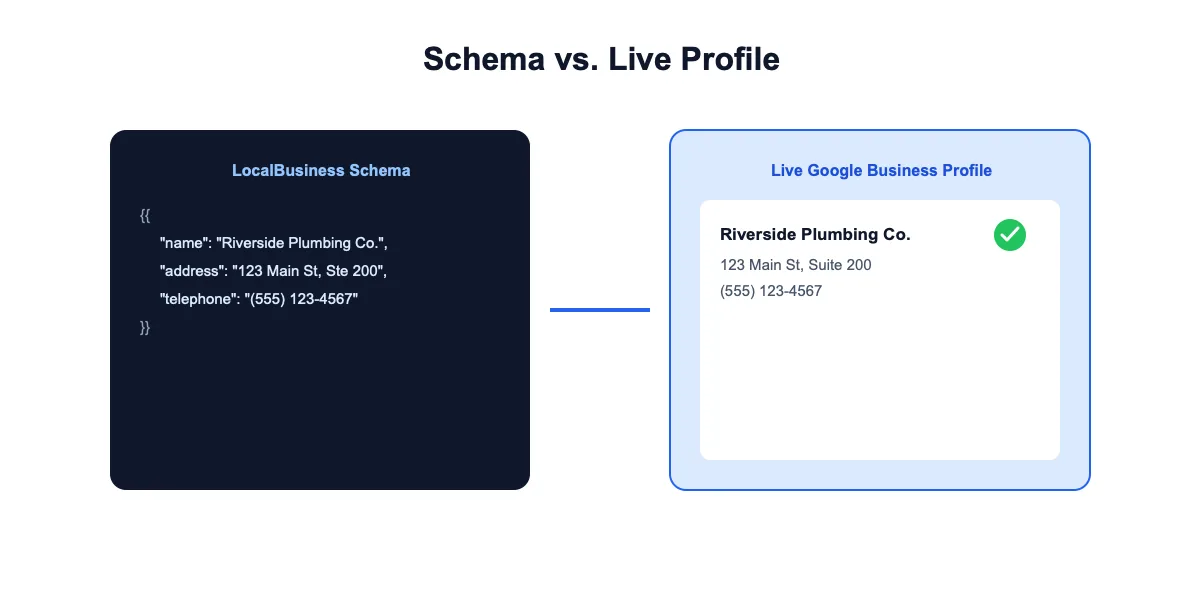
LocalBusiness Schema and Matching Your GBP
LocalBusiness structured data lets your website state its name, address, and phone number in a format search engines can parse directly, rather than inferring it from footer text. When that schema's fields don't match your Google Business Profile exactly, you've created a NAP mismatch that lives entirely inside your own site's code, invisible to a visitor but fully visible to anything reading the markup. Checking this pairing, site schema against live GBP data, is exactly the kind of cross-reference a manual read-through tends to miss.
Where On-Site NAP Mismatches Hide
The most common places a website's NAP quietly drifts: a footer phone number that never got updated after a number change, a contact page address that still shows a previous location, and structured data added once at launch and never revisited after either changed. None of these are visible from a normal page read, they only surface when someone (or something) checks the footer text, the contact page, and the schema markup against the current GBP listing side by side.
NAP Consistency: Common Questions
What happens if my address is wrong on different directories?
An inconsistent address doesn't remove your listing, but it weakens the confidence signal Google uses to confirm your business is the same entity across every site it's mentioned on. In practice this shows up as a ranking ceiling rather than a sudden drop, harder to reach the top of the local pack, not automatically removed from it.
How do I find every directory my business is listed on?
There's no single authoritative list, since citations accumulate over time from directories a business never directly submitted to. The practical approach is searching your exact business name plus city in Google and checking the first few pages of results, most citations that actually carry search weight will surface there, along with a scattering of low-value aggregator sites not worth chasing.
Does citation consistency actually affect Google ranking?
Yes, but its weight has trended downward for classic local pack and organic ranking over the past several years. It matters more today for a different reason: AI-driven search tools use citation agreement to confirm a business is real before including it in results at all, which keeps clean, consistent NAP data relevant even as its old-style ranking impact has softened.
What are the best directories to list a local business on?
Yelp, Facebook, Bing Places, and Apple Maps cover the general-purpose directories worth prioritizing for nearly any local business. Beyond those four, the right directories depend on the industry, a licensing board or professional association listing usually carries more weight for a specialized business than a generic small-business aggregator most customers never browse.
Check Your Own NAP Consistency Now
Reading through a list of what NAP consistency means is useful groundwork, but it doesn't tell you whether your own listing has a mismatch sitting in it right now. That part only shows up when your actual site and your actual profile get compared side by side.
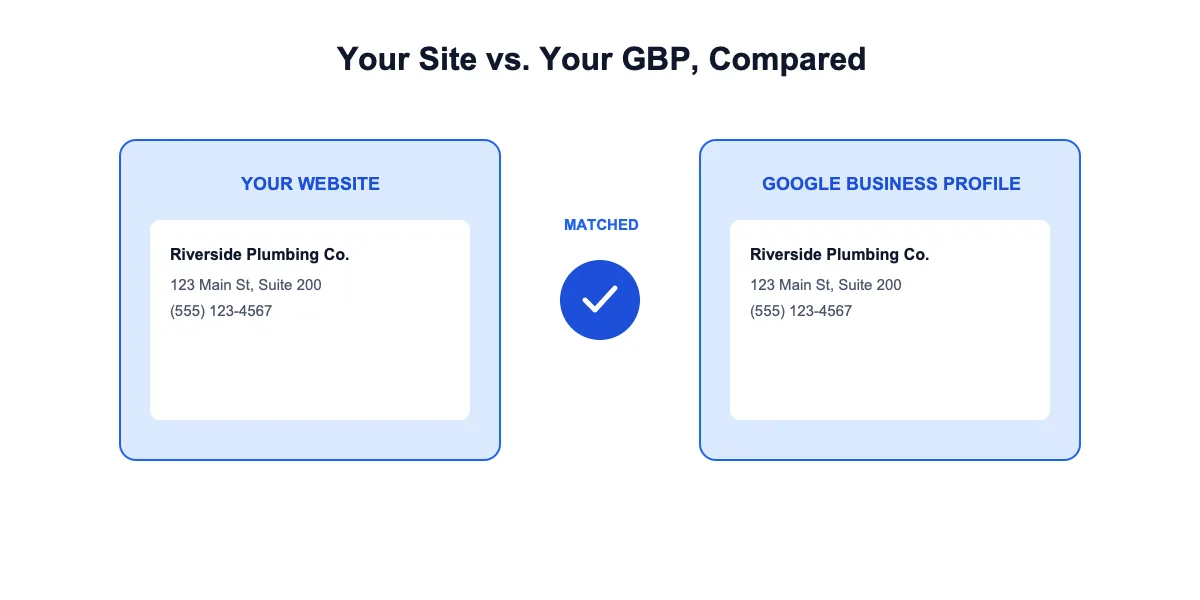
What the Website Audit Actually Compares
The website audit checks your site's name, address, and phone number directly against your live Google Business Profile, the exact comparison this guide walks through manually, done in the time it takes to load the page. It's one check inside a wider scan covering LocalBusiness schema, technical foundation, and on-page local signals, so a NAP mismatch doesn't get flagged in isolation from the rest of the picture.
Start With Your Site and GBP Side by Side
Before chasing down every directory on the internet, start with the one comparison that matters most: does your own website agree with your own Google Business Profile? Get that pair right first, then work outward to Yelp, Facebook, and the rest of the citations covered above.