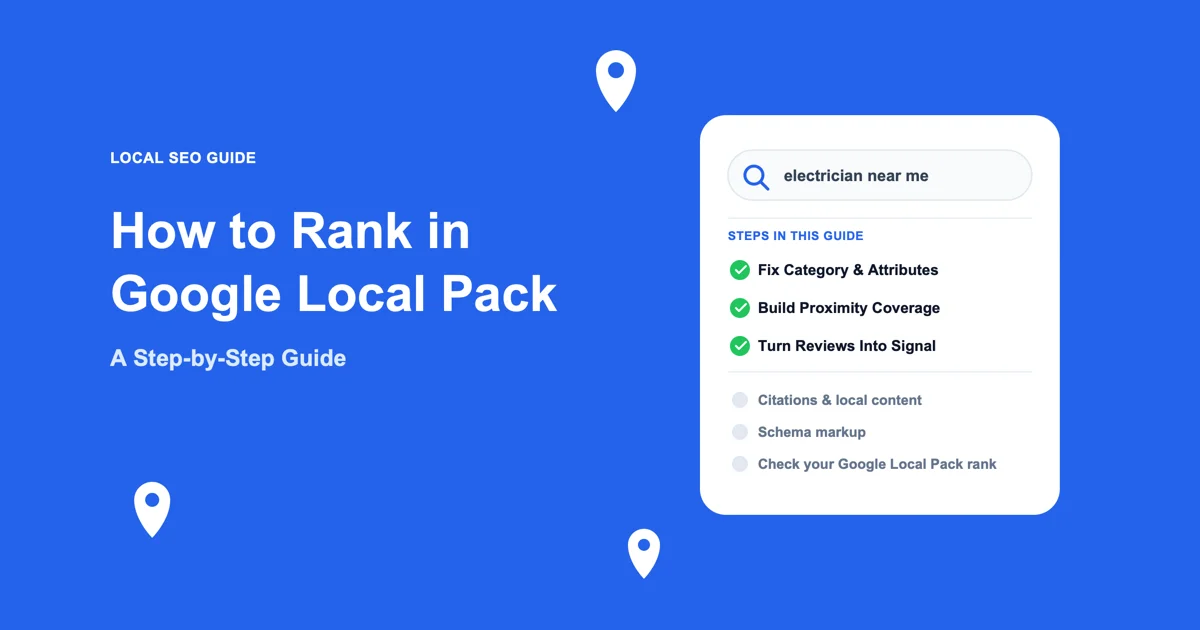

How to Rank in Google Local Pack: A Step-by-Step Guide
A business can fill in every field, add new photos every week, and still watch a newer competitor with half the reviews slide into Google Local Pack ahead of it. Local pack ranking, whether a business actually shows up in the three-listing block with a map that Google puts above regular search results, isn't decided by how finished a profile looks. It comes down to a specific, checkable set of signals most businesses have never worked through in order.
This guide walks through that order: 10 concrete moves, what to fix first, why it matters, and how to confirm a fix actually changed anything instead of just hoping it did. No jargon dump, no vague "optimize your listing" advice, just the sequence that actually improves local pack ranking.
Want to skip straight to your own numbers? Check your Google Business Profile score first, then come back and work through whichever step below matches your biggest gap.
Google's own guidance narrows all of this down to three underlying factors: relevance, distance, and prominence. Every step below maps back to one of those three.
1. Fix Your Primary Category and Attributes First
Primary category carries more weight in local pack ranking than almost anything else on a profile. It's the fastest lever to check and, for a lot of businesses, the one most likely to be set wrong.
Primary Category, the Single Biggest Relevance Signal
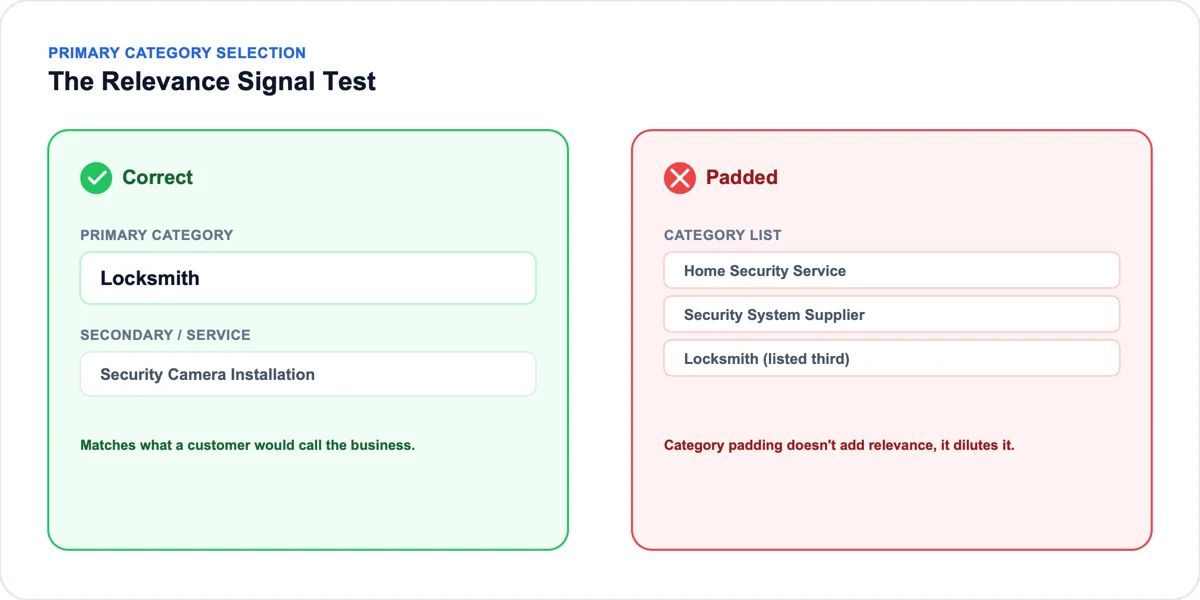
Ask what a customer would call the business first, not everything it technically does. A locksmith who also installs security cameras should have "Locksmith" as the primary category, with camera installation listed as a secondary category or a service, not the other way around. Marcus ran a mobile locksmith service out of Tucson for four years with "Home Security Service" set as his primary category, a leftover from how he'd first set up the listing. He never showed up for "locksmith near me" searches within his own service area. Switching the primary category took under five minutes. Within three weeks he was appearing in the local pack for searches he'd never ranked for before.
Attributes and Services That Reinforce Relevance
Beyond category, the Services section and any category-specific attributes (mobile service, 24-hour availability, licensed and insured) give Google more explicit signal to match against specific searches. Leave these blank and a profile is relying on category alone to prove relevance, when it doesn't have to.
2. Build Proximity Coverage Across Your Service Area
Distance is the one signal a business can't fully control, but service area settings and address accuracy still shape how far that advantage reaches.
Why One Address Can Rank Differently a Few Streets Away
Local pack ranking shifts based on where a search physically originates, not just what the profile looks like. A listing can rank in the top three searched from directly outside its own door and disappear from the pack entirely once that same search shifts even half a mile toward where a real customer is more likely searching from. Checking only from the business's own location almost always overstates how visible it actually is.
Service Area Settings That Help or Hurt Distance Signals
For service-area businesses without a walk-in storefront, an oversized service area can work against ranking instead of expanding it. Google's guidance on managing service areas recommends keeping the overall area within about two hours of driving time from the business's base. A landscaping company in Ohio had set its service area to cover three neighboring states, hoping for more reach. Local pack ranking stayed weak everywhere, including the towns closest to their yard. Trimming the service area down to a realistic 90-minute radius concentrated the relevance signal instead of spreading it thin, and local pack visibility improved within the trimmed area inside a month.
3. Turn Reviews Into a Prominence Signal
Prominence is Google's read on how well-known and trusted a business is, and reviews are the clearest signal a business can actively influence.
Review Velocity Beats Review Count
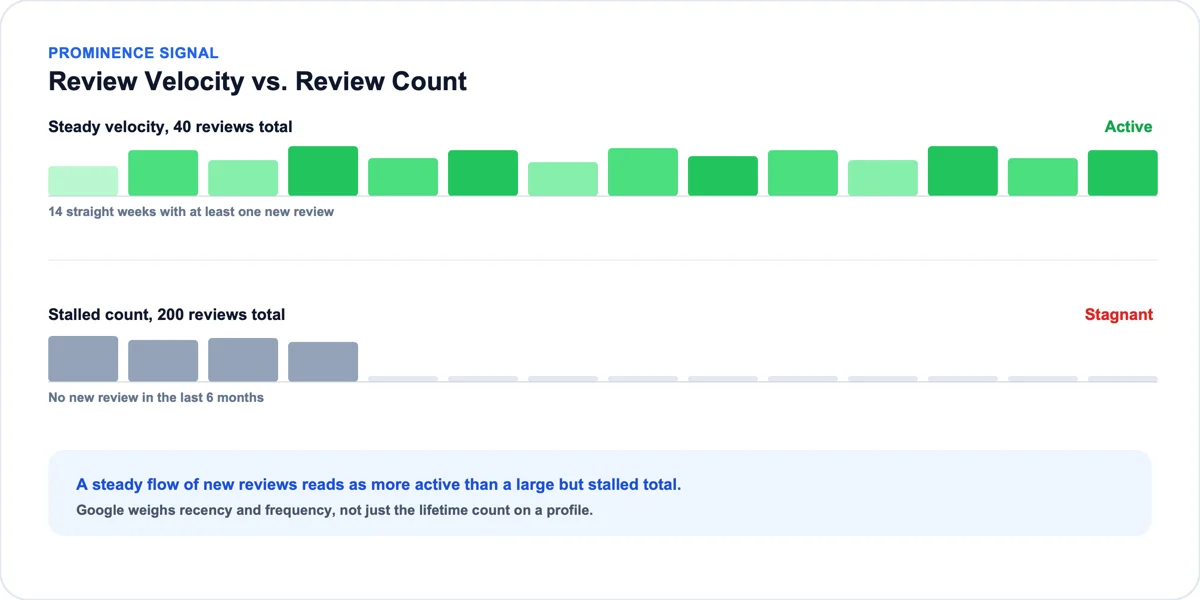
A steady flow of new reviews signals an active, trusted business more strongly than a large but stagnant total. A business with 200 reviews and none in the last six months can lose ground to a newer competitor with 40 reviews and five arriving every week. Build a simple, consistent ask into the customer experience, a text after service, a card at checkout, rather than one big review push.
Responding to Reviews Without Overdoing It
Replying to reviews, especially negative ones, shows engagement without requiring a defensive or lengthy response. A short, specific reply that acknowledges the issue and states what changed does more for prominence than either silence or an over-explained defense.
Want the fuller data behind this? Category, reviews, and prominence signals are broken down by weight in our local SEO ranking factors guide, useful once the steps here are underway and it's time to prioritize what's left.
4. Keep Your Citations and NAP Information Consistent
Citations, mentions of a business's name, address, and phone number on other sites, are a smaller lever than category or reviews, but an inconsistent one quietly caps how much Google trusts the rest of the profile.
What Counts as a Citation
Directory listings on sites like Yelp, Facebook, Bing Places, and industry-specific directories all count, whether or not anyone ever clicks through them. Google treats a consistent presence across a handful of relevant directories as a legitimacy signal, not a traffic source.
Why Even a Small NAP Mismatch Hurts
"Suite 100" on one directory and "Ste. 100" on another, or an old phone number that never got updated after a move, is enough to introduce doubt into an automated system that's matching records across sites. A quarterly spot-check across the 4 or 5 directories that actually matter for a given business catches most of this before it becomes a pattern.
5. Publish Local Content That Matches Real Searches
A Google Business Profile alone can carry a listing into the local pack, but a website with genuinely local content reinforces the same relevance signal from a second direction.
What Actually Helps: Service and Location Pages
A dedicated page per service, or per area served for a multi-location or service-area business, gives Google more specific text to match against specific searches than a single generic homepage ever can.
What to Skip: Thin, Duplicated Location Pages
A location page that's identical to every other location page except for a swapped city name does more harm than good. Google treats near-duplicate pages as low-value, and a thin page can drag down the perceived quality of the whole site rather than adding new relevance.
Not sure which searches are worth a page in the first place? A local keyword finder that pairs your service with your city or neighborhood turns this into a shortlist of real local searches instead of a guess at what to write about.
6. Add LocalBusiness Schema Markup
Schema markup doesn't directly move ranking the way category or reviews do, but it removes ambiguity from information Google already has to piece together another way.
What Schema Actually Tells Google
LocalBusiness structured data on a website states the business name, address, phone number, hours, and service area in a format machines can read directly, rather than one Google has to infer from page text and formatting.
Keep It Accurate, Not Just Present
Schema that contradicts what's actually on the Google Business Profile, an old address, outdated hours, is worse than having none at all. Treat it as something to keep in sync with the profile, not a one-time setup task. A local SEO website audit checks whether that structured data is actually present and lines up with the profile, instead of assuming a developer set it up correctly once and moved on.
7. Check Your Google Local Pack Ranking From More Than One Point
Fixing category, service area, and reviews only matters if there's a way to confirm local pack ranking actually moved. Checking from one address, again, tells an incomplete story.
How to Check Local Pack Ranking From Multiple Points
A real check means searching the target keyword from several points spread across the service area, not just from the business's own front door. That's what the free score mentioned at the start of this guide already does automatically, the business's own coordinates plus four points roughly a mile out, so it's clear whether visibility holds up across the area or drops off a few streets from home. For a denser view, a Google Maps rank tracker checks the same keyword from a full grid of points and logs how each one moves over time.
How to Track Local Pack Ranking Over Time
A single check is a snapshot, not a trend. Re-run the same check on a set schedule, weekly while actively working through fixes, monthly once ranking stabilizes, and log the position each time. Ranking movement from category or service area changes typically takes days to a few weeks to show, since it depends on when Google next recrawls and re-evaluates the signals around a listing.
8. If You Still Aren't Ranking, Compare Against the Competition
If none of the steps above are moving the needle, the gap is usually in one of two places. If the profile isn't appearing at all, diagnose a listing that isn't showing first, since ranking work only helps a profile that's live.
Why Is My Competitor Ranking Higher on Google Maps
Pull up a competitor's profile directly and compare category, review count and recency, and photo count side by side. The gap is rarely a mystery once it's laid out. Most of the time it's one clearly stronger signal, a more specific category, a faster review velocity, not five things wrong at once.
How Many Businesses Actually Show in the Local Pack
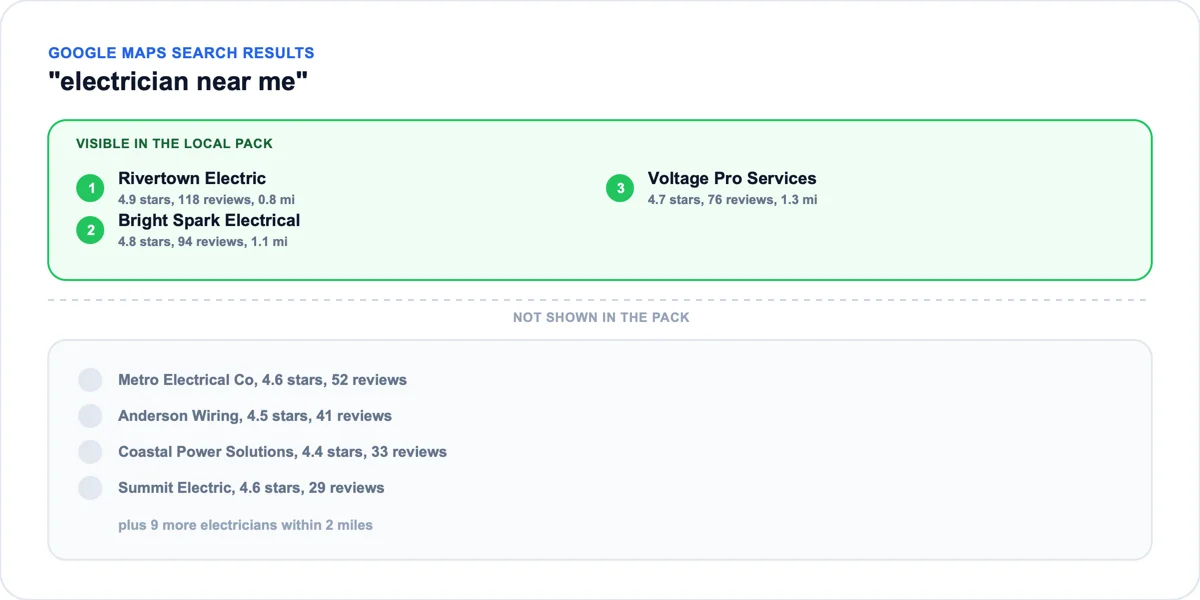
Only three listings show in the local pack for any given search, out of what's often dozens of businesses in the same category nearby. That scarcity is exactly why the fixes above matter more than they might seem to from a quick glance at a "complete-looking" profile. Ranking fourth or fifth in the category still means invisible to the large majority of that search's traffic.
9. Follow the Right Priority Order, Not Everything at Once
Working through every signal above at once is a good way to stall. This is the order that tends to move local pack ranking fastest.
Priority Order If You're Starting From Zero
- Fix the primary category and fill in relevant attributes.
- Trim or confirm the service area falls within a realistic driving radius.
- Build a consistent, low-friction review ask into the customer experience.
- Check local pack ranking from multiple points to confirm what actually moved.
What to Skip If You're Already Ranking, Just Not in the Pack
If category, service area, and reviews all check out and ranking still hovers just outside the local pack, the remaining gap is usually citation consistency or thin local content, not a reason to redo the fundamentals covered in steps 1 through 3.
10. Be Patient and Track Progress Over Time
Local pack ranking rarely moves in a straight line, and the fixes above compound rather than stack in order.
Realistic Timelines for Each Type of Fix
Field-level changes reflect within hours to a couple of days. Category and citation fixes take longer to show, since they depend on when Google next recrawls the listing. Review velocity and content changes are the slowest, often several weeks, since they depend on real customer behavior building up over time, not a setting that flips instantly.
What to Keep Doing After You Rank
Reaching the local pack isn't the end state. A profile that stops collecting reviews or lets its service area drift out of date can slide back out just as a competitor's steady effort pushes past it. Treat the checks above as an ongoing routine, not a one-time project.
Google Maps Ranking Factors at a Glance
A quick reference for the categories behind everything covered above, useful once the individual steps start blurring together.
The Categories Google Weighs Most
Google Business Profile signals carry the most weight of any category, followed by reviews, then on-page website signals, then smaller categories like citations, behavioral signals, and links. That order roughly matches the priority sequence in Step 9, not a coincidence, this guide is ordered by how much each category actually tends to move ranking.
Where Each Step Above Fits
Category and attributes cover GBP signals. Reviews cover review signals. Schema markup and local content cover on-page signals. Citations cover, unsurprisingly, citation signals. A full weighted breakdown with exact percentages lives in our local SEO ranking factors report, worth a read once these fundamentals are in place and it's time to prioritize what's left.
FAQs About Local Pack Ranking
What Is the Local Pack?
The local pack is the block of three business listings and a map that Google shows at the top of search results for searches with local intent. Some people still call it the map pack or the 3-pack, older names for the same feature, but local pack is the current term.
What's the Difference Between Local Pack Ranking and Organic Ranking?
Organic ranking is Google's regular list of website results, ranked mostly by relevance and site authority. Local pack ranking pulls from a different set of signals tied to the Google Business Profile itself: category, reviews, proximity to the searcher, and citation consistency. A business can rank well organically and still be invisible in the local pack, or the reverse, because Google evaluates the two almost independently.
How Does Google Decide Who's in the Local Pack?
Google ranks local pack results using three main factors: relevance (how well a profile matches what was searched), distance (how close the business is to the searcher or the searched area), and prominence (how well-known and trusted the business is, based largely on reviews and web presence).
Why Does My Ranking Change Depending on Where I Search From?
Distance is one of the three core local pack ranking factors, so the same search run from different physical points can return different results. A business can rank in the pack from its own address and drop out a few miles away, which is why checking from a single point never tells the full story.
Can a Service-Area Business Rank in the Local Pack Without a Storefront?
Yes. A service-area business without a public storefront can still appear in the local pack, it manages visibility through its service area settings rather than a walk-in address. The listing still needs an accurate primary category, a hidden business address, and a service area kept within a realistic driving radius, oversized coverage weakens the distance signal instead of strengthening it.
How Long Does It Take to Improve Local Pack Ranking?
Field-level changes, like fixing a category or filling in attributes, are picked up by Google within a few hours to a couple of days. Actual ranking movement takes longer, typically days to a few weeks, since it depends on review velocity building up and Google recrawling and re-evaluating the listing.
Check Your Google Local Pack Ranking Now
What a Real Check Looks Like
Everything in this guide comes down to one question: does the fix actually change where a listing shows up, checked from more than one point. A profile can look finished and still be invisible a few streets from home.
Run Your GBP Audit
Run a Google Business Profile audit to see where a listing stands today, no sign-in required, $4.99 one-time, then work through whichever step above matches the biggest gap it finds. It works the same whether it's your own listing or a competitor's you're sizing up.