
How to Rank Higher on Google Maps When You're Only #1 on Your Own Street
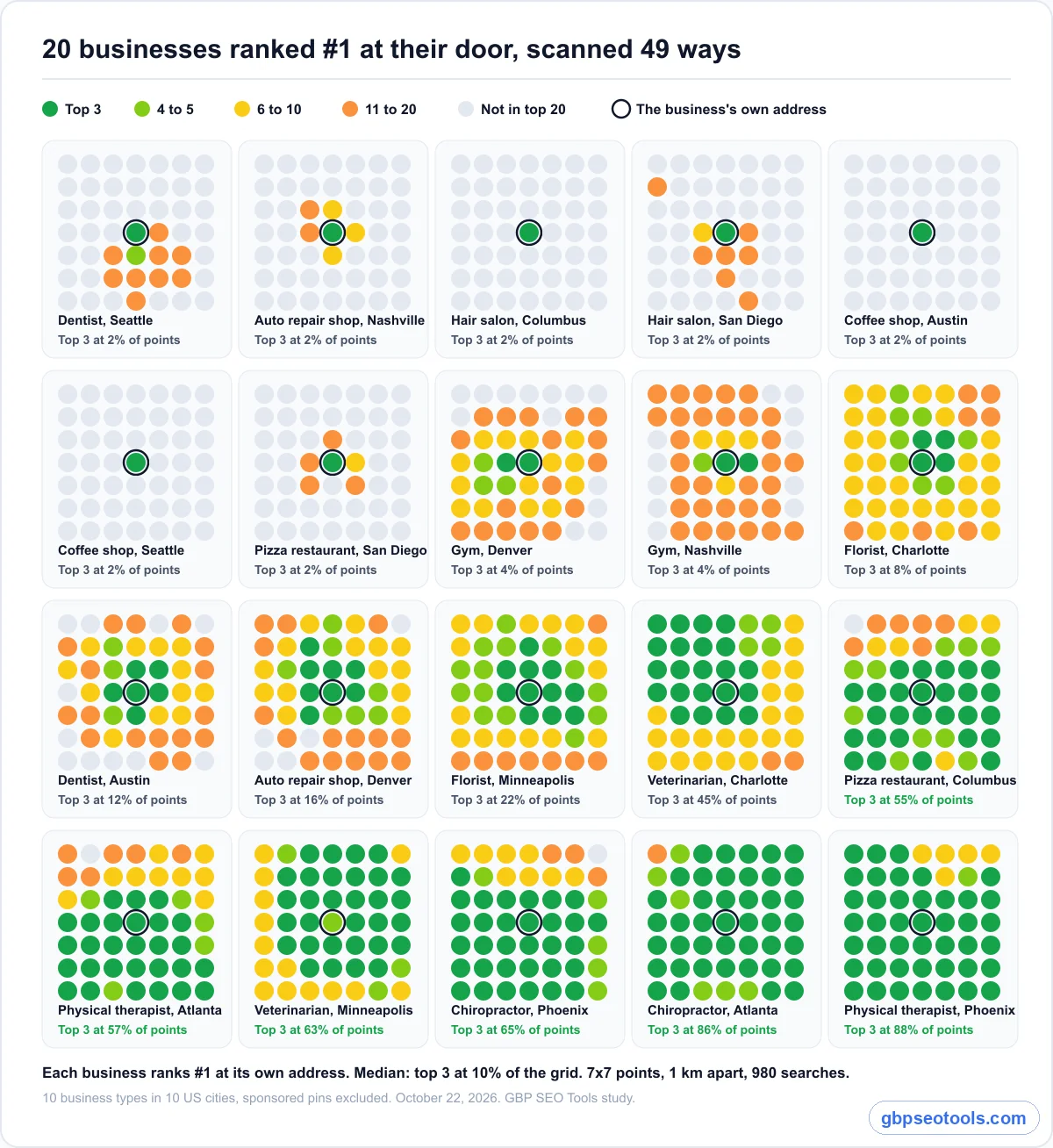
How to rank higher on Google Maps beyond your own block comes down to beating closer competitors on relevance and reputation, because distance alone hands most of the map to someone else. We scanned 980 points around 20 businesses that rank #1 when searched from their own front door, and the typical one held a top-3 spot in only 10% of the area around it.
That's the trap. You search your keyword from your shop, see yourself at the top, and assume customers see the same thing. Most of them search from somewhere else: home, the office, a parking lot two neighborhoods over.
So we measured how far a #1 actually reaches. Below are the numbers, what decides where your area ends, and the changes that push it out.
If you own the business, this shows you where nearby customers can't see you yet. If you handle local SEO for clients, it's the data behind the conversation every "but I'm #1" client needs, and a fairer way to set targets than one search from the client's office.
In this guide:
- The test: 20 businesses, 980 searches
- How fast a #1 fades
- What decides where it ends
- Which bubble you have
- How to rank higher past your street
- Measure it on your own business
- Common questions
We scanned the map around 20 businesses that rank #1
Every business in this test passed the same check first: search its main keyword from its own address, and it comes up first on Google Maps. Then we moved the searcher away from the door, one kilometer at a time, and watched what happened.
How the test worked
We picked 10 kinds of storefront businesses (dentist, auto repair shop, hair salon, veterinarian, chiropractor, coffee shop, gym, pizza restaurant, florist, physical therapist) in 10 US cities: Austin, Seattle, Denver, Nashville, Columbus, San Diego, Charlotte, Minneapolis, Phoenix and Atlanta. Each kind appears in two cities, for 20 businesses in total.
For each one we searched the plain keyword ("dentist," "coffee shop") from 49 points on a 7×7 grid centered on the business, with the points 1 km (0.6 miles) apart. That covers about 6 × 6 km, or 3.7 × 3.7 miles. It's the same 7×7, 1 km Google Maps grid scan you can run in our grid-based Maps rank tracker. We ran it on October 22, 2026, with sponsored pins left out.
What the 980 searches found
| What we measured | Result |
|---|---|
| Share of the grid where the typical business was in the top 3 | 10% (5 of 49 points) |
| Businesses in the top 3 for less than half the grid | 14 of 20 |
| Businesses in the top 3 only at their own door | 7 of 20 |
| Share of the grid in the top 10 (median) | 51% |
| Different businesses ranked #1 somewhere in one grid (median) | 21 |
| Most #1s in a single grid (a Seattle coffee shop's) | 38 |
Your #1 fades with every kilometer
Rank isn't one number on Google Maps. It's a different number at every spot a customer could be standing, and it drops off much faster than most owners expect.
At the door, it holds
At the center point, 19 of the 20 businesses were still in the top 3 on scan day. The one exception, a Minneapolis veterinary clinic, had slipped to #4 at its own address a few hours after we confirmed it at #1. Even the doorstep isn't fixed.
One kilometer out, half of it is gone
On the ring of points 1 km out, about 0.6 miles, the businesses held a top-3 spot at only 49% of points. Seven of the 20 held none at all. A coffee shop, a pizza place or a hair salon that owns its own block is often outside the top 3 a ten-minute walk away.
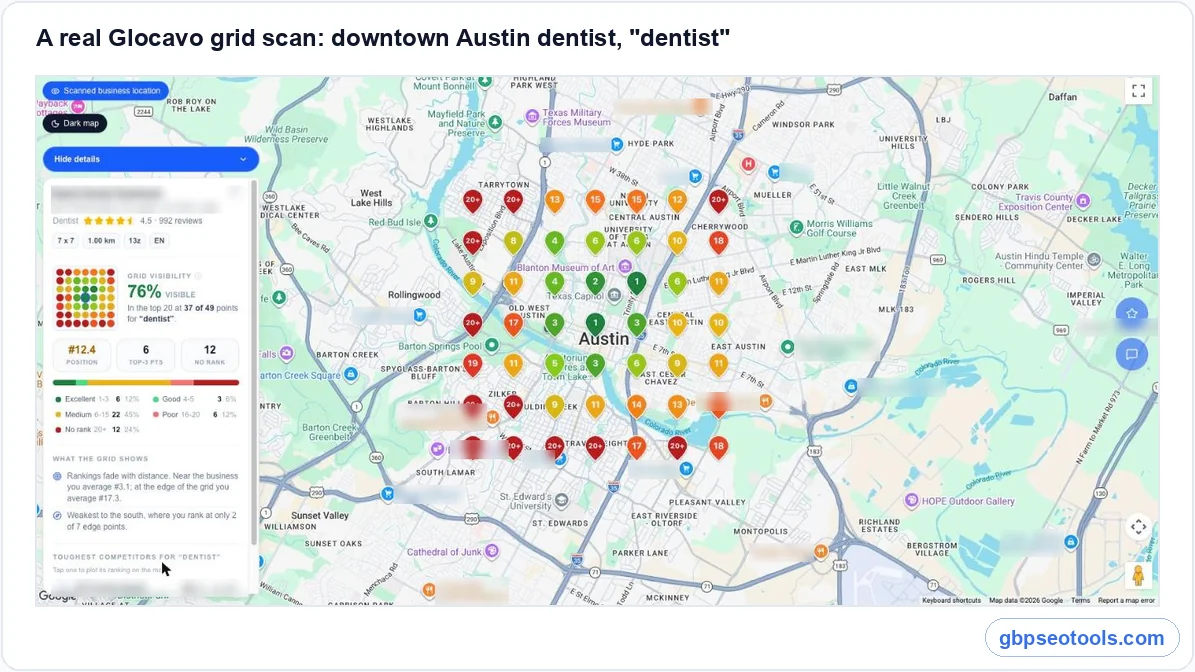
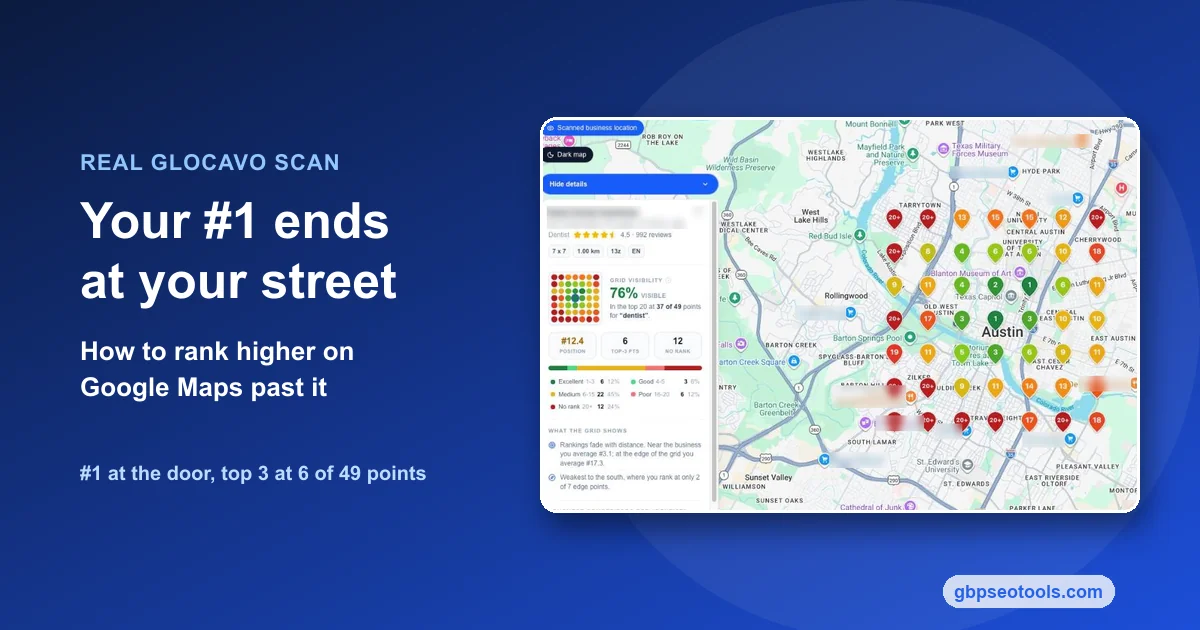
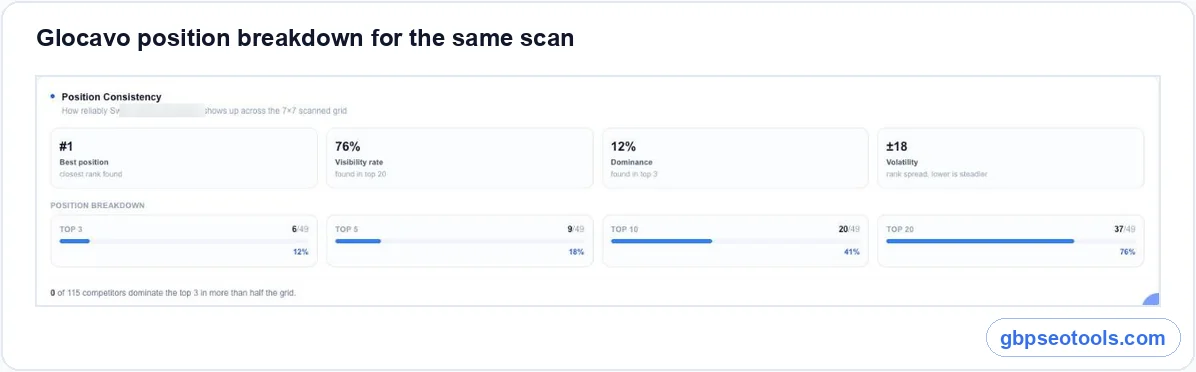
We re-ran that dentist through Glocavo afterwards to check the numbers. Same result: top 3 at 6 of 49 points, an average position of #12.4 across the grid, and no ranking at all at 12 points on the edges.
Three kilometers out, someone else owns the map
At 2 km the top-3 share fell to 26%, and at 3 km (just under 2 miles) to 18%. The businesses didn't vanish, since the typical one was still in the top 10 at about half the points. But the local pack only shows three, and those slots went to whoever sat closest to the searcher.
That's how one grid ends up with 21 different #1s. Each neighborhood has its own winner.
See your own version of this. A grid scan shows your rank at every point around your address, so you can see where your top 3 actually ends instead of guessing from one search at the counter.
What decides where your bubble ends
Google ranks local results on three things: relevance, distance and prominence, as Google's ranking factors page puts it. Our data shows how hard distance pulls once the searcher moves.
The closer business wins 92% of the time
We looked at every point where a study business had dropped out of the top 3, 714 points in total. At 660 of them (92%), the business ranked #1 there was closer to the searcher than the study business was.
So the business that takes the top spot is usually not "better." It's nearer. We've covered how Google weighs distance against relevance in depth. The short version: proximity sets the starting order at every point, and relevance and prominence decide how far you can climb against it.
More reviews didn't buy more map
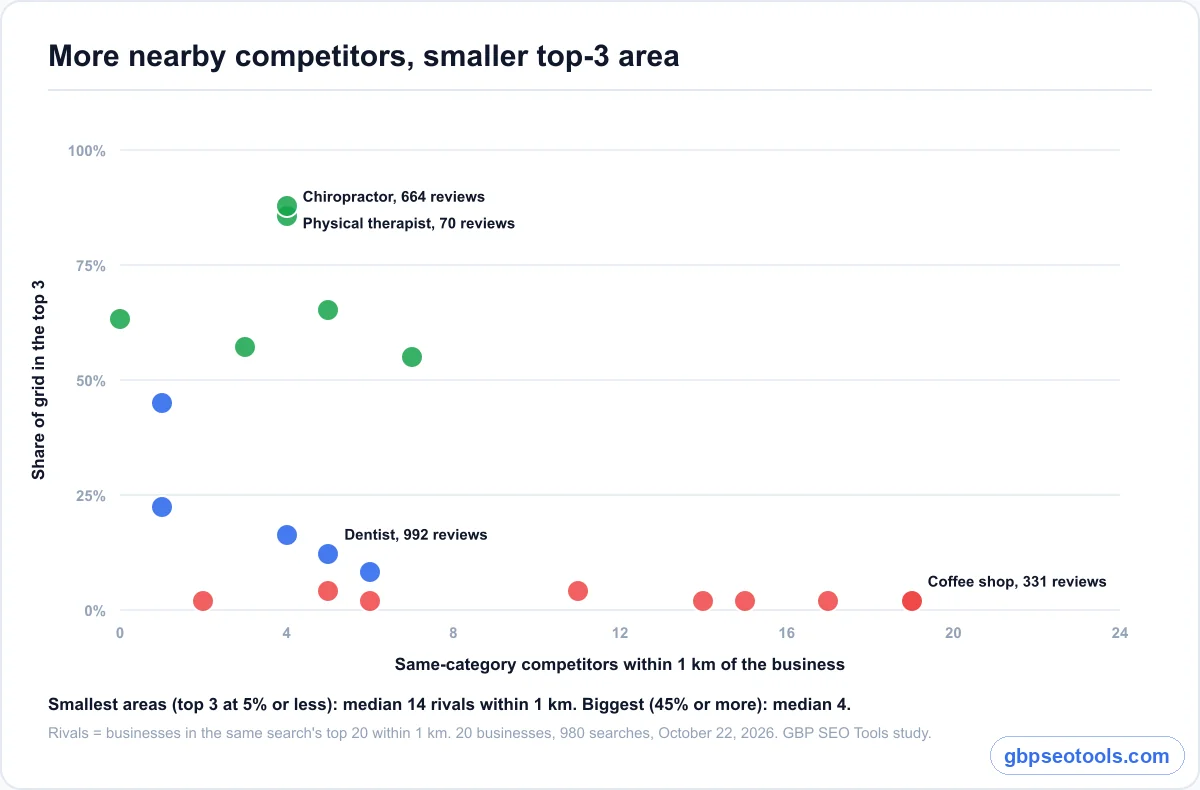
At the 663 of those points where both review counts were public, the new #1 had fewer reviews than the study business about half the time (325). Review count and bubble size barely moved together (a rank correlation of 0.21 across the 20).
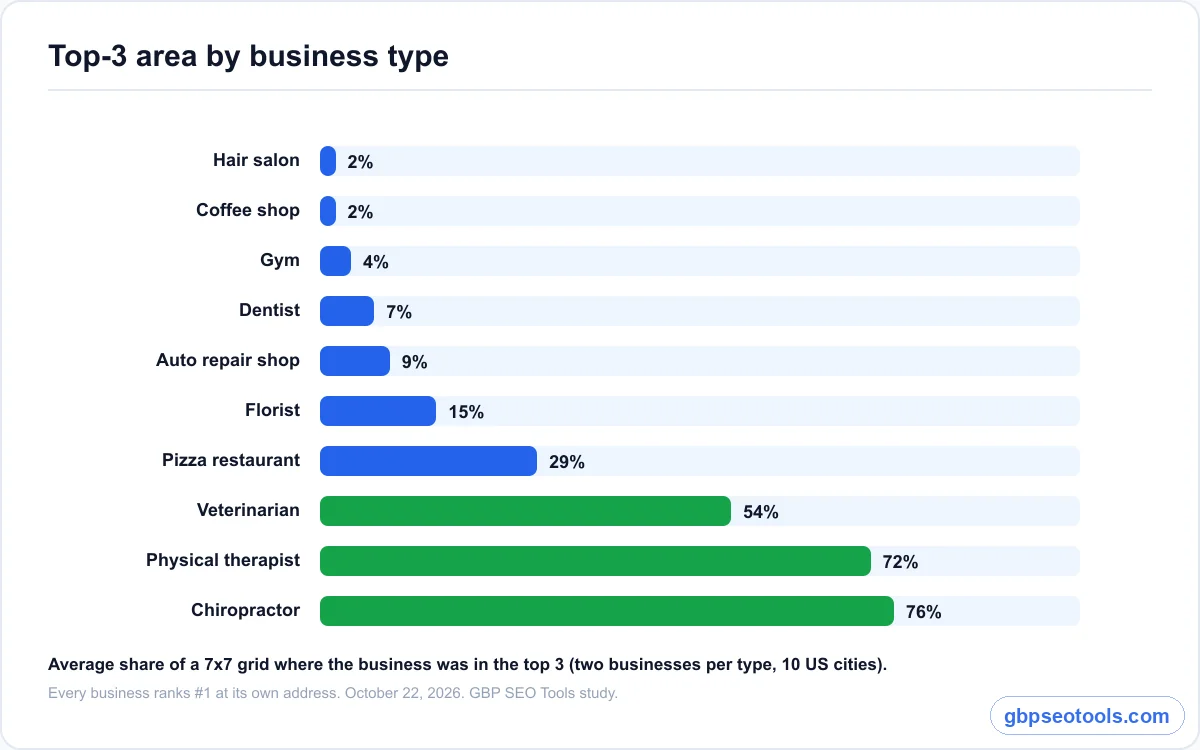
Two businesses show it plainly. A Seattle coffee shop with 331 reviews was in the top 3 at exactly one point, its own door. A Phoenix physical therapy clinic with 70 reviews held the top 3 at 43 of 49 points, 88% of its grid.
Crowded blocks make the smallest bubbles
What did match bubble size was competition nearby. The nine businesses with the smallest bubbles (top 3 at 5% of the grid or less) had a median of 14 same-category rivals within 1 km. The six with the biggest bubbles (55% or more) had a median of 4. Local map ranking, in other words, is mostly a question of how many rivals sit between you and the searcher.
Which bubble does your business have?
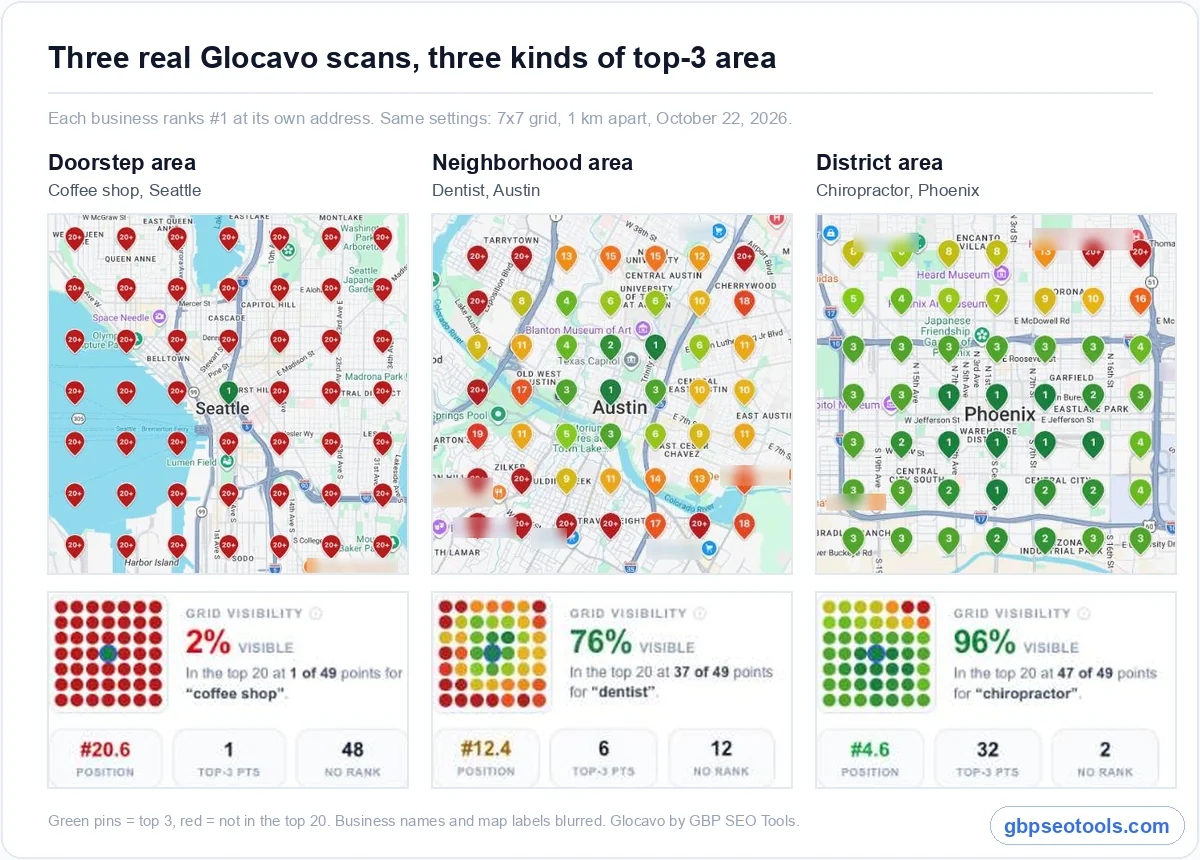
The 20 businesses fell into three clear groups. Knowing which one you're in tells an owner what's realistic and where effort pays. For an agency, it's the difference between a promise you can keep and one you can't.
The doorstep bubble: top 3 at one point
Seven businesses were in the top 3 only at their own door: two coffee shops, two hair salons, a pizza restaurant, a Seattle dentist and a Nashville auto repair shop. Most sit in dense downtown blocks with a competitor every few hundred meters.
If this is you, you won't own the city with one profile. The win is the streets closest to you, plus searches specific enough that fewer competitors match. If it's a client, say so at the start, before a city-wide goal turns into a missed one.
The neighborhood bubble: a few blocks deep
Gyms, the Austin dentist, a Denver auto shop and the florists held the top 3 at 4% to 22% of their grids. They usually stay in the top 10 across half the area or more, so they're close. A small gain in relevance or reputation turns many 4th-to-8th places into top-3 spots. This is where most of the visible progress happens, whether it's your own profile or a client's.
The district bubble: most of the grid
The vets, chiropractors, physical therapists and one Columbus pizzeria held the top 3 at 45% to 88% of their grids. They had fewer same-category neighbors, and most had strong ratings (4.7 to 5.0 stars). An Atlanta chiropractor with 664 reviews held 86% of its grid.
How to rank higher on Google Maps past your own street
You can't move your address, and you shouldn't try. What you can change is how well your profile matches the search and how strongly customers vouch for you. Those are the levers that let you beat a closer competitor.
- Set the most specific true primary category and list every service you offer.
- Target specific services where fewer nearby rivals compete.
- Earn reviews that name the job, and keep the profile fresh.
- Keep one real address, and scan your area before and after each change.
Make your profile the closest match for the search
Relevance is the lever that works at a distance. Your primary category does most of the work, so choosing your primary category well comes first: the most specific one that's true, not a broad one.
Then fill in the services list with the jobs customers actually search for, and make sure your website's main page names the same service and area. A profile that matches the search exactly can outrank a nearer one that only matches loosely.
Aim at searches where fewer rivals compete
The smallest bubbles in our data came from the most crowded categories. You can't change your category's crowd, but you can win searches with fewer matching competitors. A dentist won't own "dentist" across town, but "emergency dentist" or "dental implants" usually has far fewer close rivals.
Add those services to your profile, write a page for each on your website, and earn reviews that mention them. Then scan those keywords separately, since each one has its own map.
Give farther customers a reason to pick you
Prominence is how well known and trusted Google thinks you are, and it travels further than distance. In our data, review count alone didn't decide it, but the businesses with the biggest bubbles almost all had ratings of 4.7 or higher and reviews that described the work.
Ask every happy customer for a review, and ask them to mention the service they got. Add fresh photos and keep hours exact. These are slow gains, which is exactly why you should measure them instead of guessing.
Don't fake an address to move your pin
Some businesses try a virtual office or a second "location" to get a pin closer to more customers. Google's guidelines forbid addresses where you don't serve customers in person, and it's a common reason for suspensions. A suspended profile has no bubble at all.
If you really serve a second area with staff on site, a second real location can have its own profile. Otherwise, grow the area you have.
Measure your bubble before and after every change
One search from your desk shows one point out of thousands. Before you change anything, find out how big your bubble is today.
If you run your own business
Run a grid scan centered on your address for your main keyword and two or three specific services. Look at three numbers: the share of points in the top 3, how far out the top 3 reaches, and where you sit 4th to 10th. Those near-misses are the points you can win first.
Then make one change, such as a sharper primary category, a new services section or a review push for one service, and re-scan the same grid a few weeks later. Changing three things at once leaves you guessing which one moved the map.
If you manage rankings for clients
Scan every new client before you touch the profile. The grid becomes the baseline you report against, and it settles the "I'm already #1" debate in one picture: the client is right about their front door and wrong about the rest of the map.
Set targets by bubble type instead of one city-wide number. A doorstep business that grows from 2% to 10% top-3 coverage has made real progress, and a district business slipping from 80% to 65% needs a look even if it's still #1 at the door. Report the share of points won and lost each month, plus the competitors taking them.
Read the competition, not just your rank
A grid scan also shows who you're up against. The Austin dentist's single grid turned up 115 competing businesses, and not one of them held the top 3 across more than half of it. Nobody owns the whole map, so every point won is worth having, for your own business or for each client.
Track the same grid over time and you'll see the bubble grow, or catch the day a closer competitor opens. Either way, you'll know your real Google Maps ranking instead of the one you see from your own front door.
Questions about how far your ranking reaches
Why am I #1 at my business but not at home?
Because distance is part of every local result. From your shop, you're the closest match. From home, other businesses of the same kind sit closer to you, and in our test the closer business took #1 at 92% of the points where the study business lost the top 3.
Do more reviews help me rank farther away?
Not on their own. In our 20 grids, the business that took #1 had fewer reviews than the study business about half the time. Strong ratings and reviews that describe the service went with bigger bubbles, but review count alone didn't.
What share of my area should I expect to be top 3 in?
It depends on how crowded your category is. Businesses with few nearby rivals held the top 3 at 45% to 88% of a 6 × 6 km grid. In dense downtown categories like coffee shops and salons, 2% (just the doorstep) was common.
Can I rank in a neighborhood where I have no address?
Yes, if you beat the closer businesses on relevance and reputation. You won't usually be #1 there, but the typical study business still ranked in the top 10 at about half of its grid. Specific services with fewer competitors are the easiest way in.
How should an agency explain a small Maps area to a client?
Show them the grid. A client who sees themselves at #1 from the office believes they rank everywhere. A scan of 49 points around that office, with the doorstep #1 in the middle, explains distance better than any report, and it turns the goal into points won month by month.
How often should I scan my grid?
Monthly is enough for most businesses and most client accounts, plus a scan a few weeks after any profile change. Rankings move day to day, as the Minneapolis clinic that slipped from #1 to #4 at its own door showed, so compare trends across scans rather than reacting to one.