
Google Map Ranking Explained: Why Your Position Changes Street by Street
Google map ranking isn't one number. The same business can sit third in the local pack at its front door. Four blocks north, it can drop to twelfth. Past the edge of its service area, it can disappear from the map entirely. Google recalculates position separately for every point a search happens from, and that's the whole reason the results look inconsistent.
Most explanations name the three ranking factors Google uses and stop there. That's the easy part. The harder part is seeing what those factors look like on the ground. A business can dominate one neighborhood and vanish six blocks over, often for reasons that aren't obvious from the outside. Knowing what's actually worth fixing when distance works against a business is the harder, more useful part.
This guide covers that mechanism, not just the factor names, so a scattered set of results reads as useful information instead of a confusing mess. That's true whether you're checking it by hand or using one of the local SEO tools built for exactly this job.
Why your local pack position isn't one number
A business owner who searches their own name from their own desk usually sees a good result and stops looking. That single search is the least representative test available, and it's the one almost everyone runs first.
The local pack versus classic search results
Google calculates Maps ranking and classic organic ranking differently, even though both show up on the same results page. The local pack, the block of three map listings above the regular blue links for a "near me" or category search, competes only against nearby businesses in the same category. Classic organic ranking, by contrast, competes against every page on the web that answers the query, not just nearby competitors. A business can rank well in one and poorly in the other. The two are answering different questions: who's close and relevant, versus who wrote the best page.
Why searching your own business name tells you the least
Searching a business's own name is a navigational query. Google already knows which business the searcher means, so it shows that business near the top almost regardless of ranking strength, the same way it surfaces a company's own homepage for a branded search. That confirms the listing exists and is indexed. It says nothing about how the business ranks for real category searches like "plumber near me" or "bakery downtown," the ones that actually bring in customers. For a proper read on that, see checking your ranking from multiple points instead of a single self-search.
The three factors Google weighs at every point on the map
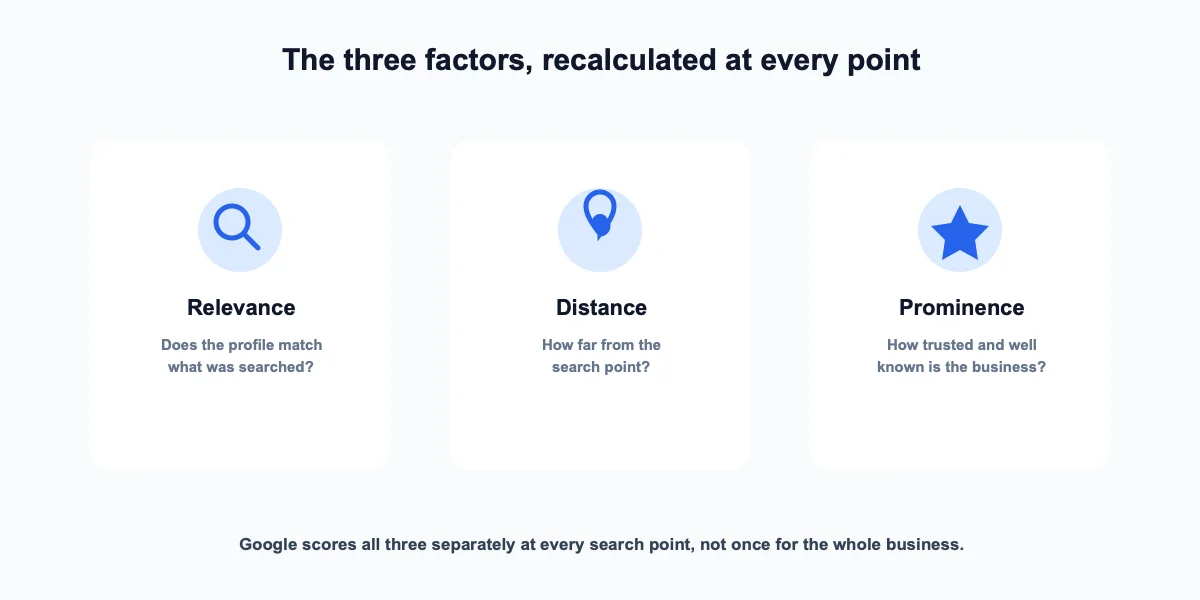
Google names three factors that determine local ranking directly:
- Relevance, how well the business profile matches the search
- Distance, how far the business sits from the search point
- Prominence, how well known and trusted the business is
None of them apply once to a business overall. Google recalculates all three separately for every point a search happens from, which is the entire reason position moves around from block to block.
Distance: the factor a business can't edit away
Distance is the simplest of the three to picture: the raw gap between a business and wherever a search is tied to, a searcher's real location or a place name typed into the query. As the proximity ranking factor, it's the one signal with no settings page to adjust. A business four miles from a search point starts at a real disadvantage against a competitor four blocks away, no matter how complete either profile is. According to how Google weighs local ranking, distance is one of the three primary signals, alongside relevance and prominence, that determine local results.
Relevance and prominence: what still moves the needle up close
Relevance measures how well a business profile matches what someone is searching for. The primary category, the business description, and the specific services listed drive it most heavily. Prominence is a broader trust signal, built from review count and rating, citation consistency across the web, and how well known the business is generally. Neither factor fully cancels out a large distance disadvantage, but both genuinely decide close contests. Two competitors sitting roughly the same distance from a search point separate almost entirely on relevance and prominence. That's where the real fight for position happens.
What a scattered ranking actually looks like
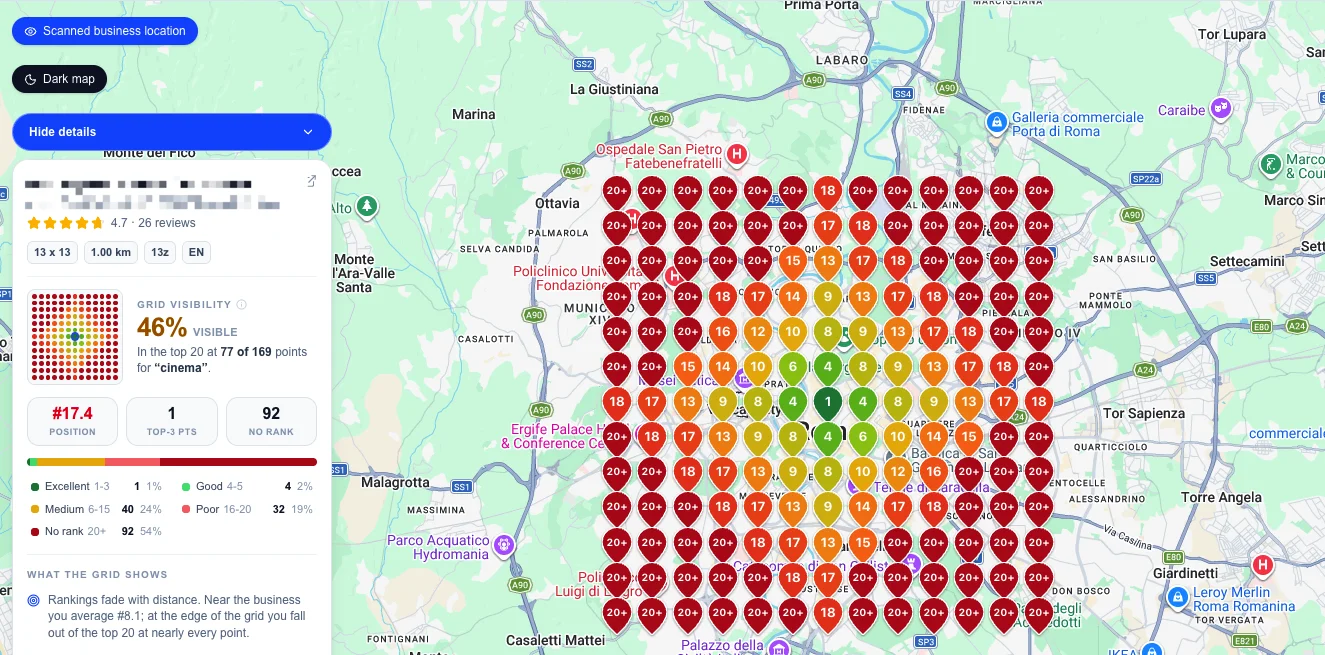
The three factors explain the mechanism. Here's what it looks like in practice, because an abstract list of factors doesn't prepare anyone for how uneven the real pattern can be.
A service business that wins downtown and disappears at the edges
A mobile locksmith serving a 15-mile radius around a single downtown base address is a clean example. Close to that base address, the business wins on distance and usually takes a top-three spot with a solid profile. Six or seven miles out, distance stops helping and starts hurting. A competitor based closer to that edge of the service area can outrank it there, even with a thinner profile. Past a certain radius, the business may not appear in the local pack at all. That's not because anything is broken. Distance has simply become too large a gap for relevance and prominence to close.
A storefront that ranks well nearby but still loses to a closer competitor
A dentist with a single physical office sees a tighter version of the same pattern. Within a mile or two, the practice competes mostly on relevance and prominence: category accuracy, review volume, and how complete the profile is, since distance is roughly even among the nearby competitors. A few miles out, a newer practice that simply sits closer to that search point can outrank a more established one with more reviews. The established practice isn't doing anything wrong. It's losing a factor it has no direct control over.
Want to see this pattern on your own listing instead of guessing at it? Scan your full service area and see exactly where the wins and losses happen, not just at one address.
What to do when distance is working against you
Distance can't be edited directly, but it isn't the only factor in play, and the other two are worth real effort in the areas where distance is already hurting.
Category accuracy and profile completeness close part of the gap
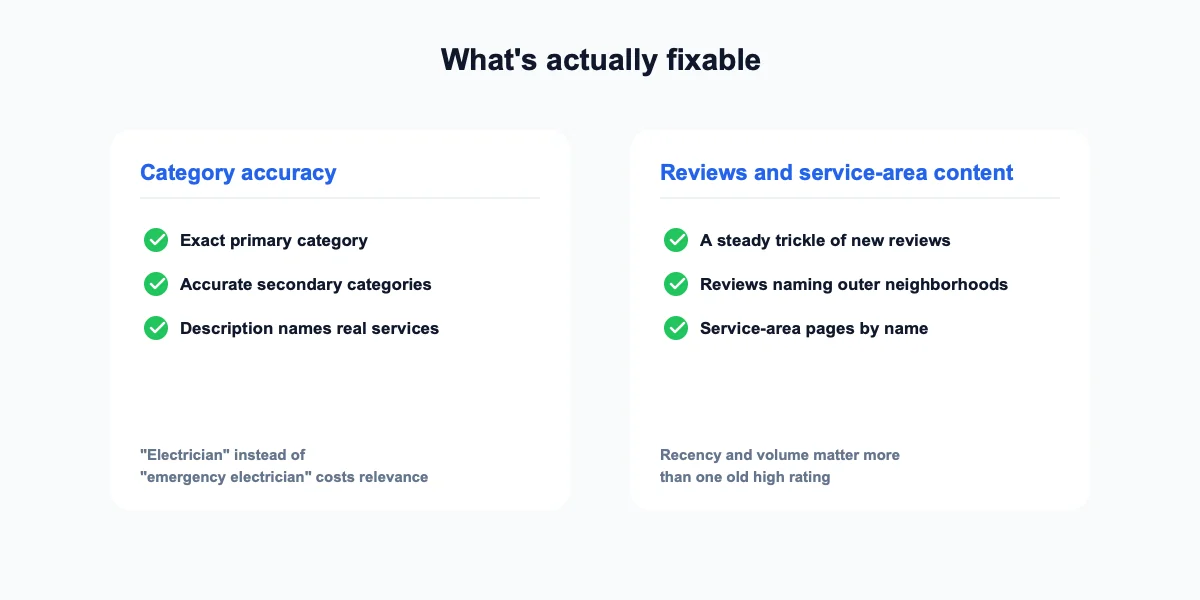
The primary category is the single strongest relevance signal a business controls directly. A surprising number of profiles carry one that's close but not exact, "electrician" instead of "emergency electrician," for example. Reviewing the primary category on a Google Business Profile, adding accurate secondary categories, and keeping the business description specific about actual services all sharpen relevance. That holds at every point on the map, not just close to the business, which is exactly where the edges of a service area need the help most. For the complete list of factors and how they're weighted in 2026, see the full local ranking factor breakdown.
Reviews and service-area content close the rest
Prominence responds to review recency and volume more than to a single high rating sitting untouched for a year. A steady trickle of new reviews does more for prominence at the edges of a service area than the same number clustered near the front door. Reviews that mention a neighborhood outside the immediate area help even more. Dedicated service-area pages work the same way on the website side. Naming the specific neighborhoods or towns served gives Google more relevant text to match against a search anchored in that area.
How to see the whole pattern instead of one point
Reading a scattered ranking correctly starts with checking more than one point. From there, a real gap opens up between the free manual option and what a dedicated tool adds once a business needs more than an occasional spot check.
Manual spot-checks and where they run out
Searching from a phone while standing in a few different parts of a service area is a real, free way to see the pattern, and it beats a single search from the front desk by a wide margin. It doesn't scale well, though. Covering even a modest service area by hand means driving to multiple points, repeating the same search at each one, and writing down what shows up. That's slow enough that most business owners do it once and never again.
What a grid scan adds
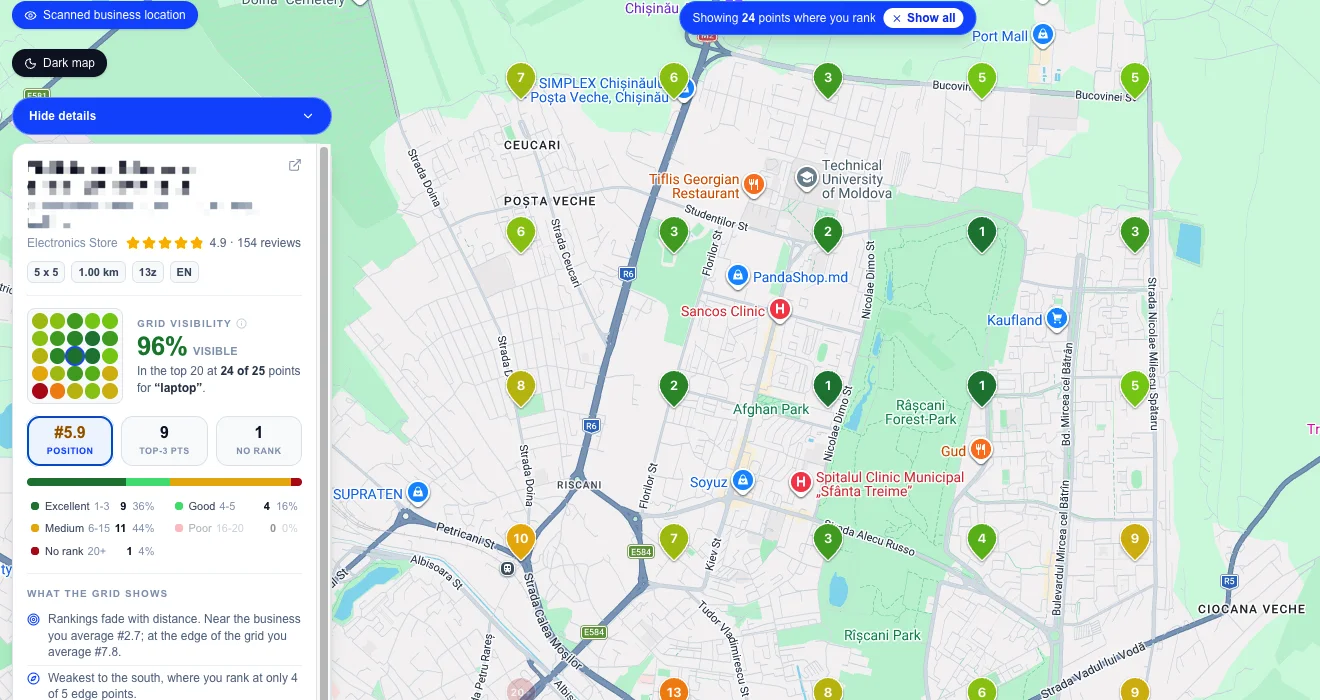
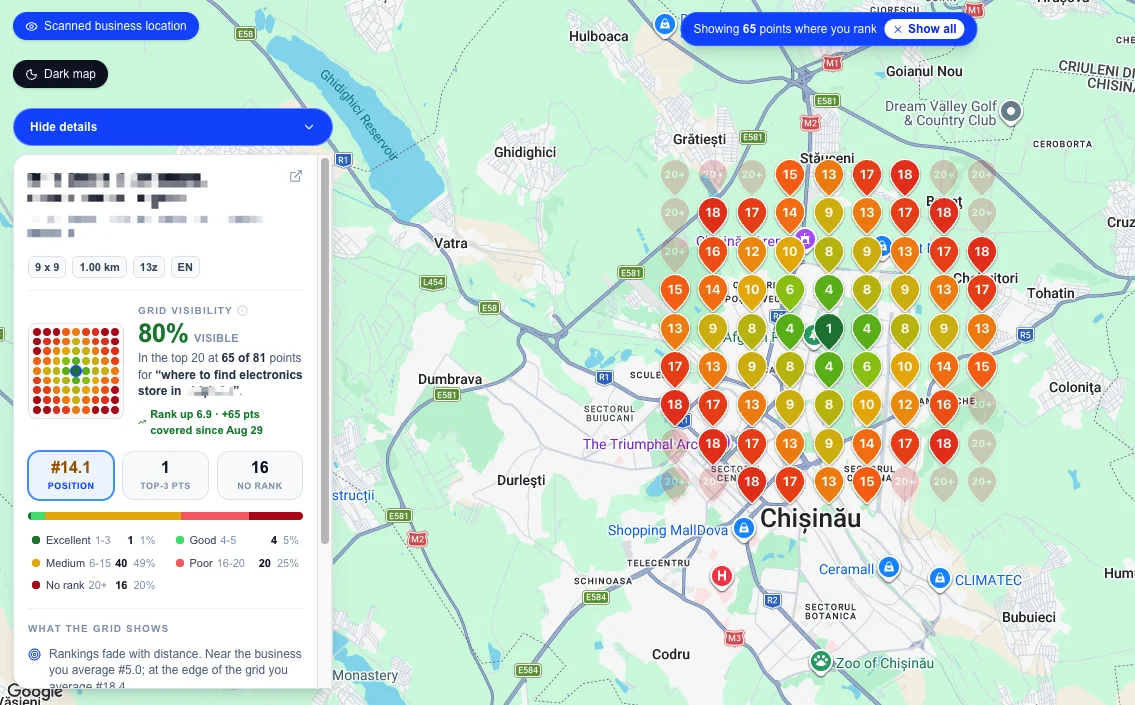
A Google Maps rank tracker runs the same idea automatically. It checks a grid of search points spread across the service area in one pass. Each point also records the top three competitors actually ranking there, not just the business's own position. The results roll up into a heatmap plus two headline numbers: average rank and coverage percentage, the share of points where the business actually shows up in the local pack. Even so, a grid scan is still a snapshot at one moment, not a trend on its own. Reading it as a trend takes a second scan after a few weeks of real changes, not just a single day's result.
Google map ranking: common questions
Why does my Google Maps ranking change depending on where I search?
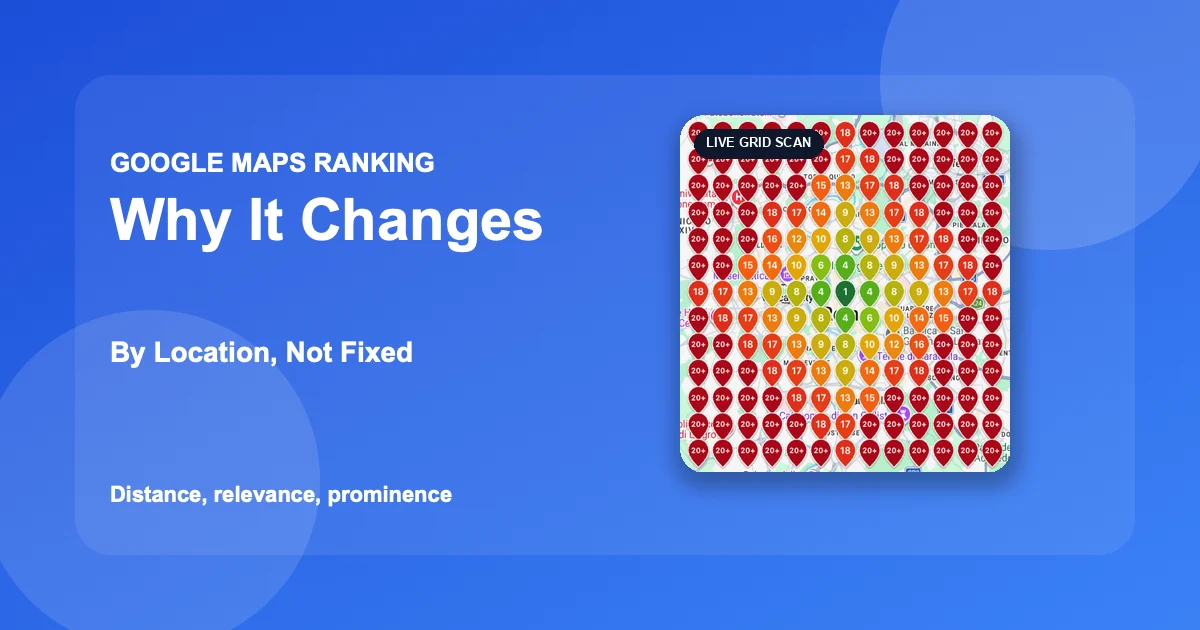
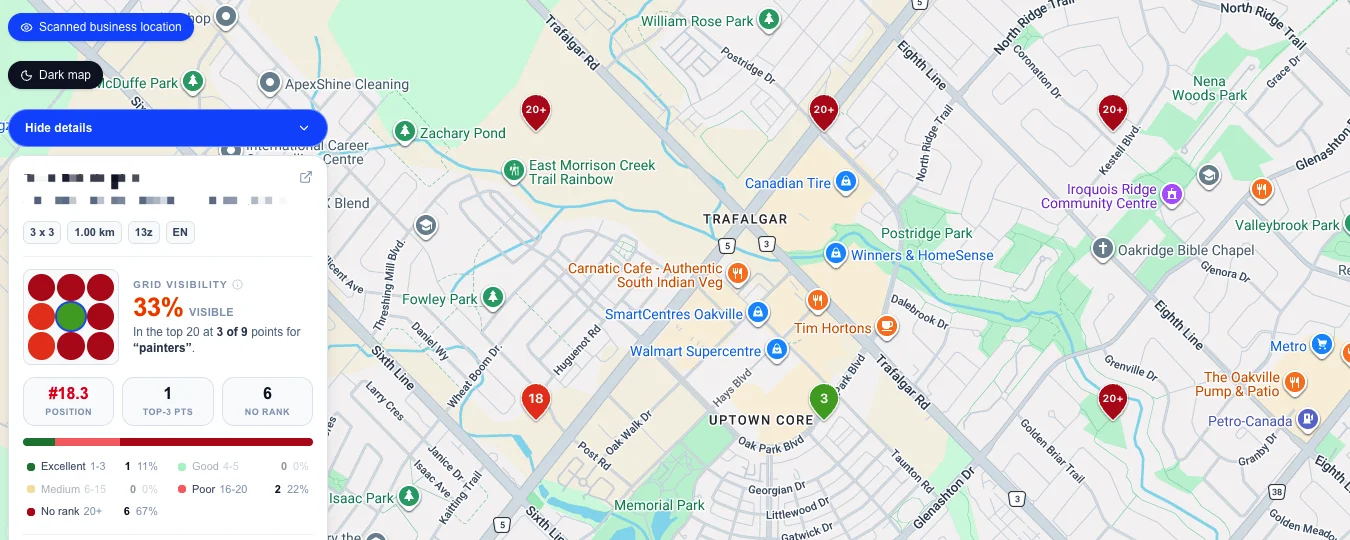
A grid scan shows this directly instead of leaving it as a claim: a 3×3 or 13×13 scan checks the same keyword from every point at once and records a separate rank at each one, the way the real scans earlier in this guide show a strong center point fading to unranked at the edges. Distance to each specific point drives most of that shift, since Google recalculates relevance, distance, and prominence per point rather than scoring a business once overall.
Does being farther away always mean I'll rank lower?
Farther away usually hurts, but it's not absolute. A business with strong relevance and prominence (an accurate category, a complete profile, and a steady volume of recent reviews) can still outrank a closer competitor with a weaker profile. Distance sets the starting disadvantage; the other two factors decide how much of it gets closed.
Can I fix my distance disadvantage?
Not directly. Distance is calculated from where the search happens, not from anything on a business profile. What's fixable is everything else: category accuracy, review recency and volume, and service-area content that gives Google relevant text to match against searches anchored outside the immediate area.
How far from my business does my Google Maps ranking actually reach?
It depends on category competition and how strong prominence is, not a fixed radius. A business with few nearby competitors and strong reviews can hold a solid rank for miles. A business in a crowded category might lose it within a few blocks. Checking more than one point is the only way to find the real edge of your own visibility.
Is local pack ranking the same as regular Google search ranking?
No. Local pack ranking is scored against nearby businesses in the same category using relevance, distance, and prominence. Classic organic ranking competes against every relevant page on the web. A business can rank well in one and poorly in the other, since the two are answering different questions.
See your full local pack position, not just one search
A Google map ranking that looks confusing from one search usually makes complete sense once distance, relevance, and prominence are read as three separate signals recalculated at every point, not one static score.
What to take from this
A scattered ranking comes down to a short list of mechanics:
- Distance sets the disadvantage a business starts with at any given spot, and no setting fixes that directly.
- Category accuracy is the strongest lever a business controls, and it's often just slightly wrong, not missing.
- Review recency and service-area content close most of the rest of the gap, especially at the edges of a service area where distance is already working against the business.
What to check next
Guessing at the pattern from a single search leaves the edges of a service area invisible. A grid scan across the real service area shows exactly where the business wins, where a competitor owns the map, and how far visibility actually reaches, in one run.
Run a grid scan across your real service area and see the full pattern for yourself.