
Local SEO Keyword Research: What It Is and the Keyword Types That Matter
Type "plumber" into a generic keyword tool and it hands back the same list whether the business is in a small town or a major metro, because it has no idea which one it's talking to. Local SEO keyword research has to start from the real business, not a seed word typed into a blank box, or the list it returns is just trivia about a category, not a target list a business can actually act on.
That distinction matters more than it sounds. A keyword list built from a seed word tells a business what a term means in general. A keyword list built from a real listing, its real category, city, and service area, tells a business what to actually target. This guide is the concept side of local SEO keyword research: what it means, the five keyword types that matter for local search, and where each type belongs once you have it. If you want the step-by-step worksheet instead, the local keyword research template walks through building the list column by column.
In this guide:
- What local SEO keyword research actually means
- The five keyword types that matter
- Where each keyword type belongs
- Doing the research: by hand or with a tool
- Common local SEO keyword research mistakes
- Local SEO keyword research: common questions
What Local SEO Keyword Research Actually Means
Local search doesn't reward the same keywords national search does. A plumber chasing "plumber" nationally is competing with directories and franchises with a decade of backlinks; the same plumber chasing "emergency plumber [their city]" is competing with maybe a dozen real local businesses.
It's not the same as generic keyword research
Generic keyword research optimizes for volume and difficulty at a national scale. Local SEO keyword research optimizes for a different variable entirely: whether a specific business, in a specific city, can realistically show up for a phrase a nearby customer would actually type. A term with modest national volume can be a genuinely strong local target if the local competition for it is thin.
Why it starts from a real profile, not a seed word
The real category on a Google Business Profile, not the generic version of the business type, is the foundation of a usable local keyword list. Google's own guidelines for representing your business are explicit that a category should complete "this business IS a," not "this business HAS a," and it carries more ranking weight than almost anything else on a profile. Research that starts from that real category, plus the actual service area and the language in real customer reviews, produces a list a business can act on. Research that starts from a typed-in seed word produces a list about a category in the abstract.
The Five Keyword Types That Matter
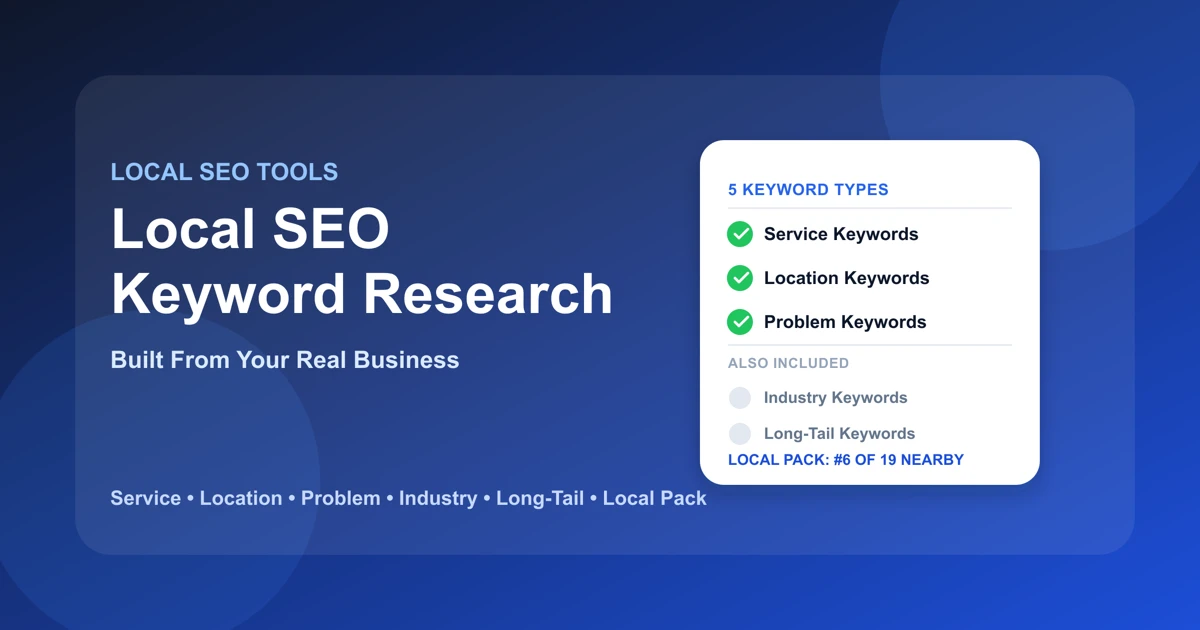
Local SEO keyword research breaks down into five categories. Sorting research into these buckets, rather than one flat list, makes it obvious which keyword fits which kind of content.
The five types, defined
Service keywords are the core offerings customers already know they want. Location keywords are searches tied to a specific city or neighborhood. Problem keywords are the pain points a business solves, worded the way a customer would type them. Industry keywords are the broader technical terms tied to the category. Long-tail keywords are specific multi-word phrases capturing a highly qualified search. Most real local targets are a service or a problem crossed with a location.
Why five buckets beats one flat list
A flat keyword list hides which terms are interchangeable and which are genuinely different searches. Split into five types, it becomes obvious that "water heater repair" (service), "water heater not heating" (problem), and "water heater repair [suburb]" (long-tail) are three separate targets that belong on three different pieces of content, not one page trying to rank for all of them at once.
A worked example
A plumber covering three towns outside a mid-size city is a good example of why this framework matters. Chasing "plumber" nationally, that business will never realistically outrank the big directories. Broken into the five types instead, the same business surfaces location keywords tied to each of its three actual service towns, problem keywords like "water heater not heating" worded the way a real customer searches, and long-tail phrases combining both, all with real, winnable local competition.
Where Each Keyword Type Belongs
Local SEO keyword research that doesn't turn into content or profile changes doesn't move a ranking. Where a keyword lands depends mostly on its intent and which bucket it came from.
Service pages and GBP posts
Location and long-tail keywords work well as page titles or Google Business Profile post topics directly, since they already combine a service with a real place. A bakery in a single neighborhood used exactly this approach recently: instead of trying to rank for "bakery" outright, the location bucket surfaced a handful of neighborhood-specific phrases with real, if modest, search volume and next to no competition. Those became the exact page titles for two new service-area pages, rather than another generic "About Us" paragraph. Once a page like that is live, a Local SEO Website Audit confirms the title tag and on-page signals actually reflect the new keyword.
Blog and FAQ content
Problem keywords make the strongest blog or FAQ content, since they're already worded as a question or a pain point a customer would search. Whether a term reads as transactional or informational signals whether it belongs on a service page or in an informational guide, removing the guesswork content writers usually spend the most time on.
Industry keywords and internal linking
Industry keywords rarely convert on their own, but they earn their place as supporting content that links to the pages targeting service and location terms. A term like "hard water damage" won't book a job, but a short explainer on it can pass relevance to the "water softener installation [city]" service page it links to.
Doing the Research: By Hand or With a Tool
Local SEO keyword research can be done by hand, and understanding the manual process makes it obvious what a good tool should actually be checking. The full sequence, mapping the service area, pulling the category as a seed list, building combinations, validating volume and local intent, then scoring and assigning each keyword, is what the template linked in the intro walks through step by step.
The short version
Start from the real Google Business Profile category and service area. Read the business's own reviews for the exact phrases customers use to describe problems. Then check competition with a local pack read, not just a national volume number: relevance, distance, and prominence are the three factors that decide local pack placement, and none of them show up in a national volume figure. A keyword with modest volume and only two or three real competitors nearby is a stronger target than a high-volume term already dominated by five entrenched businesses.
The faster version
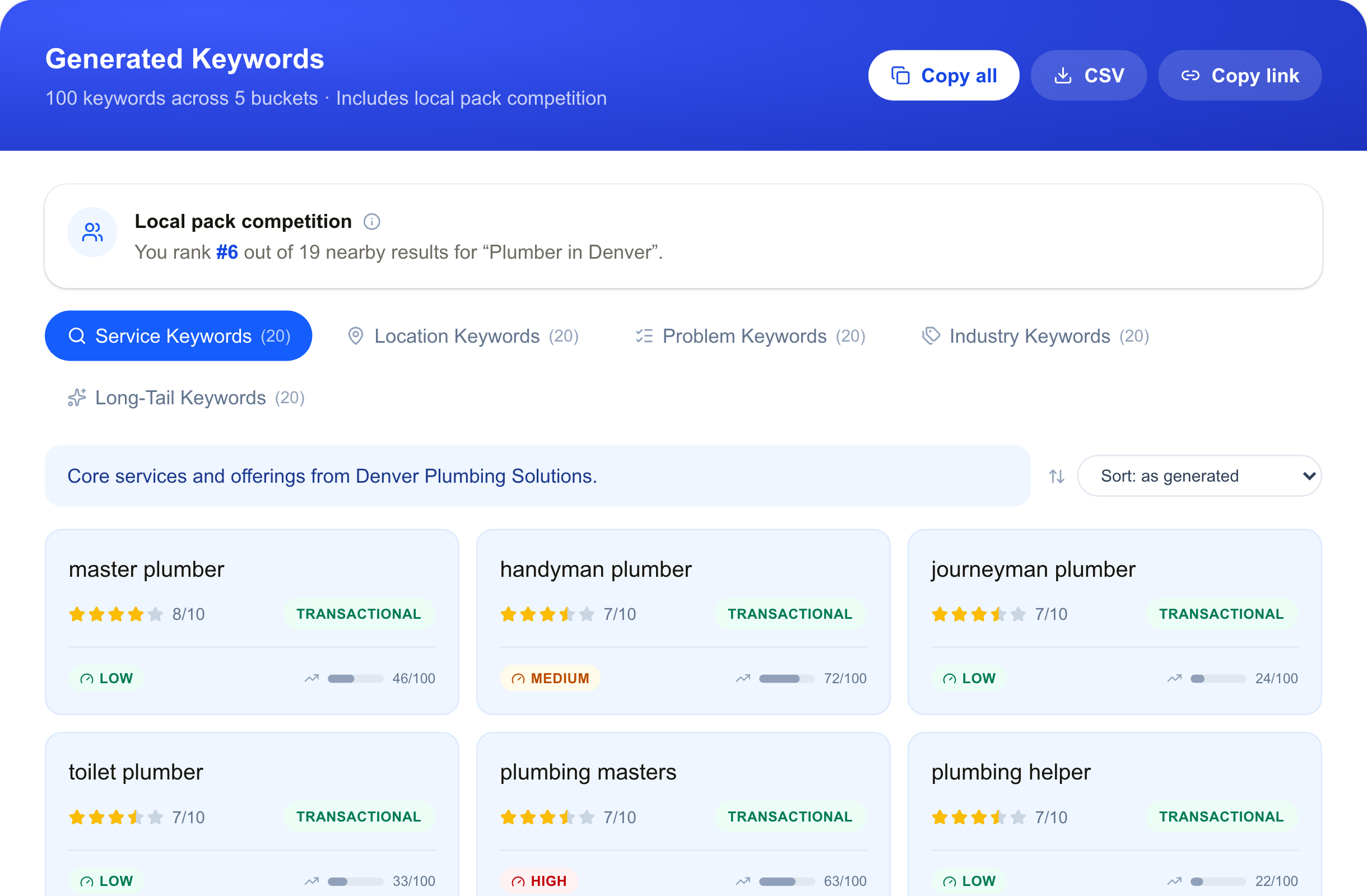
Doing all of that by hand, for every service, every neighborhood, and every real customer problem, takes hours. The Local SEO Keyword Finder reads a business's real Google Business Profile category and city, then generates keyword ideas across all five types directly from that live data, with a relevance score, a competition read, a trend score, and an intent tag on each result. It doesn't replace understanding the five types, it just skips the manual crossing of every service against every location.
Common Local SEO Keyword Research Mistakes
Two mistakes show up in local SEO keyword research whether it's done by hand or with a tool, and both are about strategy rather than effort.
Targeting national volume instead of local intent
A business chasing the highest-volume version of a keyword, ignoring how many real local competitors already dominate it, spends effort on a term it was never going to rank for. A lower-volume, location-specific version of the same term with thin local competition is almost always the better target.
Concentrating on one keyword type
A list that's all service keywords misses the problem phrases customers actually type before they know the service name, and the long-tail combinations with the thinnest competition. Spreading research across all five types covers far more of a customer's real search behavior than a deep list of only service terms.
Local SEO Keyword Research: Common Questions
What's the difference between local SEO keyword research and regular keyword research?
Regular keyword research optimizes for national volume and difficulty. Local SEO keyword research optimizes for whether a specific business, in a specific city, can realistically rank for a phrase, which means a lower-volume, location-specific term is often the stronger target over a high-volume national one.
What's the difference between this guide and the template?
This guide covers the concepts: what local SEO keyword research is and the five keyword types. The local keyword research template linked in the intro is the fill-in worksheet, the columns to build, what to put in each one, and how to score and assign the finished list. Read this one first if the five types are new, then work through the template.
Do I need a paid tool for local SEO keyword research?
No. It can be done by hand, starting from a business's real Google Business Profile category, reading reviews for the language customers actually use, and manually checking local pack competition for each candidate term. A tool automates the same steps and adds a score, competition read, and intent tag to every result.
How many local keywords should a small business target?
There's no fixed number, but spreading effort across all five types covers more of a customer's actual search behavior than concentrating only on service keywords. A short list of well-matched, low-competition keywords across multiple types outperforms a long list of only high-competition service terms.
How often should I redo local SEO keyword research?
A business's category and reviews change slowly, so a full re-run every few months is usually enough, more often after adding a new service or expanding into a new service area, since both change the local landscape being researched.
Where to Go From Here
The recap, in one place
Local SEO keyword research isn't a smaller version of regular keyword research, it's a different question entirely: not what a term means, but whether this specific business can realistically win it. Starting from a real Google Business Profile category and city, splitting results into the five types that map to different content, and checking local pack competition before committing to a term all matter more than raw search volume ever will.
Build the list next
The concepts on this page turn into an actual target list in the local keyword research template linked at the top of this guide: the columns to build, what goes in each one, and how to score and assign the finished list. Working through it by hand is the way to learn what a good keyword tool is really checking for you.